

'
_
.
Electricalkm‘ethcäds are
most
suitable (for a
heated environment and some advantage can be gained over space
heating if the aquarist isprepared to take a little trouble over the
installation. The application of heat must be slow so that the base
and gravel do not become a»lot warmer thanthe water. A normal
.
thermostat situated in a master aquarium, which represents the
temperature of“ all other aquaria, would be capable of adequate
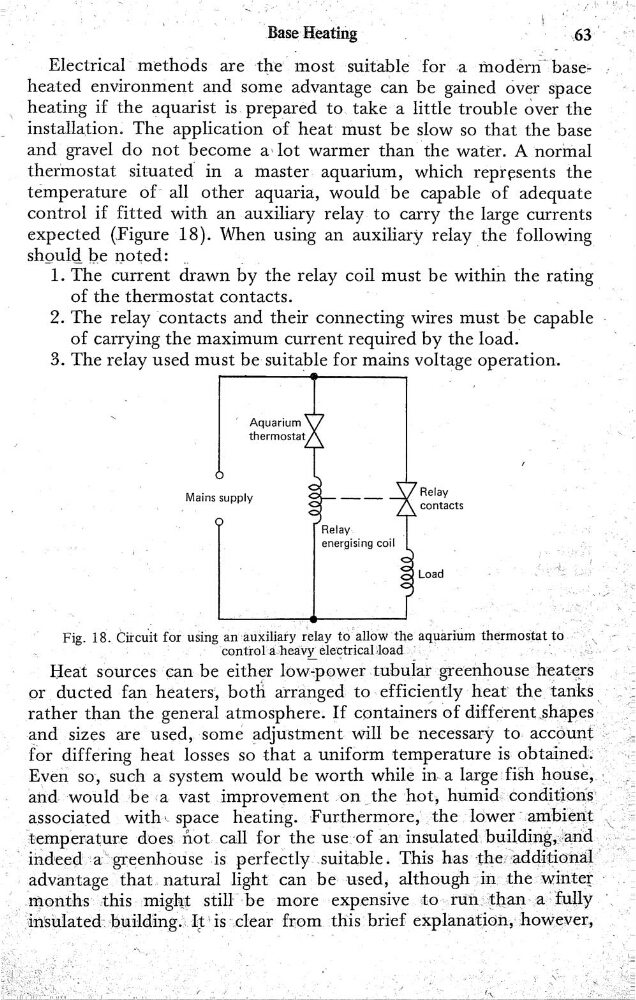
control if fitted with an auxi—liary relay to carry the large currents
,
expected (Figure 18). When using an auxiliarÿ relay the following
should be noted:
__
_
_
-
.
1. The current drawn by the relay coil must be within the rating
of the thermostat contacts.
‘
‘
.
.
Â
2. The relay Contacts and their connecting wires must be capable -
of carrying the maximum current required by the load.
—_
3. The relay used must be suitable for mains voltage operation.
\
Aquarium '
thermostatA
.
"
«
,
.
,
…
supply
%
—-—-———
!
'
.
Relay-.
_
energising coil
_
__
‘
'—
_
,
.
_
: Load
«
__Î
Fig. 18. Circuit for using an auXiliar“y felay tdàllbw'the aquarium thermostatto «‘
?
,
-
control”ztheavy‘èle‘ctrical:load
"
‘
-
._
,
Heat Sources [can-be either 10w—power tubular gre‘ehhouse heaters
or
ducted fan heaters; both arranged to efciently heat” the tanks “;
rather than the general atmosphere. If containers
different _shapes
and sizes are used, some adjustmentwill be necessary to account
f0r diffèring heat losses so that a unifOrm temperature is obtained.
Even so**, such a system would be worth While ina
.
and. would be :a vast improvement on
hot,
associated With—\ space heating.
temperature does «ñOt call for the use—of Âan
Ÿ
is perfeètly suitable. This
…
,
advantage that natural light: can be used, although in the winter
months “this might still—be more expensive to«
7 ' -
Itis “clear from this’brief eXpl'anatioi1,=ÇhoWeVer, .
”
_
.
Electricalkm‘ethcäds are
most
suitable (for a
heated environment and some advantage can be gained over space
heating if the aquarist isprepared to take a little trouble over the
installation. The application of heat must be slow so that the base
and gravel do not become a»lot warmer thanthe water. A normal
.
thermostat situated in a master aquarium, which represents the
temperature of“ all other aquaria, would be capable of adequate
control if fitted with an auxi—liary relay to carry the large currents
,
expected (Figure 18). When using an auxiliarÿ relay the following
should be noted:
__
_
_
-
.
1. The current drawn by the relay coil must be within the rating
of the thermostat contacts.
‘
‘
.
.
Â
2. The relay Contacts and their connecting wires must be capable -
of carrying the maximum current required by the load.
—_
3. The relay used must be suitable for mains voltage operation.
\
Aquarium '
thermostatA
.
"
«
,
.
,
…
supply
%
—-—-———
!
'
.
Relay-.
_
energising coil
_
__
‘
'—
_
,
.
_
: Load
«
__Î
Fig. 18. Circuit for using an auXiliar“y felay tdàllbw'the aquarium thermostatto «‘
?
,
-
control”ztheavy‘èle‘ctrical:load
"
‘
-
._
,
Heat Sources [can-be either 10w—power tubular gre‘ehhouse heaters
or
ducted fan heaters; both arranged to efciently heat” the tanks “;
rather than the general atmosphere. If containers
different _shapes
and sizes are used, some adjustmentwill be necessary to account
f0r diffèring heat losses so that a unifOrm temperature is obtained.
Even so**, such a system would be worth While ina
.
and. would be :a vast improvement on
hot,
associated With—\ space heating.
temperature does «ñOt call for the use—of Âan
Ÿ
is perfeètly suitable. This
…
,
advantage that natural light: can be used, although in the winter
months “this might still—be more expensive to«
7 ' -
Itis “clear from this’brief eXpl'anatioi1,=ÇhoWeVer, .
”