

The Application of GIS and Remote Sensing in a Spatiotemporal Analysis...
75
It has been noticed that bags are filled with beach sand and superposed along
houses while two forms of uses have been observed for the tires. In some areas tires are
horizontally superposed and filled with sand, rocks or cement blocks, in others they
are firstly tied together and half buried along houses. These desperate attempts to pro‑
tect their amenities are still inadequate to face the disastrous effects of coastal erosion.
However, some efforts of coastline protection have been put in place by local
authorities. Projects of huge structural coastal protection facilities such as dykes,
groynes, riprap and walls have been implemented. The latest infrastructure against
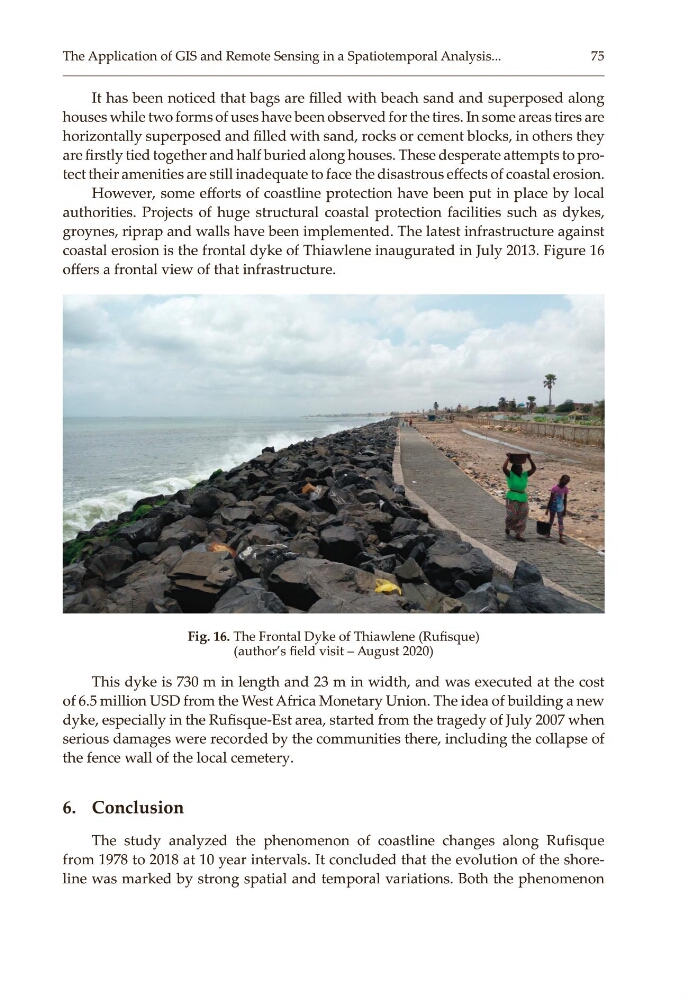
coastal erosion is the frontal dyke of Thiawlene inaugurated in July 2013. Figure 16
offers a frontal view of that infrastructure.
Fig. 16. The Frontal Dyke of Thiawlene (Rufisque)
(author’s field visit – August 2020)
This dyke is 730 m in length and 23 m in width, and was executed at the cost
of 6.5 million USD from the West Africa Monetary Union. The idea of building a new
dyke, especially in the Rufisque-Est area, started from the tragedy of July 2007 when
serious damages were recorded by the communities there, including the collapse of
the fence wall of the local cemetery.
6. Conclusion
The study analyzed the phenomenon of coastline changes along Rufisque
from 1978 to 2018 at 10 year intervals. It concluded that the evolution of the shore‑
line was marked by strong spatial and temporal variations. Both the phenomenon
75
It has been noticed that bags are filled with beach sand and superposed along
houses while two forms of uses have been observed for the tires. In some areas tires are
horizontally superposed and filled with sand, rocks or cement blocks, in others they
are firstly tied together and half buried along houses. These desperate attempts to pro‑
tect their amenities are still inadequate to face the disastrous effects of coastal erosion.
However, some efforts of coastline protection have been put in place by local
authorities. Projects of huge structural coastal protection facilities such as dykes,
groynes, riprap and walls have been implemented. The latest infrastructure against
coastal erosion is the frontal dyke of Thiawlene inaugurated in July 2013. Figure 16
offers a frontal view of that infrastructure.
Fig. 16. The Frontal Dyke of Thiawlene (Rufisque)
(author’s field visit – August 2020)
This dyke is 730 m in length and 23 m in width, and was executed at the cost
of 6.5 million USD from the West Africa Monetary Union. The idea of building a new
dyke, especially in the Rufisque-Est area, started from the tragedy of July 2007 when
serious damages were recorded by the communities there, including the collapse of
the fence wall of the local cemetery.
6. Conclusion
The study analyzed the phenomenon of coastline changes along Rufisque
from 1978 to 2018 at 10 year intervals. It concluded that the evolution of the shore‑
line was marked by strong spatial and temporal variations. Both the phenomenon