

The Application of GIS and Remote Sensing in a Spatiotemporal Analysis...
73
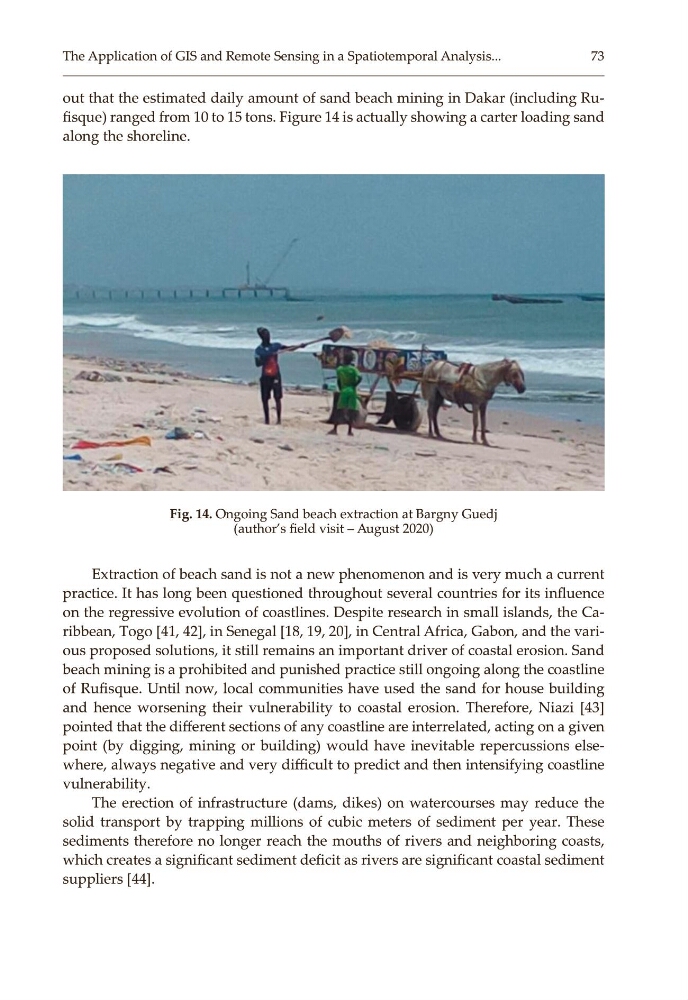
out that the estimated daily amount of sand beach mining in Dakar (including Ru‑
fisque) ranged from 10 to 15 tons. Figure 14 is actually showing a carter loading sand
along the shoreline.
Fig. 14. Ongoing Sand beach extraction at Bargny Guedj
(author’s field visit – August 2020)
Extraction of beach sand is not a new phenomenon and is very much a current
practice. It has long been questioned throughout several countries for its influence
on the regressive evolution of coastlines. Despite research in small islands, the Ca‑
ribbean, Togo [41, 42], in Senegal [18, 19, 20], in Central Africa, Gabon, and the vari‑
ous proposed solutions, it still remains an important driver of coastal erosion. Sand
beach mining is a prohibited and punished practice still ongoing along the coastline
of Rufisque. Until now, local communities have used the sand for house building
and hence worsening their vulnerability to coastal erosion. Therefore, Niazi [43]
pointed that the different sections of any coastline are interrelated, acting on a given
point (by digging, mining or building) would have inevitable repercussions else‑
where, always negative and very difficult to predict and then intensifying coastline
vulnerability.
The erection of infrastructure (dams, dikes) on watercourses may reduce the
solid transport by trapping millions of cubic meters of sediment per year. These
sediments therefore no longer reach the mouths of rivers and neighboring coasts,
which creates a significant sediment deficit as rivers are significant coastal sediment
suppliers [44].
73
out that the estimated daily amount of sand beach mining in Dakar (including Ru‑
fisque) ranged from 10 to 15 tons. Figure 14 is actually showing a carter loading sand
along the shoreline.
Fig. 14. Ongoing Sand beach extraction at Bargny Guedj
(author’s field visit – August 2020)
Extraction of beach sand is not a new phenomenon and is very much a current
practice. It has long been questioned throughout several countries for its influence
on the regressive evolution of coastlines. Despite research in small islands, the Ca‑
ribbean, Togo [41, 42], in Senegal [18, 19, 20], in Central Africa, Gabon, and the vari‑
ous proposed solutions, it still remains an important driver of coastal erosion. Sand
beach mining is a prohibited and punished practice still ongoing along the coastline
of Rufisque. Until now, local communities have used the sand for house building
and hence worsening their vulnerability to coastal erosion. Therefore, Niazi [43]
pointed that the different sections of any coastline are interrelated, acting on a given
point (by digging, mining or building) would have inevitable repercussions else‑
where, always negative and very difficult to predict and then intensifying coastline
vulnerability.
The erection of infrastructure (dams, dikes) on watercourses may reduce the
solid transport by trapping millions of cubic meters of sediment per year. These
sediments therefore no longer reach the mouths of rivers and neighboring coasts,
which creates a significant sediment deficit as rivers are significant coastal sediment
suppliers [44].