

72
CHAPTER 3. PRINCIPLES OF SIMILITUDE
In some flow models it is necessary to add artificial boundary roughness
elements to assure the flow boundary layer is not laminar by increasing the
boundary Reynolds number into the fully rough range.
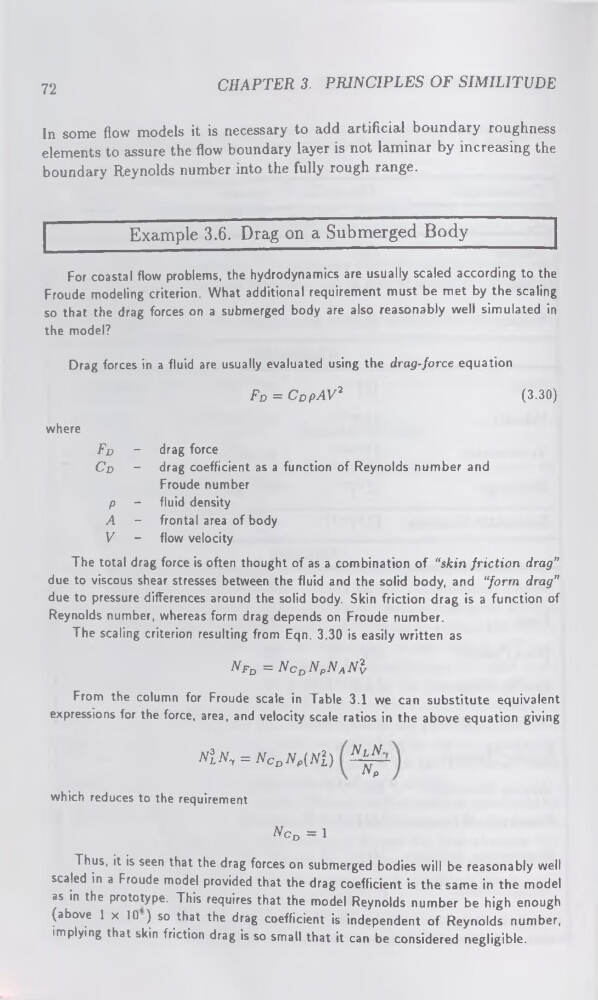
Example 3.6. Drag on a Submerged Body
For coastal flow problems, the hydrodynamics are usually scaled according to the
Froude modeling criterion. What additional requirement must be met by the scaling
so that the drag forces on a submerged body are also reasonably well simulated in
the model?
Drag forces in a fluid are usually evaluated using the drag-force equation
Fd = CDpAV2
(3.30)
where
Fd - drag force
Cd ~ drag coefficient as a function of Reynolds number and
Froude number
p
- fluid density
A
- frontal area of body
V
- flow velocity
The total drag force is often thought of as a combination of “skin friction drag’’
due to viscous shear stresses between the fluid and the solid body, and “form drag”
due to pressure differences around the solid body. Skin friction drag is a function of
Reynolds number, whereas form drag depends on Froude number.
The scaling criterion resulting from Eqn. 3.30 is easily written as
Nfd = NCdNpNaNI
From the column for Froude scale in Table 3.1 we can substitute equivalent
expressions for the force, area, and velocity scale ratios in the above equation giving
NtNy = NcDNp(Nl) NlN.
Np
which reduces to the requirement
^cD=l
Thus, it is seen that the drag forces on submerged bodies will be reasonably well
scaled in a Froude model provided that the drag coefficient is the same in the model
as in the prototype. This requires that the model Reynolds number be high enough
(above 1 x 10 ) so that the drag coefficient is independent of Reynolds number,
implying that skin friction drag is so small that it can be considered negligible.
CHAPTER 3. PRINCIPLES OF SIMILITUDE
In some flow models it is necessary to add artificial boundary roughness
elements to assure the flow boundary layer is not laminar by increasing the
boundary Reynolds number into the fully rough range.
Example 3.6. Drag on a Submerged Body
For coastal flow problems, the hydrodynamics are usually scaled according to the
Froude modeling criterion. What additional requirement must be met by the scaling
so that the drag forces on a submerged body are also reasonably well simulated in
the model?
Drag forces in a fluid are usually evaluated using the drag-force equation
Fd = CDpAV2
(3.30)
where
Fd - drag force
Cd ~ drag coefficient as a function of Reynolds number and
Froude number
p
- fluid density
A
- frontal area of body
V
- flow velocity
The total drag force is often thought of as a combination of “skin friction drag’’
due to viscous shear stresses between the fluid and the solid body, and “form drag”
due to pressure differences around the solid body. Skin friction drag is a function of
Reynolds number, whereas form drag depends on Froude number.
The scaling criterion resulting from Eqn. 3.30 is easily written as
Nfd = NCdNpNaNI
From the column for Froude scale in Table 3.1 we can substitute equivalent
expressions for the force, area, and velocity scale ratios in the above equation giving
NtNy = NcDNp(Nl) NlN.
Np
which reduces to the requirement
^cD=l
Thus, it is seen that the drag forces on submerged bodies will be reasonably well
scaled in a Froude model provided that the drag coefficient is the same in the model
as in the prototype. This requires that the model Reynolds number be high enough
(above 1 x 10 ) so that the drag coefficient is independent of Reynolds number,
implying that skin friction drag is so small that it can be considered negligible.