

68
CHAPTER 3. PRINCIPLES OF SIMILITUDE
Strouhal Number
Inertial forces in fluid flows can be caused by two types of acceleration.
Convective accelerations are accelerations due to different fluid velocities at
different locations in the flow field, and they are represented mathematically
by terms such as u(du/dx) or v(du/dy). Temporal (or local) accelerations
changes in flow velocity at a point that occur in time. I hey represent
the unsteadiness of the flow, and can be expressed mathematically by terms
such as du/dt or dv/dt. In terms of their physical units the inertial forces
due to acceleration can be expressed as
Temporal inertial force = (p£3)(V/t)
Convective inertial force = (p£3)(V2/£)
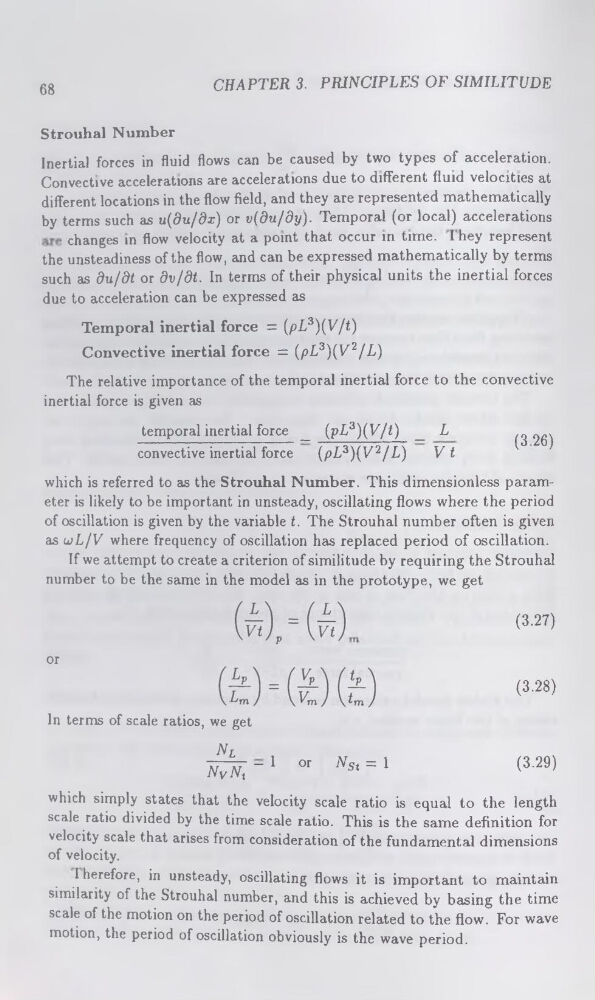
The relative importance of the temporal inertial force to the convective
inertial force is given as
temporal inertial force _ (pZ3)(V/f) _ L
(3 26)
convective inertial force
(p£3)(V2/L)
Vt
which is referred to as the Strouhal Number. This dimensionless parameter is likely to be important in unsteady, oscillating flows where the period
of oscillation is given by the variable t. The Strouhal number often is given
as wL/V where frequency of oscillation has replaced period of oscillation.
If we attempt to create a criterion of similitude by requiring the Strouhal
number to be the same in the model as in the prototype, we get
or
In terms of scale ratios, we get
Nl
NvNt ~ 1 °r Nst = 1
(3.27)
(3.28)
(3.29)
which simply states that the velocity scale ratio is equal to the length
scale ratio divided by the time scale ratio. This is the same definition for
velocity scale that arises from consideration of the fundamental dimensions
of velocity.
I herefore, in unsteady, oscillating flows it is important to maintain
similarity of the Strouhal number, and this is achieved by basing the time
scale of the motion on the period of oscillation related to the flow. For wave
motion, the period of oscillation obviously is the wave period.
CHAPTER 3. PRINCIPLES OF SIMILITUDE
Strouhal Number
Inertial forces in fluid flows can be caused by two types of acceleration.
Convective accelerations are accelerations due to different fluid velocities at
different locations in the flow field, and they are represented mathematically
by terms such as u(du/dx) or v(du/dy). Temporal (or local) accelerations
changes in flow velocity at a point that occur in time. I hey represent
the unsteadiness of the flow, and can be expressed mathematically by terms
such as du/dt or dv/dt. In terms of their physical units the inertial forces
due to acceleration can be expressed as
Temporal inertial force = (p£3)(V/t)
Convective inertial force = (p£3)(V2/£)
The relative importance of the temporal inertial force to the convective
inertial force is given as
temporal inertial force _ (pZ3)(V/f) _ L
(3 26)
convective inertial force
(p£3)(V2/L)
Vt
which is referred to as the Strouhal Number. This dimensionless parameter is likely to be important in unsteady, oscillating flows where the period
of oscillation is given by the variable t. The Strouhal number often is given
as wL/V where frequency of oscillation has replaced period of oscillation.
If we attempt to create a criterion of similitude by requiring the Strouhal
number to be the same in the model as in the prototype, we get
or
In terms of scale ratios, we get
Nl
NvNt ~ 1 °r Nst = 1
(3.27)
(3.28)
(3.29)
which simply states that the velocity scale ratio is equal to the length
scale ratio divided by the time scale ratio. This is the same definition for
velocity scale that arises from consideration of the fundamental dimensions
of velocity.
I herefore, in unsteady, oscillating flows it is important to maintain
similarity of the Strouhal number, and this is achieved by basing the time
scale of the motion on the period of oscillation related to the flow. For wave
motion, the period of oscillation obviously is the wave period.