

3.2. REQUIREMENTS OF SIMILITUDE
61
and the hat symbol represents vector quantities, i.e., both the magnitude
and direction of the force must be correctly represented.
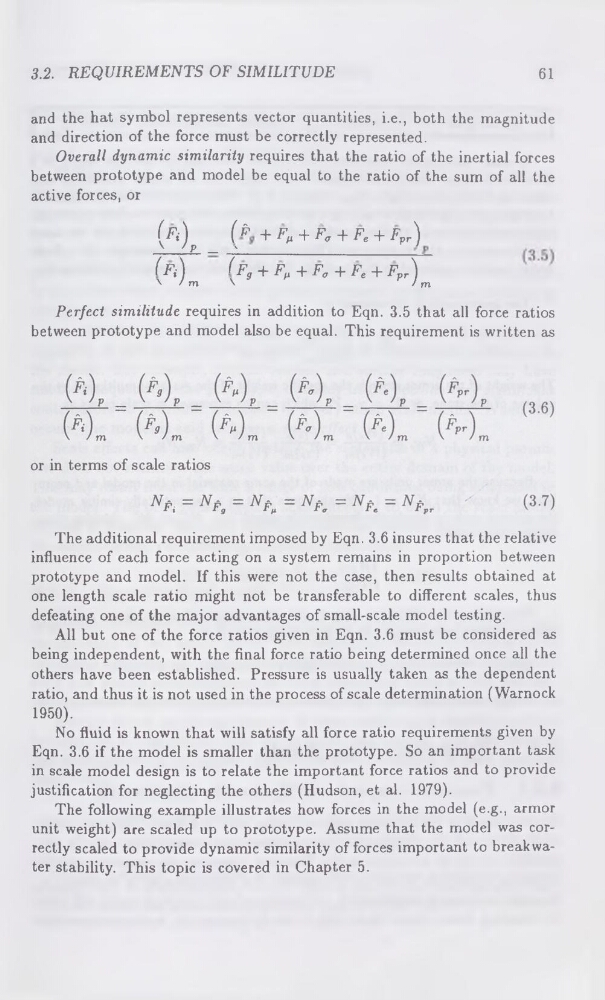
Overall dynamic similarity requires that the ratio of the inertial forces
between prototype and model be equal to the ratio of the sum of all the
active forces, or
(Fi)
(ï+F^ + Fr + Fe + Fpr)
V 7P - _2____________________________
(Fi)
(Fg + F, + Fa + Fe + Fpr}
\ / m
\
) ra
Perfect similitude requires in addition to Eqn. 3.5 that all force ratios
between prototype and model also be equal. This requirement is written as
The additional requirement imposed by Eqn. 3.6 insures that the relative
influence of each force acting on a system remains in proportion between
prototype and model. If this were not the case, then results obtained at
one length scale ratio might not be transferable to different scales, thus
defeating one of the major advantages of small-scale model testing.
All but one of the force ratios given in Eqn. 3.6 must be considered as
being independent, with the final force ratio being determined once all the
others have been established. Pressure is usually taken as the dependent
ratio, and thus it is not used in the process of scale determination (Warnock
1950).
No fluid is known that will satisfy all force ratio requirements given by
Eqn. 3.6 if the model is smaller than the prototype. So an important task
in scale model design is to relate the important force ratios and to provide
justification for neglecting the others (Hudson, et al. 1979).
The following example illustrates how forces in the model (e.g., armor
unit weight) are scaled up to prototype. Assume that the model was correctly scaled to provide dynamic similarity of forces important to breakwater stability. This topic is covered in Chapter 5.
61
and the hat symbol represents vector quantities, i.e., both the magnitude
and direction of the force must be correctly represented.
Overall dynamic similarity requires that the ratio of the inertial forces
between prototype and model be equal to the ratio of the sum of all the
active forces, or
(Fi)
(ï+F^ + Fr + Fe + Fpr)
V 7P - _2____________________________
(Fi)
(Fg + F, + Fa + Fe + Fpr}
\ / m
\
) ra
Perfect similitude requires in addition to Eqn. 3.5 that all force ratios
between prototype and model also be equal. This requirement is written as
The additional requirement imposed by Eqn. 3.6 insures that the relative
influence of each force acting on a system remains in proportion between
prototype and model. If this were not the case, then results obtained at
one length scale ratio might not be transferable to different scales, thus
defeating one of the major advantages of small-scale model testing.
All but one of the force ratios given in Eqn. 3.6 must be considered as
being independent, with the final force ratio being determined once all the
others have been established. Pressure is usually taken as the dependent
ratio, and thus it is not used in the process of scale determination (Warnock
1950).
No fluid is known that will satisfy all force ratio requirements given by
Eqn. 3.6 if the model is smaller than the prototype. So an important task
in scale model design is to relate the important force ratios and to provide
justification for neglecting the others (Hudson, et al. 1979).
The following example illustrates how forces in the model (e.g., armor
unit weight) are scaled up to prototype. Assume that the model was correctly scaled to provide dynamic similarity of forces important to breakwater stability. This topic is covered in Chapter 5.