

56
CHAPTER 3. PRINCIPLES OF SIMILITUDE
Z
- characteristic vibration amplitude
X
- characteristic string length
T
-
characteristic time
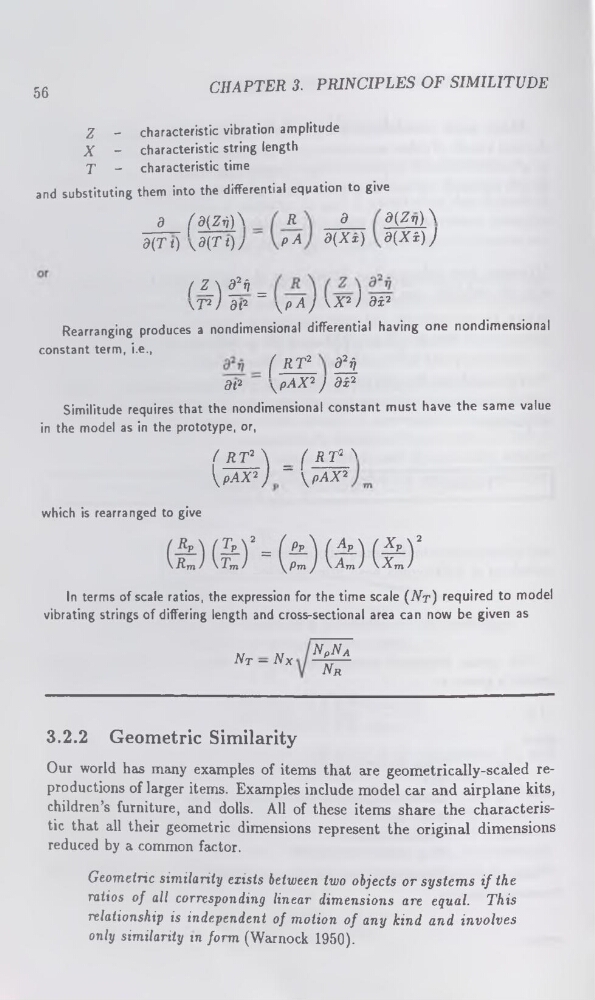
and substituting them into the differential equation to give
d
(d(Zrj)\
d(Ti) \d(T t) /
R
pA
d(Zy)\
d(Xi) J
3
d(Xx)
(Z_\^h =
XT2 ) dt2 ~ \ P A J \X2 ) di2
Rearranging produces a nondimensional differential having one nondimensional
constant term, i.e.,
( rt2 ÊÏÊ
dt2
\pAX2 J di2
Similitude requires that the nondimensional constant must have the same value
in the model as in the prototype, or,
/ RT2\ _( RT2\
[JÂX2 ) ~ \pAX2
which is rearranged to give
In terms of scale ratios, the expression for the time scale (jVt) required to model
vibrating strings of differing length and cross-sectional area can now be given as
NT — NX
NpNa
Nr
3.2.2 Geometric Similarity
Our world has many examples of items that are geometrically-scaled reproductions of larger items. Examples include model car and airplane kits,
children’s furniture, and dolls. All of these items share the characteristic that all their geometric dimensions represent the original dimensions
reduced by a common factor.
Geometric similarity exists between two objects or systems if the
ratios of all corresponding linear dimensions are equal. This
relationship is independent of motion of any kind and involves
only similarity tn form (Warnock 1950).
CHAPTER 3. PRINCIPLES OF SIMILITUDE
Z
- characteristic vibration amplitude
X
- characteristic string length
T
-
characteristic time
and substituting them into the differential equation to give
d
(d(Zrj)\
d(Ti) \d(T t) /
R
pA
d(Zy)\
d(Xi) J
3
d(Xx)
(Z_\^h =
XT2 ) dt2 ~ \ P A J \X2 ) di2
Rearranging produces a nondimensional differential having one nondimensional
constant term, i.e.,
( rt2 ÊÏÊ
dt2
\pAX2 J di2
Similitude requires that the nondimensional constant must have the same value
in the model as in the prototype, or,
/ RT2\ _( RT2\
[JÂX2 ) ~ \pAX2
which is rearranged to give
In terms of scale ratios, the expression for the time scale (jVt) required to model
vibrating strings of differing length and cross-sectional area can now be given as
NT — NX
NpNa
Nr
3.2.2 Geometric Similarity
Our world has many examples of items that are geometrically-scaled reproductions of larger items. Examples include model car and airplane kits,
children’s furniture, and dolls. All of these items share the characteristic that all their geometric dimensions represent the original dimensions
reduced by a common factor.
Geometric similarity exists between two objects or systems if the
ratios of all corresponding linear dimensions are equal. This
relationship is independent of motion of any kind and involves
only similarity tn form (Warnock 1950).