

54
CHAPTER 3. PRINCIPLES OF SIMILITUDE
3.2 Requirements of Similitude
Physical model studies can provide both qualitative and quantitative information. For example, ground-up coal can be used as a movable tracer
in a harbor model molded in concrete to give a qualitative description of
sediment paths within the flow regime. The same model, however, provides
quantitative information on short wave penetration through the harbor entrance.
Requirements of similitude will vary with the problem being studied and
the degree of accuracy desired in model reproduction of prototype behavior.
Usually, quantitative information is sought from the physical model, and it
is common to classify models on the basis of the quantitative information
they provide and the degree of similarity they have with the prototype.
Completely similar models are models in which the values of all relevant
dimensionless parameters (i.e., the complete set of dimensionless products)
in the prototype are maintained in the model. A prerequisite for complete
similarity is that the model be geometrically similar to the prototype. Other
types of models are kinematically similar models and dynamically similar
models. These types of similarity will be discussed in the following sections.
3.2.1 Scale Factors
Correspondence between prototype and model parameters is denoted by the
scale ratio or simply the scale. A frequently used convention is to define
the scale ratio as follows:
The Scale Ratio is the ratio of a parameter in the prototype
to the value of the same parameter in the model.
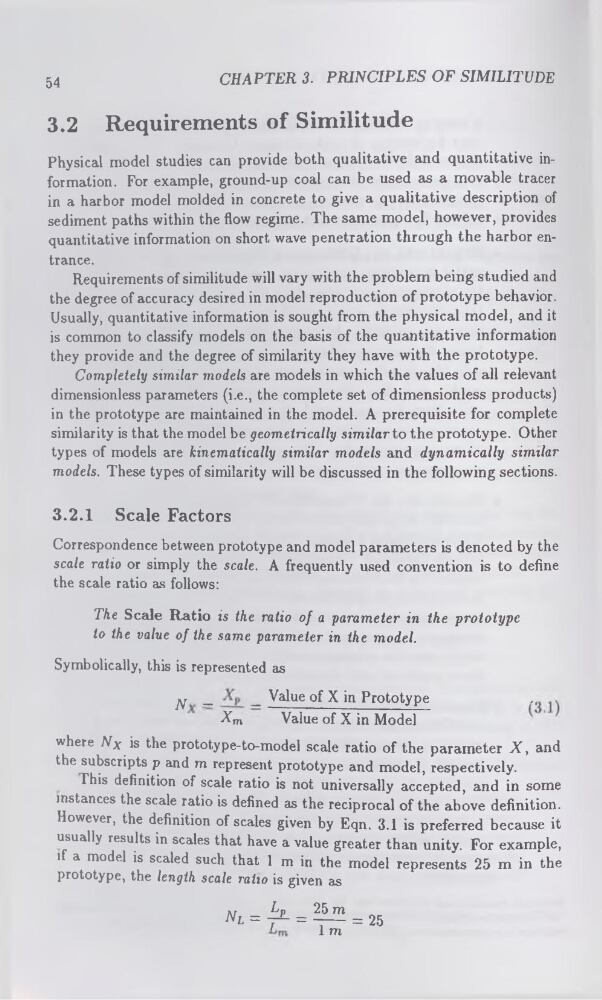
Symbolically, this is represented as
N _
_ Value of X in Prototype
,
Xm
Value of X in Model
where Nx is the prototype-to-model scale ratio of the parameter X, and
the subscripts p and m represent prototype and model, respectively.
This definition of scale ratio is not universally accepted, and in some
instances the scale ratio is defined as the reciprocal of the above definition.
However, the definition of scales given by Eqn. 3.1 is preferred because it
usually results in scales that have a value greater than unity. For example,
if a model is scaled such that 1 m in the model represents 25 m in the
prototype, the length scale ratio is given as
.r
Lp
25 m
Nl = te- = - ----= 25
Im
CHAPTER 3. PRINCIPLES OF SIMILITUDE
3.2 Requirements of Similitude
Physical model studies can provide both qualitative and quantitative information. For example, ground-up coal can be used as a movable tracer
in a harbor model molded in concrete to give a qualitative description of
sediment paths within the flow regime. The same model, however, provides
quantitative information on short wave penetration through the harbor entrance.
Requirements of similitude will vary with the problem being studied and
the degree of accuracy desired in model reproduction of prototype behavior.
Usually, quantitative information is sought from the physical model, and it
is common to classify models on the basis of the quantitative information
they provide and the degree of similarity they have with the prototype.
Completely similar models are models in which the values of all relevant
dimensionless parameters (i.e., the complete set of dimensionless products)
in the prototype are maintained in the model. A prerequisite for complete
similarity is that the model be geometrically similar to the prototype. Other
types of models are kinematically similar models and dynamically similar
models. These types of similarity will be discussed in the following sections.
3.2.1 Scale Factors
Correspondence between prototype and model parameters is denoted by the
scale ratio or simply the scale. A frequently used convention is to define
the scale ratio as follows:
The Scale Ratio is the ratio of a parameter in the prototype
to the value of the same parameter in the model.
Symbolically, this is represented as
N _
_ Value of X in Prototype
,
Xm
Value of X in Model
where Nx is the prototype-to-model scale ratio of the parameter X, and
the subscripts p and m represent prototype and model, respectively.
This definition of scale ratio is not universally accepted, and in some
instances the scale ratio is defined as the reciprocal of the above definition.
However, the definition of scales given by Eqn. 3.1 is preferred because it
usually results in scales that have a value greater than unity. For example,
if a model is scaled such that 1 m in the model represents 25 m in the
prototype, the length scale ratio is given as
.r
Lp
25 m
Nl = te- = - ----= 25
Im