

2.3. DIMENSIONAL ANALYSIS METHODOLOGY
47
and determination of an empirical formulation becomes intractable (Munson, et al. 1990). Often, physical models can be used to determine specific
characteristics of these more complicated problems.
Example 2.10. Motion of a Simple Pendulum
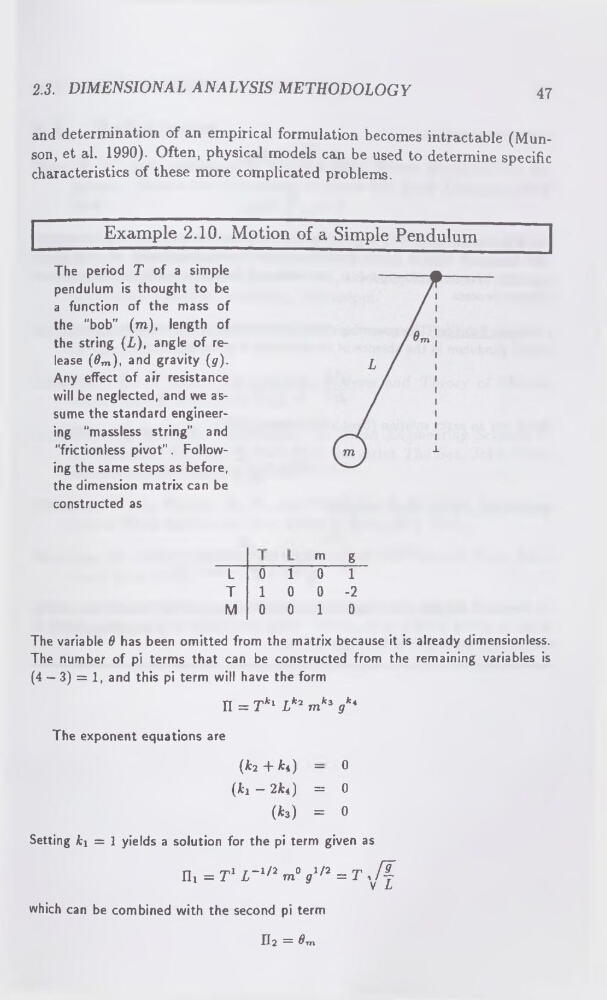
The period T of a simple
pendulum is thought to be
a function of the mass of
the "bob” (m), length of
the string (Z), angle of release (0m), and gravity (ÿ).
Any effect of air resistance
will be neglected, and we assume the standard engineering "massless string” and
“frictionless pivot". Following the same steps as before,
the dimension matrix can be
constructed as
0
1
1
0
0 0
L
T
M
m
g
0
1
0 -2
1
0
The variable 0 has been omitted from the matrix because it is already dimensionless.
The number of pi terms that can be constructed from the remaining variables is
(4 — 3) = 1, and this pi term will have the form
H = Tkl Lk2 mk3 gk*
The exponent equations are
(fca + kt) — 0
(An - 2Jb4) = 0
(k3) = 0
Setting ki = 1 yields a solution for the pi term given as
III = T1 Z"1/2 m° g1/2 = T J^
V X/
which can be combined with the second pi term
II2 = 0m
47
and determination of an empirical formulation becomes intractable (Munson, et al. 1990). Often, physical models can be used to determine specific
characteristics of these more complicated problems.
Example 2.10. Motion of a Simple Pendulum
The period T of a simple
pendulum is thought to be
a function of the mass of
the "bob” (m), length of
the string (Z), angle of release (0m), and gravity (ÿ).
Any effect of air resistance
will be neglected, and we assume the standard engineering "massless string” and
“frictionless pivot". Following the same steps as before,
the dimension matrix can be
constructed as
0
1
1
0
0 0
L
T
M
m
g
0
1
0 -2
1
0
The variable 0 has been omitted from the matrix because it is already dimensionless.
The number of pi terms that can be constructed from the remaining variables is
(4 — 3) = 1, and this pi term will have the form
H = Tkl Lk2 mk3 gk*
The exponent equations are
(fca + kt) — 0
(An - 2Jb4) = 0
(k3) = 0
Setting ki = 1 yields a solution for the pi term given as
III = T1 Z"1/2 m° g1/2 = T J^
V X/
which can be combined with the second pi term
II2 = 0m