

44
CHAPTER 2. DIMENSIONAL ANALYSIS
must indicate that other physical factors are important. It is then necessary
to identify the additional factors and include them in the analysis.
Munson, et al. (1990) gave the following example of a fluid flow problem
that can be described by a single dimensionless product.
Example 2.9. Stokes Law for Viscous Flow
The drag force (D) exerted on a spherical particle falling through very viscous
fluid depends on the sphere's diameter (d), the sphere's velocity (V), and the fluid
dynamic viscosity (/x). The relationship between these variables is investigated by
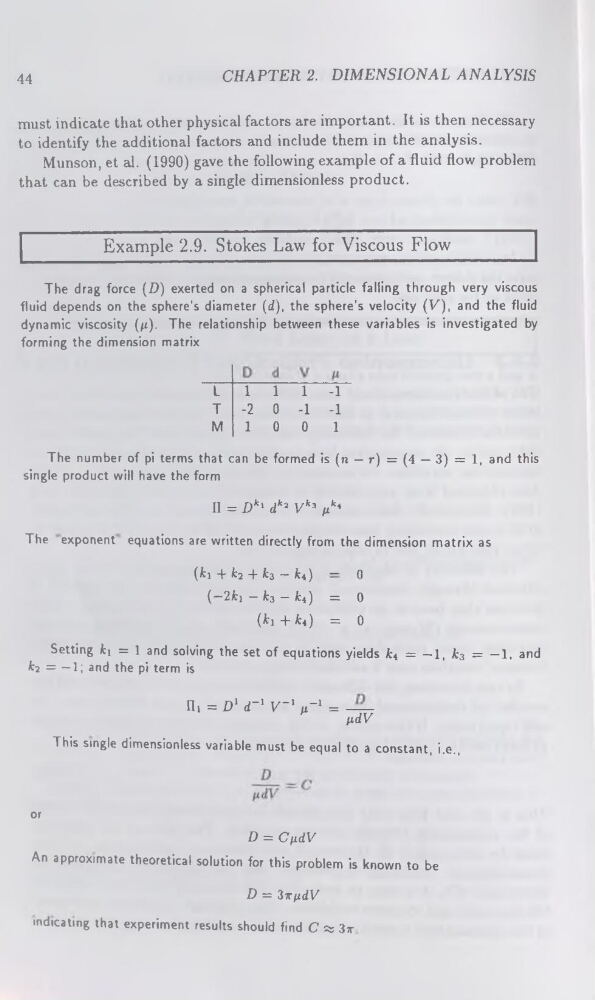
forming the dimension matrix
L
T
M
1
1
1
-2
0 -1
1
0
0
-1
-1
1
The number of pi terms that can be formed is (n — r) = (4 — 3) = 1, and this
single product will have the form
II = Dkl dk' Vk3 nk*
The exponent equations are written directly from the dimension matrix as
(fcj + &2 + £3 — ki) — 0
(~2fci - fc3 - fc4) = 0
(&i + fc4) = 0
Setting fci = 1 and solving the set of equations yields fc4 = -1, fc3 = -1. and
^2 = -1; and the pi term is
IIi = D'd~> V-1 g’1 = —
ndV
This single dimensionless variable must be equal to a constant, i.e.,
or
D = CiidV
An approximate theoretical solution for this problem is known to be
D = 3irndV
indicating that experiment results should find C « 3tt
CHAPTER 2. DIMENSIONAL ANALYSIS
must indicate that other physical factors are important. It is then necessary
to identify the additional factors and include them in the analysis.
Munson, et al. (1990) gave the following example of a fluid flow problem
that can be described by a single dimensionless product.
Example 2.9. Stokes Law for Viscous Flow
The drag force (D) exerted on a spherical particle falling through very viscous
fluid depends on the sphere's diameter (d), the sphere's velocity (V), and the fluid
dynamic viscosity (/x). The relationship between these variables is investigated by
forming the dimension matrix
L
T
M
1
1
1
-2
0 -1
1
0
0
-1
-1
1
The number of pi terms that can be formed is (n — r) = (4 — 3) = 1, and this
single product will have the form
II = Dkl dk' Vk3 nk*
The exponent equations are written directly from the dimension matrix as
(fcj + &2 + £3 — ki) — 0
(~2fci - fc3 - fc4) = 0
(&i + fc4) = 0
Setting fci = 1 and solving the set of equations yields fc4 = -1, fc3 = -1. and
^2 = -1; and the pi term is
IIi = D'd~> V-1 g’1 = —
ndV
This single dimensionless variable must be equal to a constant, i.e.,
or
D = CiidV
An approximate theoretical solution for this problem is known to be
D = 3irndV
indicating that experiment results should find C « 3tt