

516 CHAPTER 8. LABORATORY MEASUREMENT AND ANALYSIS
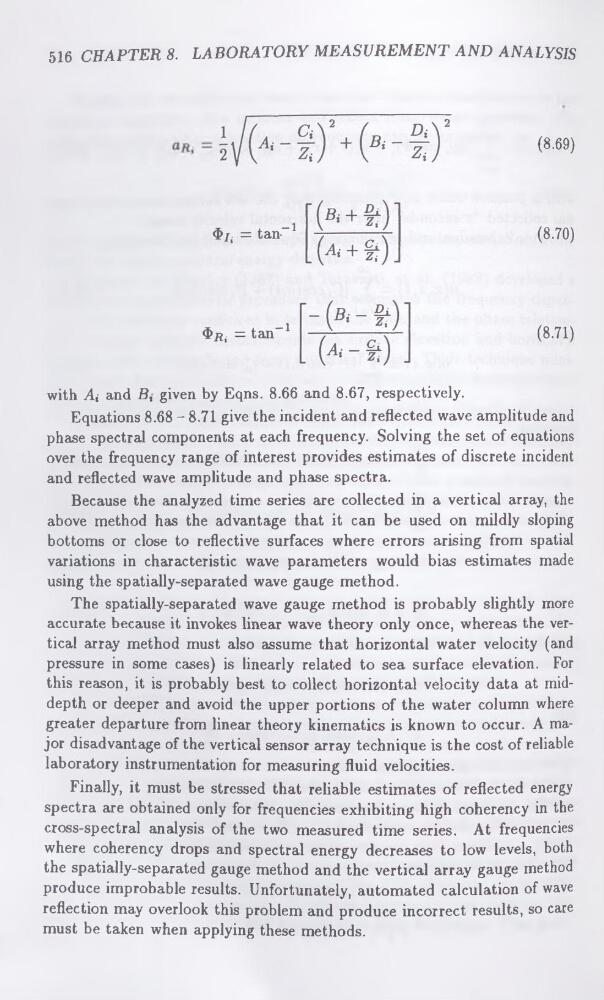
(8.69)
with Ai and Bt given by Eqns. 8.66 and 8.67, respectively.
Equations 8.68 - 8.71 give the incident and reflected wave amplitude and
phase spectral components at each frequency. Solving the set of equations
over the frequency range of interest provides estimates of discrete incident
and reflected wave amplitude and phase spectra.
Because the analyzed time series are collected in a vertical array, the
above method has the advantage that it can be used on mildly sloping
bottoms or close to reflective surfaces where errors arising from spatial
variations in characteristic wave parameters would bias estimates made
using the spatially-separated wave gauge method.
The spatially-separated wave gauge method is probably slightly more
accurate because it invokes linear wave theory only once, whereas the vertical array method must also assume that horizontal water velocity (and
pressure in some cases) is linearly related to sea surface elevation. For
this reason, it is probably best to collect horizontal velocity data at middepth or deeper and avoid the upper portions of the water column where
greater departure from linear theory kinematics is known to occur. A major disadvantage of the vertical sensor array technique is the cost of reliable
laboratory instrumentation for measuring fluid velocities.
Finally, it must be stressed that reliable estimates of reflected energy
spectra are obtained only for frequencies exhibiting high coherency in the
cross-spectral analysis of the two measured time series. At frequencies
where coherency drops and spectral energy decreases to low levels, both
the spatially-separated gauge method and the vertical array gauge method
produce improbable results. Unfortunately, automated calculation of wave
reflection may overlook this problem and produce incorrect results, so care
must be taken when applying these methods.
(8.69)
with Ai and Bt given by Eqns. 8.66 and 8.67, respectively.
Equations 8.68 - 8.71 give the incident and reflected wave amplitude and
phase spectral components at each frequency. Solving the set of equations
over the frequency range of interest provides estimates of discrete incident
and reflected wave amplitude and phase spectra.
Because the analyzed time series are collected in a vertical array, the
above method has the advantage that it can be used on mildly sloping
bottoms or close to reflective surfaces where errors arising from spatial
variations in characteristic wave parameters would bias estimates made
using the spatially-separated wave gauge method.
The spatially-separated wave gauge method is probably slightly more
accurate because it invokes linear wave theory only once, whereas the vertical array method must also assume that horizontal water velocity (and
pressure in some cases) is linearly related to sea surface elevation. For
this reason, it is probably best to collect horizontal velocity data at middepth or deeper and avoid the upper portions of the water column where
greater departure from linear theory kinematics is known to occur. A major disadvantage of the vertical sensor array technique is the cost of reliable
laboratory instrumentation for measuring fluid velocities.
Finally, it must be stressed that reliable estimates of reflected energy
spectra are obtained only for frequencies exhibiting high coherency in the
cross-spectral analysis of the two measured time series. At frequencies
where coherency drops and spectral energy decreases to low levels, both
the spatially-separated gauge method and the vertical array gauge method
produce improbable results. Unfortunately, automated calculation of wave
reflection may overlook this problem and produce incorrect results, so care
must be taken when applying these methods.