

514 CHAPTER 8. LABORATORY MEASUREMENT AND ANALYSIS
Finally, the two fabricated wave trains are Fourier transformed to the
frequency domain to give incident and reflect long-wave spectra. The
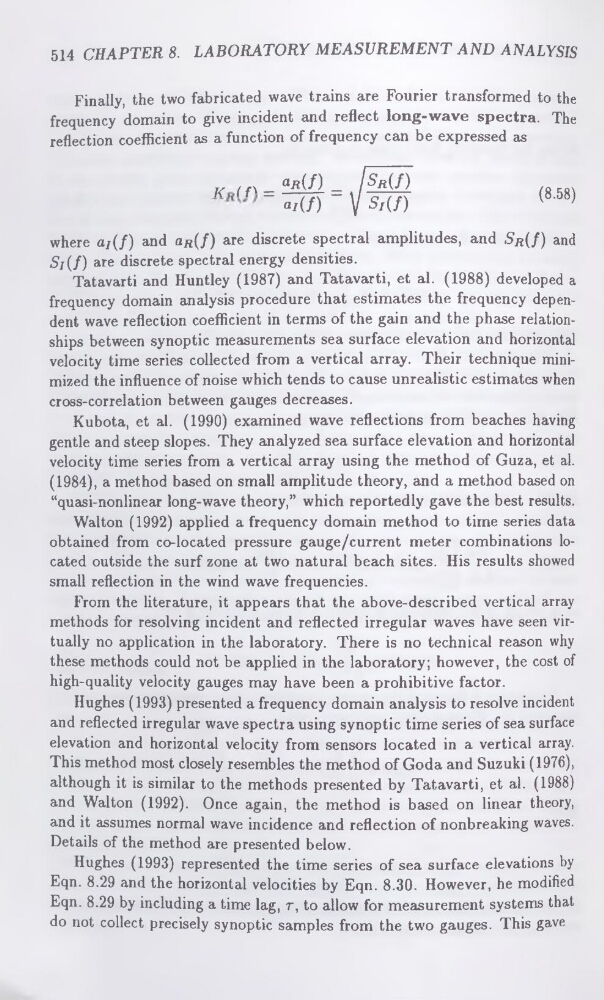
reflection coefficient as a function of frequency can be expressed as
K (f\- aRW = . ISrW
zq rox
- a/(/) y s/(/)
(8-58)
where a/(/) and afi(/) are discrete spectral amplitudes, and Sr(P) and
Sj(f) are discrete spectral energy densities.
Tatavarti and Huntley (1987) and Tatavarti, et al. (1988) developed a
frequency domain analysis procedure that estimates the frequency dependent wave reflection coefficient in terms of the gain and the phase relationships between synoptic measurements sea surface elevation and horizontal
velocity time series collected from a vertical array. Their technique minimized the influence of noise which tends to cause unrealistic estimates when
cross-correlation between gauges decreases.
Kubota, et al. (1990) examined wave reflections from beaches having
gentle and steep slopes. They analyzed sea surface elevation and horizontal
velocity time series from a vertical array using the method of Guza, et al.
(1984), a method based on small amplitude theory, and a method based on
“quasi-nonlinear long-wave theory,” which reportedly gave the best results.
Walton (1992) applied a frequency domain method to time series data
obtained from co-located pressure gauge/current meter combinations located outside the surf zone at two natural beach sites. His results showed
small reflection in the wind wave frequencies.
From the literature, it appears that the above-described vertical array
methods for resolving incident and reflected irregular waves have seen virtually no application in the laboratory. There is no technical reason why
these methods could not be applied in the laboratory; however, the cost of
high-quality velocity gauges may have been a prohibitive factor.
Hughes (1993) presented a frequency domain analysis to resolve incident
and reflected irregular wave spectra using synoptic time series of sea surface
elevation and horizontal velocity from sensors located in a vertical array.
This method most closely resembles the method of Goda and Suzuki (1976),
although it is similar to the methods presented by Tatavarti, et al. (1988)
and Walton (1992). Once again, the method is based on linear theory,
and it assumes normal wave incidence and reflection of nonbreaking waves.
Details of the method are presented below.
Hughes (1993) represented the time series of sea surface elevations by
Eqn. 8.29 and the horizontal velocities by Eqn. 8.30. However, he modified
Eqn. 8.29 by including a time lag, r, to allow for measurement systems that
do not collect precisely synoptic samples from the two gauges. This gave
Finally, the two fabricated wave trains are Fourier transformed to the
frequency domain to give incident and reflect long-wave spectra. The
reflection coefficient as a function of frequency can be expressed as
K (f\- aRW = . ISrW
zq rox
- a/(/) y s/(/)
(8-58)
where a/(/) and afi(/) are discrete spectral amplitudes, and Sr(P) and
Sj(f) are discrete spectral energy densities.
Tatavarti and Huntley (1987) and Tatavarti, et al. (1988) developed a
frequency domain analysis procedure that estimates the frequency dependent wave reflection coefficient in terms of the gain and the phase relationships between synoptic measurements sea surface elevation and horizontal
velocity time series collected from a vertical array. Their technique minimized the influence of noise which tends to cause unrealistic estimates when
cross-correlation between gauges decreases.
Kubota, et al. (1990) examined wave reflections from beaches having
gentle and steep slopes. They analyzed sea surface elevation and horizontal
velocity time series from a vertical array using the method of Guza, et al.
(1984), a method based on small amplitude theory, and a method based on
“quasi-nonlinear long-wave theory,” which reportedly gave the best results.
Walton (1992) applied a frequency domain method to time series data
obtained from co-located pressure gauge/current meter combinations located outside the surf zone at two natural beach sites. His results showed
small reflection in the wind wave frequencies.
From the literature, it appears that the above-described vertical array
methods for resolving incident and reflected irregular waves have seen virtually no application in the laboratory. There is no technical reason why
these methods could not be applied in the laboratory; however, the cost of
high-quality velocity gauges may have been a prohibitive factor.
Hughes (1993) presented a frequency domain analysis to resolve incident
and reflected irregular wave spectra using synoptic time series of sea surface
elevation and horizontal velocity from sensors located in a vertical array.
This method most closely resembles the method of Goda and Suzuki (1976),
although it is similar to the methods presented by Tatavarti, et al. (1988)
and Walton (1992). Once again, the method is based on linear theory,
and it assumes normal wave incidence and reflection of nonbreaking waves.
Details of the method are presented below.
Hughes (1993) represented the time series of sea surface elevations by
Eqn. 8.29 and the horizontal velocities by Eqn. 8.30. However, he modified
Eqn. 8.29 by including a time lag, r, to allow for measurement systems that
do not collect precisely synoptic samples from the two gauges. This gave