

510 CHAPTER 8. LABORATORY MEASUREMENT AND ANALYSIS
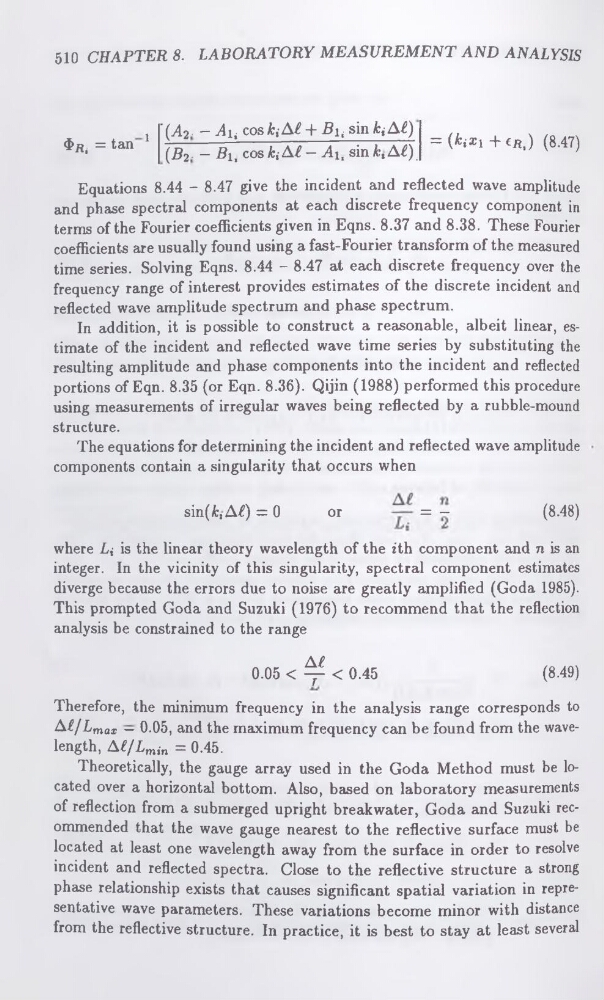
$Ri = tan 1
'(A2. - A< cos kjM + Bij sin kjM)
(B2. - A, cosfcjA/ — A, sin Ar, AZ).
= (kiXi + €fl_) (8-47)
Equations 8.44 - 8.47 give the incident and reflected wave amplitude
and phase spectral components at each discrete frequency component in
terms of the Fourier coefficients given in Eqns. 8.37 and 8.38. These Fourier
coefficients are usually found using a fast-Fourier transform of the measured
time series. Solving Eqns. 8.44 - 8.47 at each discrete frequency over the
frequency range of interest provides estimates of the discrete incident and
reflected wave amplitude spectrum and phase spectrum.
In addition, it is possible to construct a reasonable, albeit linear, estimate of the incident and reflected wave time series by substituting the
resulting amplitude and phase components into the incident and reflected
portions of Eqn. 8.35 (or Eqn. 8.36). Qijin (1988) performed this procedure
using measurements of irregular waves being reflected by a rubble-mound
structure.
The equations for determining the incident and reflected wave amplitude
components contain a singularity that occurs when
sin(fc,AZ) = 0
or
= —
(8.48)
where Li is the linear theory wavelength of the ith component and n is an
integer. In the vicinity of this singularity, spectral component estimates
diverge because the errors due to noise are greatly amplified (Goda 1985).
This prompted Goda and Suzuki (1976) to recommend that the reflection
analysis be constrained to the range
0.05 < ^ < 0.45
(8.49)
Therefore, the minimum frequency in the analysis range corresponds to
AZ/Lmax — 0.05, and the maximum frequency can be found from the wavelength, M/Lmin = 0.45.
Theoretically, the gauge array used in the Goda Method must be located over a horizontal bottom. Also, based on laboratory measurements
of reflection from a submerged upright breakwater, Goda and Suzuki recommended that the wave gauge nearest to the reflective surface must be
located at least one wavelength away from the surface in order to resolve
incident and reflected spectra. Close to the reflective structure a strong
phase relationship exists that causes significant spatial variation in representative wave parameters. These variations become minor with distance
from the reflective structure. In practice, it is best to stay at least several
$Ri = tan 1
'(A2. - A< cos kjM + Bij sin kjM)
(B2. - A, cosfcjA/ — A, sin Ar, AZ).
= (kiXi + €fl_) (8-47)
Equations 8.44 - 8.47 give the incident and reflected wave amplitude
and phase spectral components at each discrete frequency component in
terms of the Fourier coefficients given in Eqns. 8.37 and 8.38. These Fourier
coefficients are usually found using a fast-Fourier transform of the measured
time series. Solving Eqns. 8.44 - 8.47 at each discrete frequency over the
frequency range of interest provides estimates of the discrete incident and
reflected wave amplitude spectrum and phase spectrum.
In addition, it is possible to construct a reasonable, albeit linear, estimate of the incident and reflected wave time series by substituting the
resulting amplitude and phase components into the incident and reflected
portions of Eqn. 8.35 (or Eqn. 8.36). Qijin (1988) performed this procedure
using measurements of irregular waves being reflected by a rubble-mound
structure.
The equations for determining the incident and reflected wave amplitude
components contain a singularity that occurs when
sin(fc,AZ) = 0
or
= —
(8.48)
where Li is the linear theory wavelength of the ith component and n is an
integer. In the vicinity of this singularity, spectral component estimates
diverge because the errors due to noise are greatly amplified (Goda 1985).
This prompted Goda and Suzuki (1976) to recommend that the reflection
analysis be constrained to the range
0.05 < ^ < 0.45
(8.49)
Therefore, the minimum frequency in the analysis range corresponds to
AZ/Lmax — 0.05, and the maximum frequency can be found from the wavelength, M/Lmin = 0.45.
Theoretically, the gauge array used in the Goda Method must be located over a horizontal bottom. Also, based on laboratory measurements
of reflection from a submerged upright breakwater, Goda and Suzuki recommended that the wave gauge nearest to the reflective surface must be
located at least one wavelength away from the surface in order to resolve
incident and reflected spectra. Close to the reflective structure a strong
phase relationship exists that causes significant spatial variation in representative wave parameters. These variations become minor with distance
from the reflective structure. In practice, it is best to stay at least several