

8.4. WAVE REFLECTION ANALYSIS
505
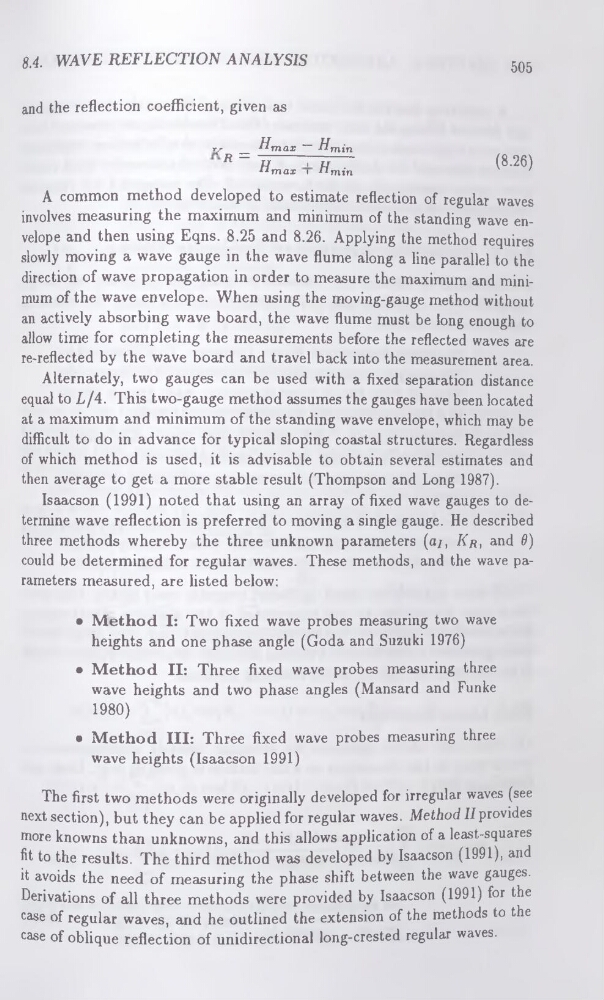
and the reflection coefficient, given as
rz _ Hmax — Hmin
R ~ fj
i rr
(8.26)
11max i rimin
A common method developed to estimate reflection of regular waves
involves measuring the maximum and minimum of the standing wave envelope and then using Eqns. 8.25 and 8.26. Applying the method requires
slowly moving a wave gauge in the wave flume along a line parallel to the
direction of wave propagation in order to measure the maximum and minimum of the wave envelope. When using the moving-gauge method without
an actively absorbing wave board, the wave flume must be long enough to
allow time for completing the measurements before the reflected waves are
re-reflected by the wave board and travel back into the measurement area.
Alternately, two gauges can be used with a fixed separation distance
equal to Z/4. This two-gauge method assumes the gauges have been located
at a maximum and minimum of the standing wave envelope, which may be
difficult to do in advance for typical sloping coastal structures. Regardless
of which method is used, it is advisable to obtain several estimates and
then average to get a more stable result (Thompson and Long 1987).
Isaacson (1991) noted that using an array of fixed wave gauges to determine wave reflection is preferred to moving a single gauge. He described
three methods whereby the three unknown parameters (a/, K#, and 0)
could be determined for regular waves. These methods, and the wave parameters measured, are listed below:
• Method I: Two fixed wave probes measuring two wave
heights and one phase angle (Goda and Suzuki 1976)
• Method II: Three fixed wave probes measuring three
wave heights and two phase angles (Mansard and Funke
1980)
• Method III: Three fixed wave probes measuring three
wave heights (Isaacson 1991)
The first two methods were originally developed for irregular waves (see
next section), but they can be applied for regular waves. Method IIprovides
more knowns than unknowns, and this allows application of a least-squares
fit to the results. The third method was developed by Isaacson (1991), and
it avoids the need of measuring the phase shift between the wave gauges.
Derivations of all three methods were provided by Isaacson (1991) for the
case of regular waves, and he outlined the extension of the methods to the
case of oblique reflection of unidirectional long-crested regular waves.
505
and the reflection coefficient, given as
rz _ Hmax — Hmin
R ~ fj
i rr
(8.26)
11max i rimin
A common method developed to estimate reflection of regular waves
involves measuring the maximum and minimum of the standing wave envelope and then using Eqns. 8.25 and 8.26. Applying the method requires
slowly moving a wave gauge in the wave flume along a line parallel to the
direction of wave propagation in order to measure the maximum and minimum of the wave envelope. When using the moving-gauge method without
an actively absorbing wave board, the wave flume must be long enough to
allow time for completing the measurements before the reflected waves are
re-reflected by the wave board and travel back into the measurement area.
Alternately, two gauges can be used with a fixed separation distance
equal to Z/4. This two-gauge method assumes the gauges have been located
at a maximum and minimum of the standing wave envelope, which may be
difficult to do in advance for typical sloping coastal structures. Regardless
of which method is used, it is advisable to obtain several estimates and
then average to get a more stable result (Thompson and Long 1987).
Isaacson (1991) noted that using an array of fixed wave gauges to determine wave reflection is preferred to moving a single gauge. He described
three methods whereby the three unknown parameters (a/, K#, and 0)
could be determined for regular waves. These methods, and the wave parameters measured, are listed below:
• Method I: Two fixed wave probes measuring two wave
heights and one phase angle (Goda and Suzuki 1976)
• Method II: Three fixed wave probes measuring three
wave heights and two phase angles (Mansard and Funke
1980)
• Method III: Three fixed wave probes measuring three
wave heights (Isaacson 1991)
The first two methods were originally developed for irregular waves (see
next section), but they can be applied for regular waves. Method IIprovides
more knowns than unknowns, and this allows application of a least-squares
fit to the results. The third method was developed by Isaacson (1991), and
it avoids the need of measuring the phase shift between the wave gauges.
Derivations of all three methods were provided by Isaacson (1991) for the
case of regular waves, and he outlined the extension of the methods to the
case of oblique reflection of unidirectional long-crested regular waves.