

8.4. WAVE REFLECTION ANALYSIS
503
8.4.1 Reflection Analysis of Regular Waves
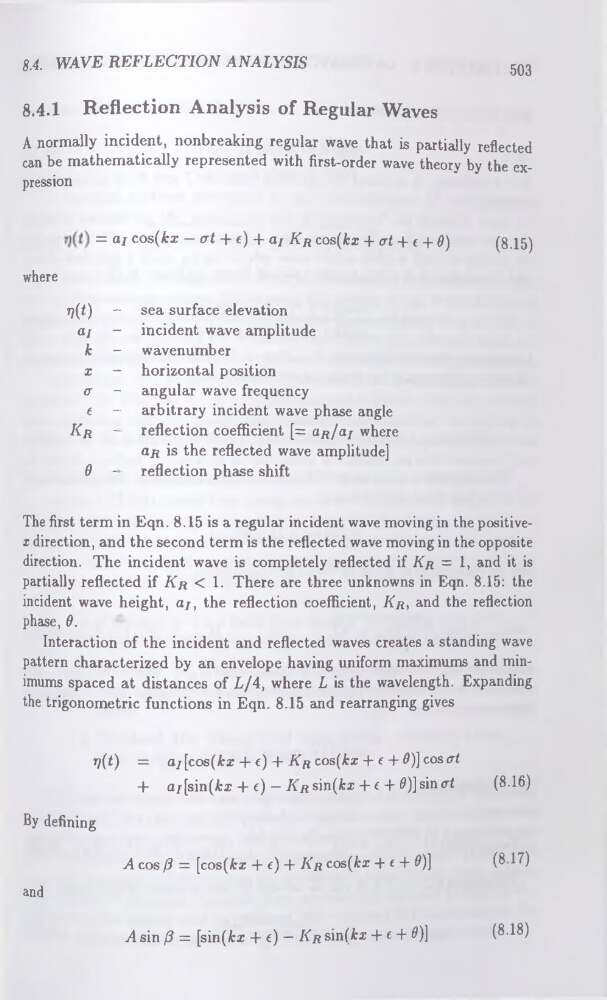
A normally incident, nonbreaking regular wave that is partially reflected
can be mathematically represented with first-order wave theory by the expression
= aj cosÇkx - at 4- e) 4- aT Kr cos(fcz 4- at 4- c 4- 0)
(8.15)
where
z/(f) - sea surface elevation
aj - incident wave amplitude
k - wavenumber
x
- horizontal position
a - angular wave frequency
e - arbitrary incident wave phase angle
Kr - reflection coefficient [= ur/cli where
a.R is the reflected wave amplitude]
0
-
reflection phase shift
The first term in Eqn. 8.15 is a regular incident wave moving in the positivex direction, and the second term is the reflected wave moving in the opposite
direction. The incident wave is completely reflected if Kr = 1, and it is
partially reflected if Kr < 1. There are three unknowns in Eqn. 8.15: the
incident wave height, aj, the reflection coefficient, Kr, and the reflection
phase, 9.
Interaction of the incident and reflected waves creates a standing wave
pattern characterized by an envelope having uniform maximums and minimums spaced at distances of L/4, where L is the wavelength. Expanding
the trigonometric functions in Eqn. 8.15 and rearranging gives
T](t) = aj[cos(fcz 4-e) 4-TTr cos(£o: 4-c 4-0)]cos(rt
4- a/[sin(fcz 4-e) — Æj?sin(fci 4-£ 4-0)]sincrt
(8.16)
By defining
A cos /? = [cos(fcx 4- c) 4- Kr cos(kx 4- e 4- 0)]
(817)
and
A sin /3 = [sin(fcx 4- c) — Kr sin(kx 4- £ 4- #)]
(8-18)
503
8.4.1 Reflection Analysis of Regular Waves
A normally incident, nonbreaking regular wave that is partially reflected
can be mathematically represented with first-order wave theory by the expression
= aj cosÇkx - at 4- e) 4- aT Kr cos(fcz 4- at 4- c 4- 0)
(8.15)
where
z/(f) - sea surface elevation
aj - incident wave amplitude
k - wavenumber
x
- horizontal position
a - angular wave frequency
e - arbitrary incident wave phase angle
Kr - reflection coefficient [= ur/cli where
a.R is the reflected wave amplitude]
0
-
reflection phase shift
The first term in Eqn. 8.15 is a regular incident wave moving in the positivex direction, and the second term is the reflected wave moving in the opposite
direction. The incident wave is completely reflected if Kr = 1, and it is
partially reflected if Kr < 1. There are three unknowns in Eqn. 8.15: the
incident wave height, aj, the reflection coefficient, Kr, and the reflection
phase, 9.
Interaction of the incident and reflected waves creates a standing wave
pattern characterized by an envelope having uniform maximums and minimums spaced at distances of L/4, where L is the wavelength. Expanding
the trigonometric functions in Eqn. 8.15 and rearranging gives
T](t) = aj[cos(fcz 4-e) 4-TTr cos(£o: 4-c 4-0)]cos(rt
4- a/[sin(fcz 4-e) — Æj?sin(fci 4-£ 4-0)]sincrt
(8.16)
By defining
A cos /? = [cos(fcx 4- c) 4- Kr cos(kx 4- e 4- 0)]
(817)
and
A sin /3 = [sin(fcx 4- c) — Kr sin(kx 4- £ 4- #)]
(8-18)