

484 CHAPTERS. LABORATORY MEASUREMENT AND ANALYSIS
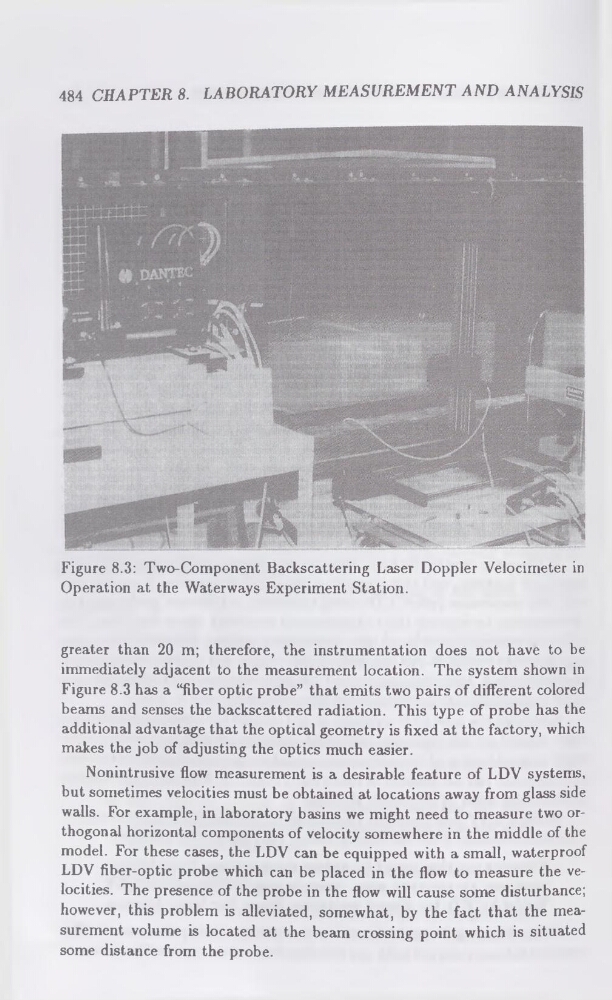
Figure 8.3: Two-Component Backscattering Laser Doppler Velocimeter in
Operation at the Waterways Experiment Station.
greater than 20 m; therefore, the instrumentation does not have to be
immediately adjacent to the measurement location. The system shown in
Figure 8.3 has a “fiber optic probe” that emits two pairs of different colored
beams and senses the backscattered radiation. This type of probe has the
additional advantage that the optical geometry is fixed at the factory, which
makes the job of adjusting the optics much easier.
Nonintrusive flow measurement is a desirable feature of LDV systems,
but sometimes velocities must be obtained at locations away from glass side
walls. For example, in laboratory basins we might need to measure two orthogonal horizontal components of velocity somewhere in the middle of the
model. For these cases, the LDV can be equipped with a small, waterproof
LDV fiber-optic probe which can be placed in the flow to measure the velocities. The presence of the probe in the flow will cause some disturbance;
however, this problem is alleviated, somewhat, by the fact that the measurement volume is located at the beam crossing point which is situated
some distance from the probe.
Figure 8.3: Two-Component Backscattering Laser Doppler Velocimeter in
Operation at the Waterways Experiment Station.
greater than 20 m; therefore, the instrumentation does not have to be
immediately adjacent to the measurement location. The system shown in
Figure 8.3 has a “fiber optic probe” that emits two pairs of different colored
beams and senses the backscattered radiation. This type of probe has the
additional advantage that the optical geometry is fixed at the factory, which
makes the job of adjusting the optics much easier.
Nonintrusive flow measurement is a desirable feature of LDV systems,
but sometimes velocities must be obtained at locations away from glass side
walls. For example, in laboratory basins we might need to measure two orthogonal horizontal components of velocity somewhere in the middle of the
model. For these cases, the LDV can be equipped with a small, waterproof
LDV fiber-optic probe which can be placed in the flow to measure the velocities. The presence of the probe in the flow will cause some disturbance;
however, this problem is alleviated, somewhat, by the fact that the measurement volume is located at the beam crossing point which is situated
some distance from the probe.