

480 CHAPTER 8. LABORATORY MEASUREMENT AND ANALYSIS
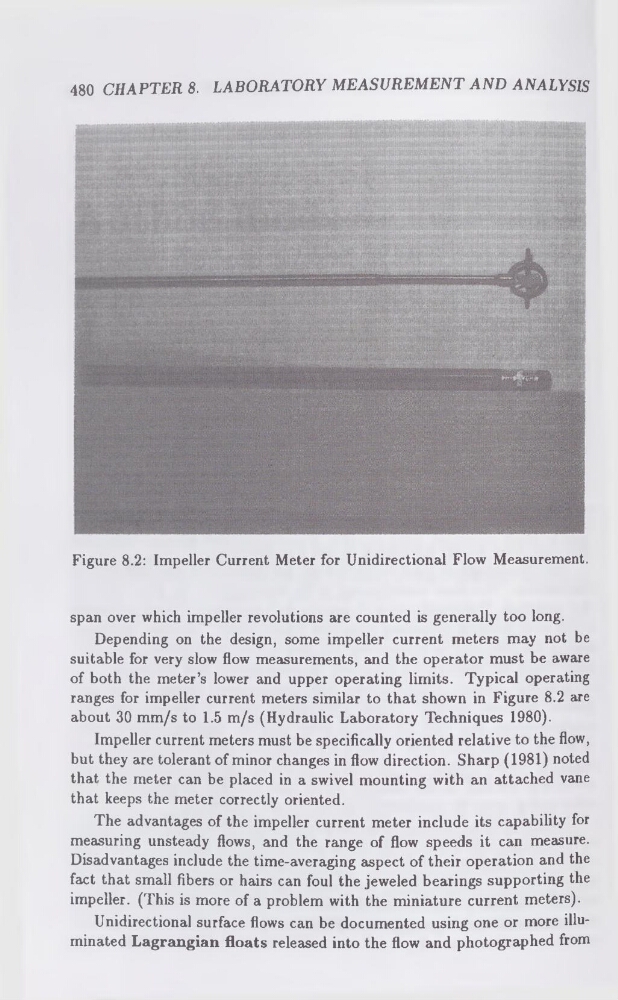
Figure 8.2: Impeller Current Meter for Unidirectional Flow Measurement.
span over which impeller revolutions are counted is generally too long.
Depending on the design, some impeller current meters may not be
suitable for very slow flow measurements, and the operator must be aware
of both the meter’s lower and upper operating limits. Typical operating
ranges for impeller current meters similar to that shown in Figure 8.2 are
about 30 mm/s to 1.5 m/s (Hydraulic Laboratory Techniques 1980).
Impeller current meters must be specifically oriented relative to the flow,
but they are tolerant of minor changes in flow direction. Sharp (1981) noted
that the meter can be placed in a swivel mounting with an attached vane
that keeps the meter correctly oriented.
The advantages of the impeller current meter include its capability for
measuring unsteady flows, and the range of flow speeds it can measure.
Disadvantages include the time-averaging aspect of their operation and the
fact that small fibers or hairs can foul the jeweled bearings supporting the
impeller. (This is more of a problem with the miniature current meters).
Unidirectional surface flows can be documented using one or more illuminated Lagrangian floats released into the flow and photographed from
Figure 8.2: Impeller Current Meter for Unidirectional Flow Measurement.
span over which impeller revolutions are counted is generally too long.
Depending on the design, some impeller current meters may not be
suitable for very slow flow measurements, and the operator must be aware
of both the meter’s lower and upper operating limits. Typical operating
ranges for impeller current meters similar to that shown in Figure 8.2 are
about 30 mm/s to 1.5 m/s (Hydraulic Laboratory Techniques 1980).
Impeller current meters must be specifically oriented relative to the flow,
but they are tolerant of minor changes in flow direction. Sharp (1981) noted
that the meter can be placed in a swivel mounting with an attached vane
that keeps the meter correctly oriented.
The advantages of the impeller current meter include its capability for
measuring unsteady flows, and the range of flow speeds it can measure.
Disadvantages include the time-averaging aspect of their operation and the
fact that small fibers or hairs can foul the jeweled bearings supporting the
impeller. (This is more of a problem with the miniature current meters).
Unidirectional surface flows can be documented using one or more illuminated Lagrangian floats released into the flow and photographed from