

442
CHAPTER 7. LABORATORY WAVE GENERATION
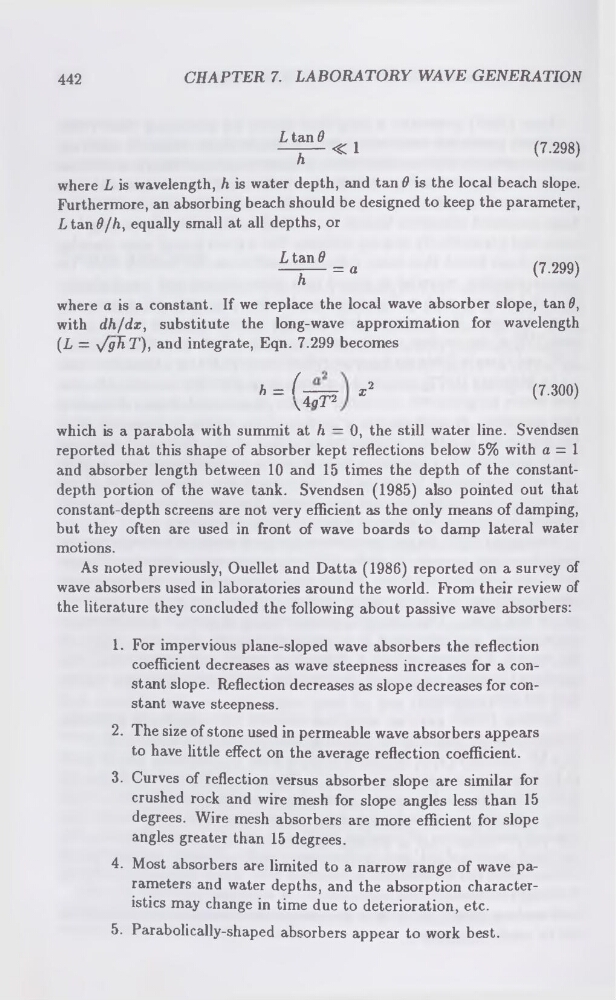
L tan 0 < 1
h
(7.298)
where L is wavelength, h is water depth, and tan 0 is the local beach slope.
Furthermore, an absorbing beach should be designed to keep the parameter,
Ltan#/h, equally small at all depths, or
Ztan#
h
(7.299)
= a
where a is a constant. If we replace the local wave absorber slope, tan0,
with dh/dx, substitute the long-wave approximation for wavelength
(Z, = y/gJiT), and integrate, Eqn. 7.299 becomes
h = (
\4 1. For impervious plane-sloped wave absorbers the reflection
coefficient decreases as wave steepness increases for a constant slope. Reflection decreases as slope decreases for constant wave steepness.
2. The size of stone used in permeable wave absorbers appears
to have little effect on the average reflection coefficient.
3. Curves of reflection versus absorber slope are similar for
crushed rock and wire mesh for slope angles less than 15
degrees. Wire mesh absorbers are more efficient for slope
angles greater than 15 degrees.
4. Most absorbers are limited to a narrow range of wave parameters and water depths, and the absorption characteristics may change in time due to deterioration, etc.
5. Parabolically-shaped absorbers appear to work best.
x2
(7.300)
which is a parabola with summit at h — 0, the still water line. Svendsen
reported that this shape of absorber kept reflections below 5% with a = 1
and absorber length between 10 and 15 times the depth of the constantdepth portion of the wave tank. Svendsen (1985) also pointed out that
constant-depth screens are not very efficient as the only means of damping,
but they often are used in front of wave boards to damp lateral water
motions.
As noted previously, Ouellet and Datta (1986) reported on a survey of
wave absorbers used in laboratories around the world. From their review of
the literature they concluded the following about passive wave absorbers:
CHAPTER 7. LABORATORY WAVE GENERATION
L tan 0 < 1
h
(7.298)
where L is wavelength, h is water depth, and tan 0 is the local beach slope.
Furthermore, an absorbing beach should be designed to keep the parameter,
Ltan#/h, equally small at all depths, or
Ztan#
h
(7.299)
= a
where a is a constant. If we replace the local wave absorber slope, tan0,
with dh/dx, substitute the long-wave approximation for wavelength
(Z, = y/gJiT), and integrate, Eqn. 7.299 becomes
h = (
\4 1. For impervious plane-sloped wave absorbers the reflection
coefficient decreases as wave steepness increases for a constant slope. Reflection decreases as slope decreases for constant wave steepness.
2. The size of stone used in permeable wave absorbers appears
to have little effect on the average reflection coefficient.
3. Curves of reflection versus absorber slope are similar for
crushed rock and wire mesh for slope angles less than 15
degrees. Wire mesh absorbers are more efficient for slope
angles greater than 15 degrees.
4. Most absorbers are limited to a narrow range of wave parameters and water depths, and the absorption characteristics may change in time due to deterioration, etc.
5. Parabolically-shaped absorbers appear to work best.
x2
(7.300)
which is a parabola with summit at h — 0, the still water line. Svendsen
reported that this shape of absorber kept reflections below 5% with a = 1
and absorber length between 10 and 15 times the depth of the constantdepth portion of the wave tank. Svendsen (1985) also pointed out that
constant-depth screens are not very efficient as the only means of damping,
but they often are used in front of wave boards to damp lateral water
motions.
As noted previously, Ouellet and Datta (1986) reported on a survey of
wave absorbers used in laboratories around the world. From their review of
the literature they concluded the following about passive wave absorbers: