

438
CHAPTER 7. LABORATORY WAVE GENERATION
First-order theory for the spiral wavemaker was given by Dalrymple and
Dean (1972) for the case of a flat bottom. Formulation of the theory paralleled the case for the two-dimensional wavemaker theory with the Laplace
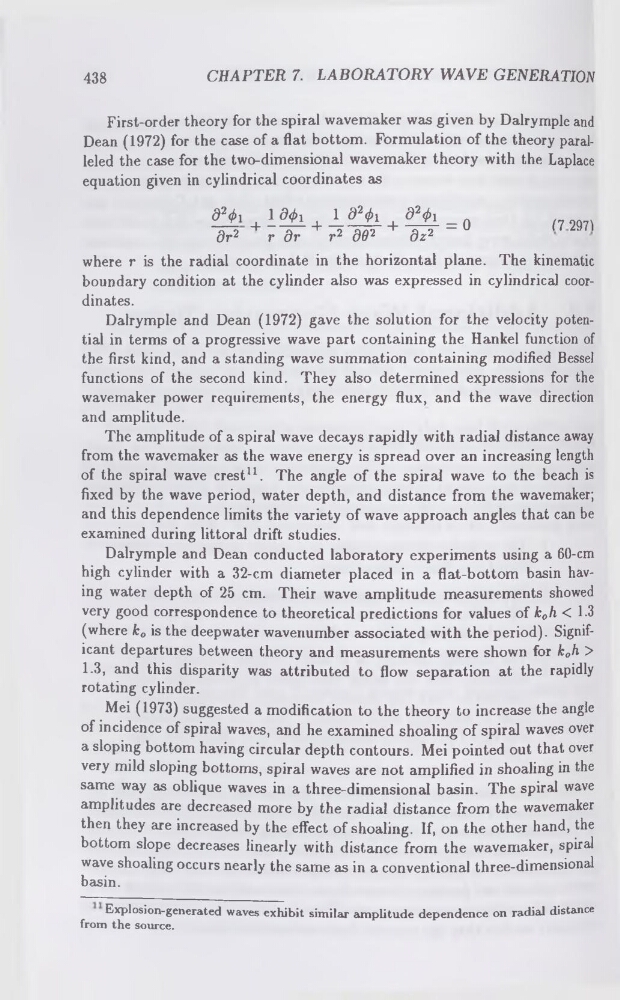
equation given in cylindrical coordinates as
fl>+l^i + lÊ^L + ^Él = 0
(7 297)
dr2
r dr
r2 dO2
dz2
where r is the radial coordinate in the horizontal plane. The kinematic
boundary condition at the cylinder also was expressed in cylindrical coordinates.
Dalrymple and Dean (1972) gave the solution for the velocity potential in terms of a progressive wave part containing the Hankel function of
the first kind, and a standing wave summation containing modified Bessel
functions of the second kind. They also determined expressions for the
wavemaker power requirements, the energy flux, and the wave direction
and amplitude.
The amplitude of a spiral wave decays rapidly with radial distance away
from the wavemaker as the wave energy is spread over an increasing length
of the spiral wave crest11. The angle of the spiral wave to the beach is
fixed by the wave period, water depth, and distance from the wavemaker;
and this dependence limits the variety of wave approach angles that can be
examined during littoral drift studies.
Dalrymple and Dean conducted laboratory experiments using a 60-cm
high cylinder with a 32-cm diameter placed in a flat-bottom basin having water depth of 25 cm. Their wave amplitude measurements showed
very good correspondence to theoretical predictions for values of koh <1.3
(where ko is the deepwater wavenumber associated with the period). Significant departures between theory and measurements were shown for koh >
1.3, and this disparity was attributed to flow separation at the rapidly
rotating cylinder.
Mei (1973) suggested a modification to the theory to increase the angle
of incidence of spiral waves, and he examined shoaling of spiral waves over
a sloping bottom having circular depth contours. Mei pointed out that over
very mild sloping bottoms, spiral waves are not amplified in shoaling in the
same way as oblique waves in a three-dimensional basin. The spiral wave
amplitudes are decreased more by the radial distance from the wavemaker
then they are increased by the effect of shoaling. If, on the other hand, the
bottom slope decreases linearly with distance from the wavemaker, spiral
wave shoaling occurs nearly the same as in a conventional three-dimensional
basin.
Explosion-generated waves exhibit similar amplitude dependence on radial distance
from the source.
CHAPTER 7. LABORATORY WAVE GENERATION
First-order theory for the spiral wavemaker was given by Dalrymple and
Dean (1972) for the case of a flat bottom. Formulation of the theory paralleled the case for the two-dimensional wavemaker theory with the Laplace
equation given in cylindrical coordinates as
fl>+l^i + lÊ^L + ^Él = 0
(7 297)
dr2
r dr
r2 dO2
dz2
where r is the radial coordinate in the horizontal plane. The kinematic
boundary condition at the cylinder also was expressed in cylindrical coordinates.
Dalrymple and Dean (1972) gave the solution for the velocity potential in terms of a progressive wave part containing the Hankel function of
the first kind, and a standing wave summation containing modified Bessel
functions of the second kind. They also determined expressions for the
wavemaker power requirements, the energy flux, and the wave direction
and amplitude.
The amplitude of a spiral wave decays rapidly with radial distance away
from the wavemaker as the wave energy is spread over an increasing length
of the spiral wave crest11. The angle of the spiral wave to the beach is
fixed by the wave period, water depth, and distance from the wavemaker;
and this dependence limits the variety of wave approach angles that can be
examined during littoral drift studies.
Dalrymple and Dean conducted laboratory experiments using a 60-cm
high cylinder with a 32-cm diameter placed in a flat-bottom basin having water depth of 25 cm. Their wave amplitude measurements showed
very good correspondence to theoretical predictions for values of koh <1.3
(where ko is the deepwater wavenumber associated with the period). Significant departures between theory and measurements were shown for koh >
1.3, and this disparity was attributed to flow separation at the rapidly
rotating cylinder.
Mei (1973) suggested a modification to the theory to increase the angle
of incidence of spiral waves, and he examined shoaling of spiral waves over
a sloping bottom having circular depth contours. Mei pointed out that over
very mild sloping bottoms, spiral waves are not amplified in shoaling in the
same way as oblique waves in a three-dimensional basin. The spiral wave
amplitudes are decreased more by the radial distance from the wavemaker
then they are increased by the effect of shoaling. If, on the other hand, the
bottom slope decreases linearly with distance from the wavemaker, spiral
wave shoaling occurs nearly the same as in a conventional three-dimensional
basin.
Explosion-generated waves exhibit similar amplitude dependence on radial distance
from the source.