

2.2. PRINCIPLES OF DIMENSIONAL ANALYSIS
27
Lo
2tT 1
2.2.1 Dimensional Homogeneity
Langhaar (1951) said, “An equation is dimensionally homogeneous if the
form of the equation does not depend on the units of the variables within
the equation.” This means that a dimensionally homogeneous equation is
correct regardless of what system of units are used when substituting for
the variables in the equation (provided the system of units is dimensionally
consistent). Dimensionally homogeneous equations are easier to work with
and less prone to errors because it is a simple task to check for dimensional
consistency when substituting real values for the variables.
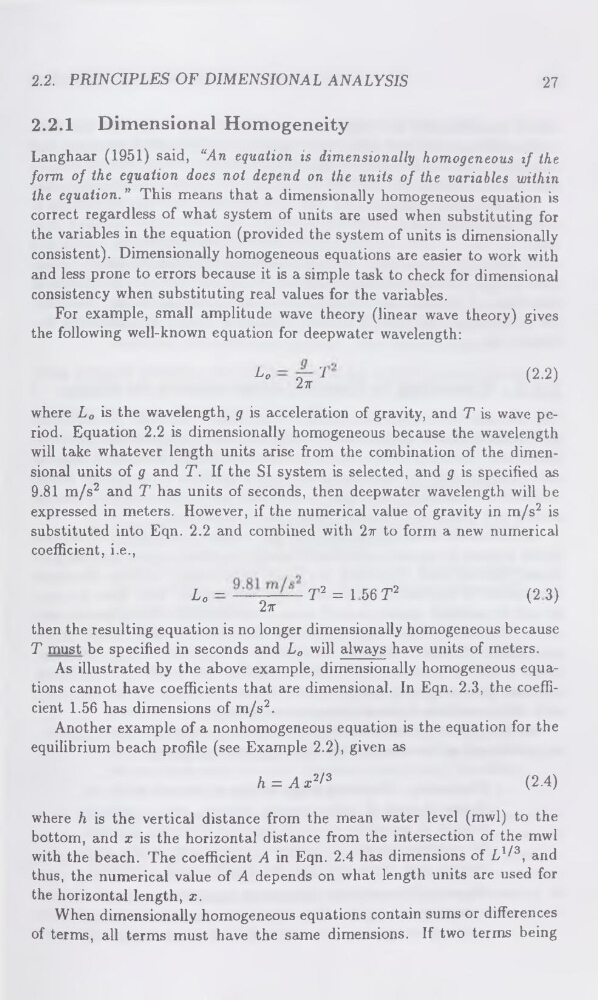
For example, small amplitude wave theory (linear wave theory) gives
the following well-known equation for deepwater wavelength:
(2-2)
where Lo is the wavelength, g is acceleration of gravity, and T is wave period. Equation 2.2 is dimensionally homogeneous because the wavelength
will take whatever length units arise from the combination of the dimensional units of g and T. If the SI system is selected, and g is specified as
9.81 m/s2 and T has units of seconds, then deepwater wavelength will be
expressed in meters. However, if the numerical value of gravity in m/s2 is
substituted into Eqn. 2.2 and combined with 2tt to form a new numerical
coefficient, i.e.,
Lo _
T2 = 1 56 T2
(2 3)
2%
then the resulting equation is no longer dimensionally homogeneous because
T must be specified in seconds and Lo will always have units of meters.
As illustrated by the above example, dimensionally homogeneous equations cannot have coefficients that are dimensional. In Eqn. 2.3, the coefficient 1.56 has dimensions of m/s2.
Another example of a nonhomogeneous equation is the equation for the
equilibrium beach profile (see Example 2.2), given as
h = Ax2'3
(2.4)
where h is the vertical distance from the mean water level (mwl) to the
bottom, and x is the horizontal distance from the intersection of the mwl
with the beach. The coefficient A in Eqn. 2.4 has dimensions of L1/3, and
thus, the numerical value of A depends on what length units are used for
the horizontal length, x.
When dimensionally homogeneous equations contain sums or differences
of terms, all terms must have the same dimensions. If two terms being
27
Lo
2tT 1
2.2.1 Dimensional Homogeneity
Langhaar (1951) said, “An equation is dimensionally homogeneous if the
form of the equation does not depend on the units of the variables within
the equation.” This means that a dimensionally homogeneous equation is
correct regardless of what system of units are used when substituting for
the variables in the equation (provided the system of units is dimensionally
consistent). Dimensionally homogeneous equations are easier to work with
and less prone to errors because it is a simple task to check for dimensional
consistency when substituting real values for the variables.
For example, small amplitude wave theory (linear wave theory) gives
the following well-known equation for deepwater wavelength:
(2-2)
where Lo is the wavelength, g is acceleration of gravity, and T is wave period. Equation 2.2 is dimensionally homogeneous because the wavelength
will take whatever length units arise from the combination of the dimensional units of g and T. If the SI system is selected, and g is specified as
9.81 m/s2 and T has units of seconds, then deepwater wavelength will be
expressed in meters. However, if the numerical value of gravity in m/s2 is
substituted into Eqn. 2.2 and combined with 2tt to form a new numerical
coefficient, i.e.,
Lo _
T2 = 1 56 T2
(2 3)
2%
then the resulting equation is no longer dimensionally homogeneous because
T must be specified in seconds and Lo will always have units of meters.
As illustrated by the above example, dimensionally homogeneous equations cannot have coefficients that are dimensional. In Eqn. 2.3, the coefficient 1.56 has dimensions of m/s2.
Another example of a nonhomogeneous equation is the equation for the
equilibrium beach profile (see Example 2.2), given as
h = Ax2'3
(2.4)
where h is the vertical distance from the mean water level (mwl) to the
bottom, and x is the horizontal distance from the intersection of the mwl
with the beach. The coefficient A in Eqn. 2.4 has dimensions of L1/3, and
thus, the numerical value of A depends on what length units are used for
the horizontal length, x.
When dimensionally homogeneous equations contain sums or differences
of terms, all terms must have the same dimensions. If two terms being