

402
CHAPTER 7. LABORATORY WAVE GENERATION
because waves more likely to cause damage have been included in the time
series. This can significantly reduce costs, thus allowing a wider variety
of conditions to be tested. In actual design applications, the special wave
events must be related to the probability of their occurring in nature (Funke
and Mansard 1987).
The principle argument against deterministic irregular wave synthesis
is that (in most cases) there is no guarantee that the special condition
generated is the condition that is likely to cause damage. In the words of
Huntington (1987), “...our definition of the “worst-case” wave may not
produce the “worst-case” response.” Huntington suggested that the deterministic methods could be used in isolation for comparative testing, but he
argued that longer test runs are needed for design where absolute responses
must be determined.
A thorough discussion of nonspectral characteristics that might be controlled in deterministic wave synthesis was given by Funke and Mansard
(1987), and they provided references related to control of wave grouping,
wave asymmetries, maximum wave heights, nonlinear characteristics, and
subharmonics and superharmonics. They also gave interesting examples of
typical model studies and the variability of results stemming from the use
of irregular waves.
SIWEH Deterministic Wave Group Synthesis Method. Funke and
Mansard (1979, 1980) cited several irregular wave studies that had emphasized the importance of such irregular wave characteristics as wave steepness, wave sequencing, and wave grouping. Over the course of a lengthy
time series realization, desired values of these various parameters eventually will occur naturally in nondeterministic and partially deterministic
time series realizations. However, lengthy runs can become expensive.
Funke and Mansard developed a deterministic method for synthesizing irregular waves that exhibited specified wave grouping characteristics.
They named the method SIWEH, which is an acronym for Smoothed
Instantaneous Wave Energy History (Funke and Mansard 1979). The SIWEH is a function that describes the distribution of energy in an irregular
wave time series as a function of time. It was proposed as an alternative
to envelope functions for describing wave group activity within an irregular
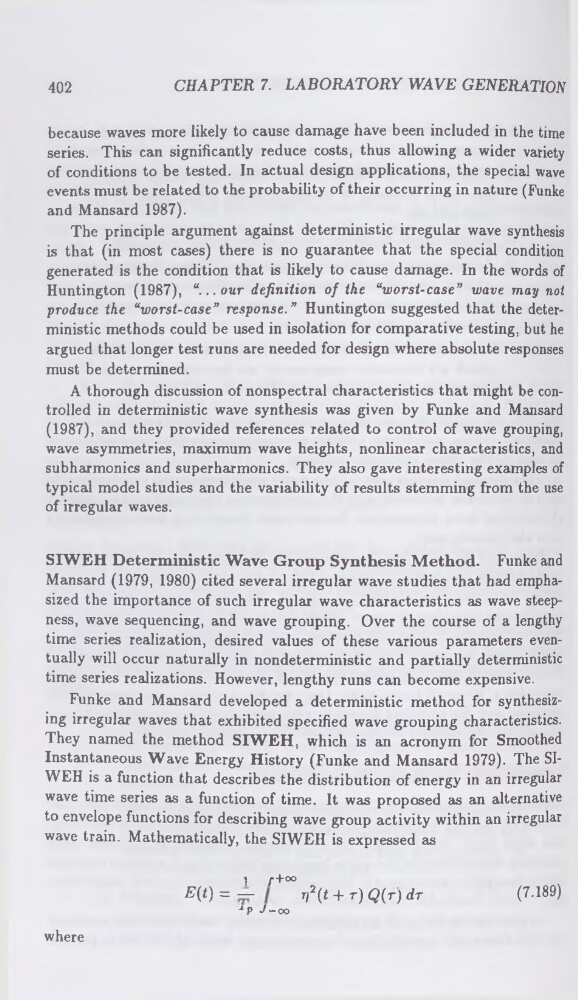
wave train. Mathematically, the SIWEH is expressed as
1
/‘+°°
E(t) = —
rj2(t + t) Q(t) dr
(7.189)
-‘P J — oo
where
CHAPTER 7. LABORATORY WAVE GENERATION
because waves more likely to cause damage have been included in the time
series. This can significantly reduce costs, thus allowing a wider variety
of conditions to be tested. In actual design applications, the special wave
events must be related to the probability of their occurring in nature (Funke
and Mansard 1987).
The principle argument against deterministic irregular wave synthesis
is that (in most cases) there is no guarantee that the special condition
generated is the condition that is likely to cause damage. In the words of
Huntington (1987), “...our definition of the “worst-case” wave may not
produce the “worst-case” response.” Huntington suggested that the deterministic methods could be used in isolation for comparative testing, but he
argued that longer test runs are needed for design where absolute responses
must be determined.
A thorough discussion of nonspectral characteristics that might be controlled in deterministic wave synthesis was given by Funke and Mansard
(1987), and they provided references related to control of wave grouping,
wave asymmetries, maximum wave heights, nonlinear characteristics, and
subharmonics and superharmonics. They also gave interesting examples of
typical model studies and the variability of results stemming from the use
of irregular waves.
SIWEH Deterministic Wave Group Synthesis Method. Funke and
Mansard (1979, 1980) cited several irregular wave studies that had emphasized the importance of such irregular wave characteristics as wave steepness, wave sequencing, and wave grouping. Over the course of a lengthy
time series realization, desired values of these various parameters eventually will occur naturally in nondeterministic and partially deterministic
time series realizations. However, lengthy runs can become expensive.
Funke and Mansard developed a deterministic method for synthesizing irregular waves that exhibited specified wave grouping characteristics.
They named the method SIWEH, which is an acronym for Smoothed
Instantaneous Wave Energy History (Funke and Mansard 1979). The SIWEH is a function that describes the distribution of energy in an irregular
wave time series as a function of time. It was proposed as an alternative
to envelope functions for describing wave group activity within an irregular
wave train. Mathematically, the SIWEH is expressed as
1
/‘+°°
E(t) = —
rj2(t + t) Q(t) dr
(7.189)
-‘P J — oo
where