

7.6. IRREGULAR (2-D) WAVE GENERATION
397
variance.
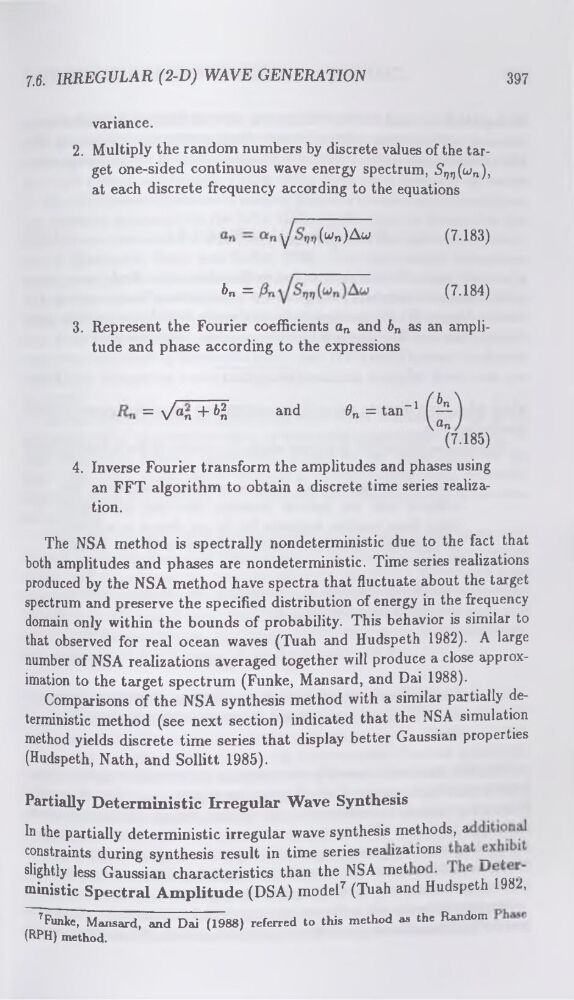
2. Multiply the random numbers by discrete values of the target one-sided continuous wave energy spectrum, S„(un),
at each discrete frequency according to the equations
y
(wn)AcJ
(7.183)
bn =
(7.184)
3. Represent the Fourier coefficients an and bn as an amplitude and phase according to the expressions
= Van+bl and
(7.185)
4. Inverse Fourier transform the amplitudes and phases using
an FFT algorithm to obtain a discrete time series realization.
The NSA method is spectrally nondeterministic due to the fact that
both amplitudes and phases are nondeterministic. Time series realizations
produced by the NSA method have spectra that fluctuate about the target
spectrum and preserve the specified distribution of energy in the frequency
domain only within the bounds of probability. This behavior is similar to
that observed for real ocean waves (Tuah and Hudspeth 1982). A large
number of NSA realizations averaged together will produce a close approximation to the target spectrum (Funke, Mansard, and Dai 1988).
Comparisons of the NSA synthesis method with a similar partially deterministic method (see next section) indicated that the NSA simulation
method yields discrete time series that display better Gaussian properties
(Hudspeth, Nath, and Sollitt 1985).
Partially Deterministic Irregular Wave Synthesis
In the partially deterministic irregular wave synthesis methods, a
constraints during synthesis result in time series rea izations
_ ,
slightly less Gaussian characteristics than the NSA met o .
ministic Spectral Amplitude (DSA) model’ (Tuah and Hudspeth 1982,
’Funke, Mansard, and Dai (1988) referred to this method as the Random
(RPH) method.
397
variance.
2. Multiply the random numbers by discrete values of the target one-sided continuous wave energy spectrum, S„(un),
at each discrete frequency according to the equations
y
(wn)AcJ
(7.183)
bn =
(7.184)
3. Represent the Fourier coefficients an and bn as an amplitude and phase according to the expressions
= Van+bl and
(7.185)
4. Inverse Fourier transform the amplitudes and phases using
an FFT algorithm to obtain a discrete time series realization.
The NSA method is spectrally nondeterministic due to the fact that
both amplitudes and phases are nondeterministic. Time series realizations
produced by the NSA method have spectra that fluctuate about the target
spectrum and preserve the specified distribution of energy in the frequency
domain only within the bounds of probability. This behavior is similar to
that observed for real ocean waves (Tuah and Hudspeth 1982). A large
number of NSA realizations averaged together will produce a close approximation to the target spectrum (Funke, Mansard, and Dai 1988).
Comparisons of the NSA synthesis method with a similar partially deterministic method (see next section) indicated that the NSA simulation
method yields discrete time series that display better Gaussian properties
(Hudspeth, Nath, and Sollitt 1985).
Partially Deterministic Irregular Wave Synthesis
In the partially deterministic irregular wave synthesis methods, a
constraints during synthesis result in time series rea izations
_ ,
slightly less Gaussian characteristics than the NSA met o .
ministic Spectral Amplitude (DSA) model’ (Tuah and Hudspeth 1982,
’Funke, Mansard, and Dai (1988) referred to this method as the Random
(RPH) method.