

7.5. TRANSIENT WAVE GENERATION
387
2
f [ rr ,
xcoshfc(/i + z)
’(a: ’‘) = ?/0 Jo J_h
coshM
™l‘X'OS<,(t-T')dzdrdk
(7.176)
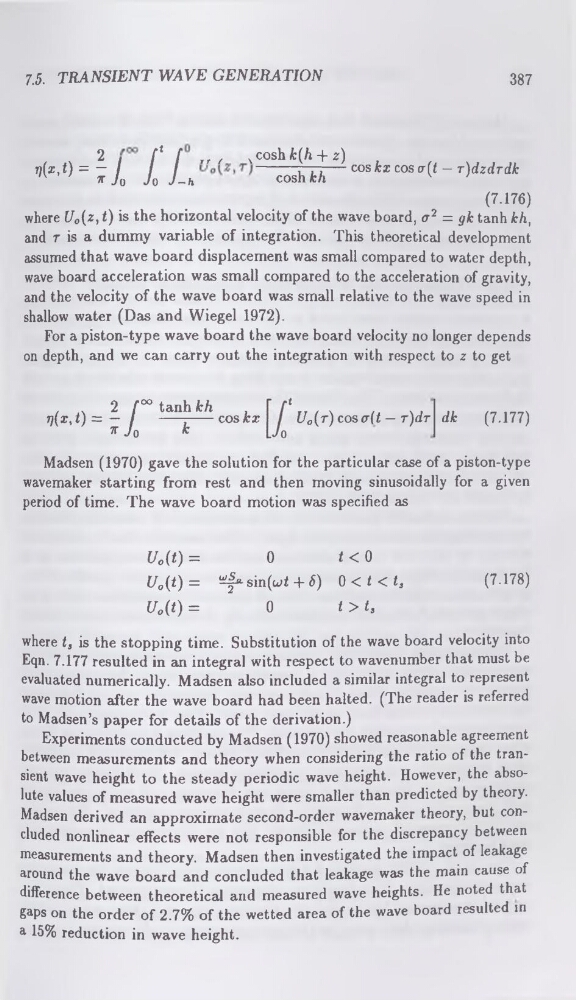
where U0(z, /) is the horizontal velocity of the wave board, cr2 = gk tanh kh,
and r is a dummy variable of integration. This theoretical development
assumed that wave board displacement was small compared to water depth,
wave board acceleration was small compared to the acceleration of gravity,
and the velocity of the wave board was small relative to the wave speed in
shallow water (Das and Wiegel 1972).
For a piston-type wave board the wave board velocity no longer depends
on depth, and we can carry out the integration with respect to z to get
T](x,t) =
2 f°° tanh kh
.
— /
r-----cos kx
* Jo
k
Uo(t) cos a(t — ijdr dk
(7.177)
Madsen (1970) gave the solution for the particular case of a piston-type
wavemaker starting from rest and then moving sinusoidally for a given
period of time. The wave board motion was specified as
t < 0
U0(t) =
U0{t) =
uo(t) =
0
^sin(wi + 6) 0
0
t > t,
where ts is the stopping time. Substitution of the wave board velocity into
Eqn. 7.177 resulted in an integral with respect to wavenumber that must be
evaluated numerically. Madsen also included a similar integral to represent
wave motion after the wave board had been halted. (The reader is referred
to Madsen’s paper for details of the derivation.)
Experiments conducted by Madsen (1970) showed reasonable agreement
between measurements and theory when considering the ratio of the transient wave height to the steady periodic wave height. However, the absolute values of measured wave height were smaller than predicted by theory.
Madsen derived an approximate second-order wavemaker theory, but concluded nonlinear effects were not responsible for the discrepancy between
measurements and theory. Madsen then investigated the impact of leakage
around the wave board and concluded that leakage was the main cause of
difference between theoretical and measured wave heights. He noted that
gaps on the order of 2.7% of the wetted area of the wave board resulted in
a 15% reduction in wave height.
387
2
f [ rr ,
xcoshfc(/i + z)
’(a: ’‘) = ?/0 Jo J_h
coshM
™l‘X'OS<,(t-T')dzdrdk
(7.176)
where U0(z, /) is the horizontal velocity of the wave board, cr2 = gk tanh kh,
and r is a dummy variable of integration. This theoretical development
assumed that wave board displacement was small compared to water depth,
wave board acceleration was small compared to the acceleration of gravity,
and the velocity of the wave board was small relative to the wave speed in
shallow water (Das and Wiegel 1972).
For a piston-type wave board the wave board velocity no longer depends
on depth, and we can carry out the integration with respect to z to get
T](x,t) =
2 f°° tanh kh
.
— /
r-----cos kx
* Jo
k
Uo(t) cos a(t — ijdr dk
(7.177)
Madsen (1970) gave the solution for the particular case of a piston-type
wavemaker starting from rest and then moving sinusoidally for a given
period of time. The wave board motion was specified as
t < 0
U0(t) =
U0{t) =
uo(t) =
0
^sin(wi + 6) 0
0
t > t,
where ts is the stopping time. Substitution of the wave board velocity into
Eqn. 7.177 resulted in an integral with respect to wavenumber that must be
evaluated numerically. Madsen also included a similar integral to represent
wave motion after the wave board had been halted. (The reader is referred
to Madsen’s paper for details of the derivation.)
Experiments conducted by Madsen (1970) showed reasonable agreement
between measurements and theory when considering the ratio of the transient wave height to the steady periodic wave height. However, the absolute values of measured wave height were smaller than predicted by theory.
Madsen derived an approximate second-order wavemaker theory, but concluded nonlinear effects were not responsible for the discrepancy between
measurements and theory. Madsen then investigated the impact of leakage
around the wave board and concluded that leakage was the main cause of
difference between theoretical and measured wave heights. He noted that
gaps on the order of 2.7% of the wetted area of the wave board resulted in
a 15% reduction in wave height.