

384
CHAPTER 7. LABORATORY WAVE GENERATION
Because the wave board trajectory is essentially a hyperbolic tangent
function with displacement only in the positive x-direction, the wave board
is usually moved to an initial resting position given by Xo(0) = — \/477/i/3,
and then activated in a forward motion until it comes to rest at X0(tj) =
+ y/4Hh/3.
Goring (1979) and Goring and Raichlen (1980) compared laboratory
generated solitary waves to the classical wave theories. They reported good
agreement over the entire wave form for smaller amplitude solitary waves
(H/h ~ 0.15), and fairly good agreement for the larger waves (H/h ~ 0.6).
They also found that optimum stroke duration was slightly longer than
predicted by Eqn. 7.168, and they attributed this difference to the fact
that the actual velocity distribution beneath solitary waves is not exactly
uniform, thus the boundary condition at the moving wave board is not
satisfied.
Goring and Raichlen (1980) also compared measured values of H/S,
to the theoretical expression given by Eqn. 7.165. Good agreement was
reported for low values of H/h, but as H/h increased, the measured values
of H/Ss fell below the theoretical predictions. Frictional effects in the
wave flume were thought to be part of the cause for the observed deviation
from theory. A detailed discussion of the experimental results was given by
Goring (1979).
Cnoidal Waves
A theory for generation of cnoidal waves using a piston-type wavemaker
was also developed by Goring (1979) and reported in Goring and Raichlen
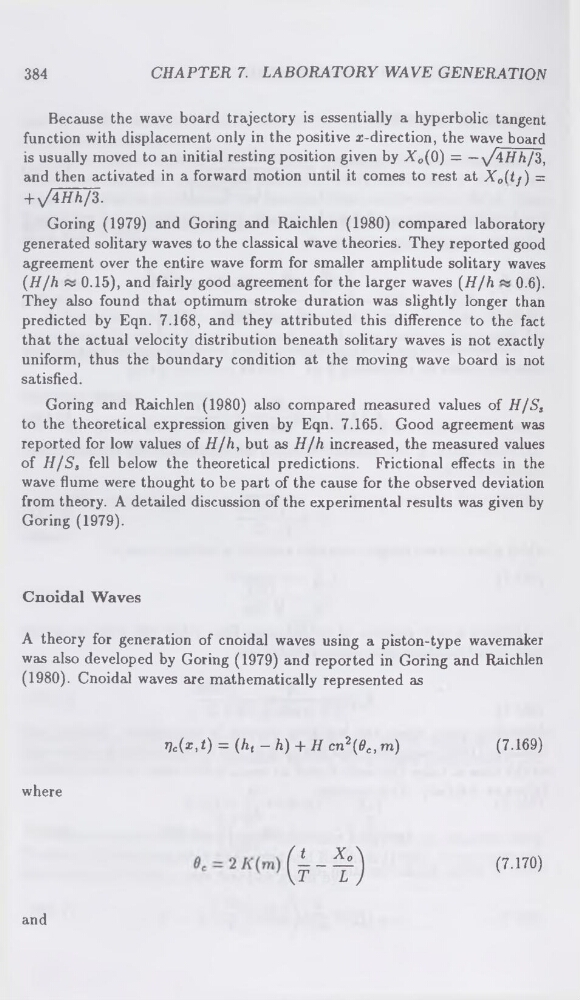
(1980). Cnoidal waves are mathematically represented as
7jc(z, f) = (ht — h) + H cn2(J)c,m)
(7.169)
where
(7.170)
and
CHAPTER 7. LABORATORY WAVE GENERATION
Because the wave board trajectory is essentially a hyperbolic tangent
function with displacement only in the positive x-direction, the wave board
is usually moved to an initial resting position given by Xo(0) = — \/477/i/3,
and then activated in a forward motion until it comes to rest at X0(tj) =
+ y/4Hh/3.
Goring (1979) and Goring and Raichlen (1980) compared laboratory
generated solitary waves to the classical wave theories. They reported good
agreement over the entire wave form for smaller amplitude solitary waves
(H/h ~ 0.15), and fairly good agreement for the larger waves (H/h ~ 0.6).
They also found that optimum stroke duration was slightly longer than
predicted by Eqn. 7.168, and they attributed this difference to the fact
that the actual velocity distribution beneath solitary waves is not exactly
uniform, thus the boundary condition at the moving wave board is not
satisfied.
Goring and Raichlen (1980) also compared measured values of H/S,
to the theoretical expression given by Eqn. 7.165. Good agreement was
reported for low values of H/h, but as H/h increased, the measured values
of H/Ss fell below the theoretical predictions. Frictional effects in the
wave flume were thought to be part of the cause for the observed deviation
from theory. A detailed discussion of the experimental results was given by
Goring (1979).
Cnoidal Waves
A theory for generation of cnoidal waves using a piston-type wavemaker
was also developed by Goring (1979) and reported in Goring and Raichlen
(1980). Cnoidal waves are mathematically represented as
7jc(z, f) = (ht — h) + H cn2(J)c,m)
(7.169)
where
(7.170)
and