

378
CHAPTER 7. LABORATORY WAVE GENERATION
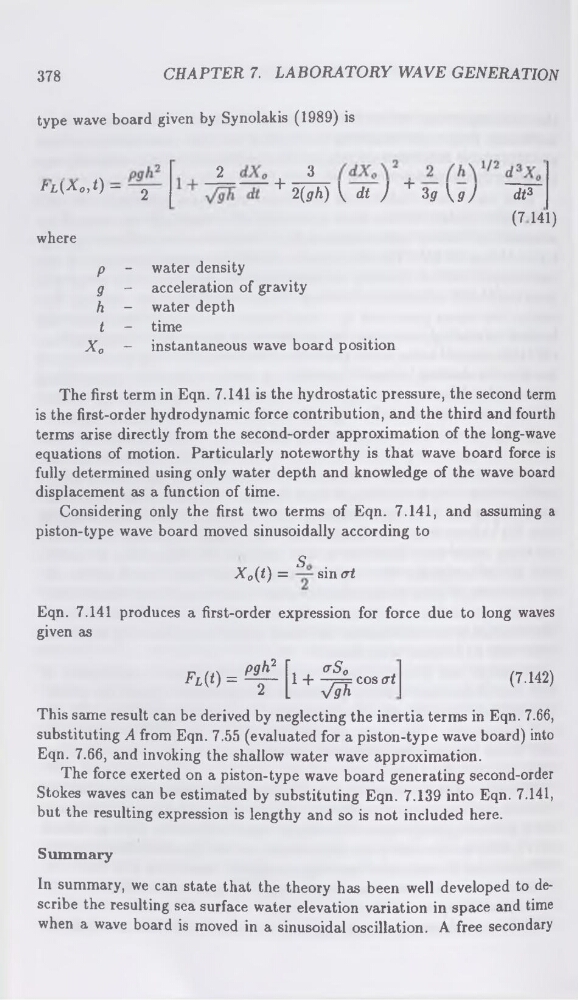
type wave board given by Synolakis (1989) is
a
2
1
3
LL{A0,t)- 2
T 2^)^ dt J ^3g\gJ
W
(7141)
where
p - water density
g - acceleration of gravity
h - water depth
t - time
Xo - instantaneous wave board position
The first term in Eqn. 7.141 is the hydrostatic pressure, the second term
is the first-order hydrodynamic force contribution, and the third and fourth
terms arise directly from the second-order approximation of the long-wave
equations of motion. Particularly noteworthy is that wave board force is
fully determined using only water depth and knowledge of the wave board
displacement as a function of time.
Considering only the first two terms of Eqn. 7.141, and assuming a
piston-type wave board moved sinusoidally according to
s
X0(t) =
sin at
Eqn. 7.141 produces a first-order expression for force due to long waves
given as
f /A Pgh2 Fi i aS°
4
ElV)=—^— 1 + -7== cos at
2 L
V9h
(7.142)
2
This same result can be derived by neglecting the inertia terms in Eqn. 7.66,
substituting A from Eqn. 7.55 (evaluated for a piston-type wave board) into
Eqn. 7.66, and invoking the shallow water wave approximation.
The force exerted on a piston-type wave board generating second-order
Stokes waves can be estimated by substituting Eqn. 7.139 into Eqn. 7.141,
but the resulting expression is lengthy and so is not included here.
Summary
In summary, we can state that the theory has been well developed to describe the resulting sea surface water elevation variation in space and time
when a wave board is moved in a sinusoidal oscillation. A free secondary
CHAPTER 7. LABORATORY WAVE GENERATION
type wave board given by Synolakis (1989) is
a
2
1
3
LL{A0,t)- 2
T 2^)^ dt J ^3g\gJ
W
(7141)
where
p - water density
g - acceleration of gravity
h - water depth
t - time
Xo - instantaneous wave board position
The first term in Eqn. 7.141 is the hydrostatic pressure, the second term
is the first-order hydrodynamic force contribution, and the third and fourth
terms arise directly from the second-order approximation of the long-wave
equations of motion. Particularly noteworthy is that wave board force is
fully determined using only water depth and knowledge of the wave board
displacement as a function of time.
Considering only the first two terms of Eqn. 7.141, and assuming a
piston-type wave board moved sinusoidally according to
s
X0(t) =
sin at
Eqn. 7.141 produces a first-order expression for force due to long waves
given as
f /A Pgh2 Fi i aS°
4
ElV)=—^— 1 + -7== cos at
2 L
V9h
(7.142)
2
This same result can be derived by neglecting the inertia terms in Eqn. 7.66,
substituting A from Eqn. 7.55 (evaluated for a piston-type wave board) into
Eqn. 7.66, and invoking the shallow water wave approximation.
The force exerted on a piston-type wave board generating second-order
Stokes waves can be estimated by substituting Eqn. 7.139 into Eqn. 7.141,
but the resulting expression is lengthy and so is not included here.
Summary
In summary, we can state that the theory has been well developed to describe the resulting sea surface water elevation variation in space and time
when a wave board is moved in a sinusoidal oscillation. A free secondary