

370
CHAPTER 7. LABORATORY WAVE GENERATION
f& =
(7.124;
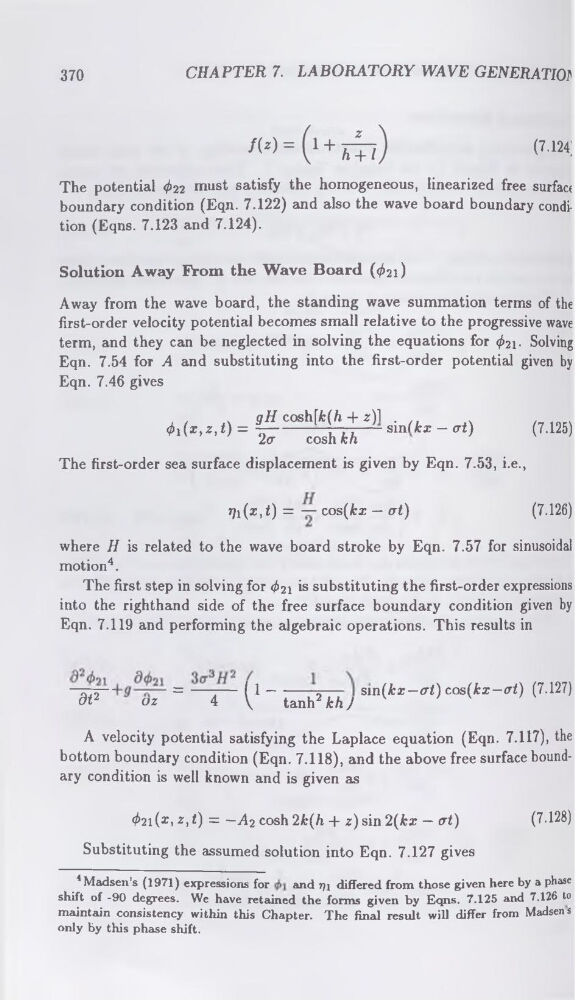
The potential ^22 must satisfy the homogeneous, linearized free surface
boundary condition (Eqn. 7.122) and also the wave board boundary condition (Eqns. 7.123 and 7.124).
Solution Away From the Wave Board (<^21 )
Away from the wave board, the standing wave summation terms of the
first-order velocity potential becomes small relative to the progressive wave
term, and they can be neglected in solving the equations for 02i- Solving
Eqn. 7.54 for A and substituting into the first-order potential given by
Eqn. 7.46 gives
, .
.
gH cosh[fc(/i 4- z)l .
<$i(x,z,t) = —---------- r-73—— sm(kx — at)
(7.125)
2a
cosh kh
The first-order sea surface displacement is given by Eqn. 7.53, i.e.,
771 (x, t) = — cos(fcx — at)
(7.126)
where H is related to the wave board stroke by Eqn. 7.57 for sinusoidal
motion4.
4 Madsen’s (1971) expressions for
and 7)1 differed from those given here by a phase
shift of -90 degrees. We have retained the forms given by Eqns. 7.125 and 7.126 to
maintain consistency within this Chapter. The final result will differ from Madsens
only by this phase shift.
The first step in solving for <^21 is substituting the first-order expressions
into the righthand side of the free surface boundary condition given by
Eqn. 7.119 and performing the algebraic operations. This results in
-075—= —7— I 1 - . ,2,, sin( * z-
01
oz
4
\
tanh kh )
A velocity potential satisfying the Laplace equation (Eqn. 7.117), the
bottom boundary condition (Eqn. 7.118), and the above free surface boundary condition is well known and is given as
2i(z, z,t) = -A2 cosh 2k(h + z) sin 2(kx — at)
(7.128)
Substituting the assumed solution into Eqn. 7.127 gives
CHAPTER 7. LABORATORY WAVE GENERATION
f& =
(7.124;
The potential ^22 must satisfy the homogeneous, linearized free surface
boundary condition (Eqn. 7.122) and also the wave board boundary condition (Eqns. 7.123 and 7.124).
Solution Away From the Wave Board (<^21 )
Away from the wave board, the standing wave summation terms of the
first-order velocity potential becomes small relative to the progressive wave
term, and they can be neglected in solving the equations for 02i- Solving
Eqn. 7.54 for A and substituting into the first-order potential given by
Eqn. 7.46 gives
, .
.
gH cosh[fc(/i 4- z)l .
<$i(x,z,t) = —---------- r-73—— sm(kx — at)
(7.125)
2a
cosh kh
The first-order sea surface displacement is given by Eqn. 7.53, i.e.,
771 (x, t) = — cos(fcx — at)
(7.126)
where H is related to the wave board stroke by Eqn. 7.57 for sinusoidal
motion4.
4 Madsen’s (1971) expressions for
and 7)1 differed from those given here by a phase
shift of -90 degrees. We have retained the forms given by Eqns. 7.125 and 7.126 to
maintain consistency within this Chapter. The final result will differ from Madsens
only by this phase shift.
The first step in solving for <^21 is substituting the first-order expressions
into the righthand side of the free surface boundary condition given by
Eqn. 7.119 and performing the algebraic operations. This results in
-075—= —7— I 1 - . ,2,, sin( * z-
01
oz
4
\
tanh kh )
A velocity potential satisfying the Laplace equation (Eqn. 7.117), the
bottom boundary condition (Eqn. 7.118), and the above free surface boundary condition is well known and is given as
2i(z, z,t) = -A2 cosh 2k(h + z) sin 2(kx — at)
(7.128)
Substituting the assumed solution into Eqn. 7.127 gives