

2.1. DIMENSIONS
21
• British Mass System (foot-pound-second), with force unit
defined as poundal (this system is also referred to as British
Type II)
Force systems of measurement and their corresponding dimensions of
length, force, and time include:
• MKS Force System (meter-kilogram-second), with mass
unit defined as kilogram second squared per meter
• American Engineering System (foot-pound-second), with
mass unit defined as slug (this system is also referred to as
British Type I)
Obviously, there has always been confusion between the various mass
and force systems because of the conflicting use of nomenclature. For example, the kilogram is considered a mass in the SI System, while the kilogram is the basic unit of force in the MKS Force System. Because mass is
considered by many as being more fundamental1 * , this text will conform to
the widely accepted SI System (mass system) of measurement with some recourse to the American Engineering System (force system) where necessary
to introduce empirical results. Langhaar (1951) discussed in more detail
the relationships between the above cited measurement systems. Details
on the SI System of Units are given in Appendix A.
1The mass system can be readily adapted for use where the gravitational acceleration
is different than the Earth’s.
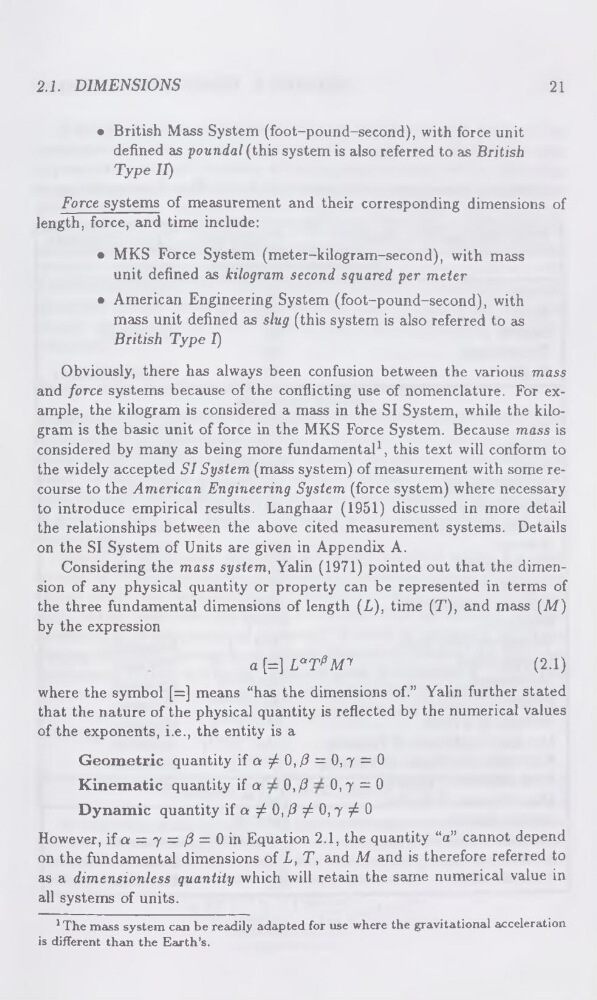
Considering the mass system, Yalin (1971) pointed out that the dimension of any physical quantity or property can be represented in terms of
the three fundamental dimensions of length (L), time (T), and mass (AI)
by the expression
a [=] LaT?M7
(2.1)
where the symbol [=] means “has the dimensions of.” Yalin further stated
that the nature of the physical quantity is reflected by the numerical values
of the exponents, i.e., the entity is a
Geometric quantity ifa^0,/? = 0, 7 = 0
Kinematic quantity if a 0,/? 0,7 = 0
Dynamic quantity ifa/0,/?/0,7/0
However, ifa = 7 = /?=0in Equation 2.1, the quantity “a” cannot depend
on the fundamental dimensions of L, T, and M and is therefore referred to
as a dimensionless quantity which will retain the same numerical value in
all systems of units.
21
• British Mass System (foot-pound-second), with force unit
defined as poundal (this system is also referred to as British
Type II)
Force systems of measurement and their corresponding dimensions of
length, force, and time include:
• MKS Force System (meter-kilogram-second), with mass
unit defined as kilogram second squared per meter
• American Engineering System (foot-pound-second), with
mass unit defined as slug (this system is also referred to as
British Type I)
Obviously, there has always been confusion between the various mass
and force systems because of the conflicting use of nomenclature. For example, the kilogram is considered a mass in the SI System, while the kilogram is the basic unit of force in the MKS Force System. Because mass is
considered by many as being more fundamental1 * , this text will conform to
the widely accepted SI System (mass system) of measurement with some recourse to the American Engineering System (force system) where necessary
to introduce empirical results. Langhaar (1951) discussed in more detail
the relationships between the above cited measurement systems. Details
on the SI System of Units are given in Appendix A.
1The mass system can be readily adapted for use where the gravitational acceleration
is different than the Earth’s.
Considering the mass system, Yalin (1971) pointed out that the dimension of any physical quantity or property can be represented in terms of
the three fundamental dimensions of length (L), time (T), and mass (AI)
by the expression
a [=] LaT?M7
(2.1)
where the symbol [=] means “has the dimensions of.” Yalin further stated
that the nature of the physical quantity is reflected by the numerical values
of the exponents, i.e., the entity is a
Geometric quantity ifa^0,/? = 0, 7 = 0
Kinematic quantity if a 0,/? 0,7 = 0
Dynamic quantity ifa/0,/?/0,7/0
However, ifa = 7 = /?=0in Equation 2.1, the quantity “a” cannot depend
on the fundamental dimensions of L, T, and M and is therefore referred to
as a dimensionless quantity which will retain the same numerical value in
all systems of units.