

310
CHAPTER 6. SEDIMENT TRANSPORT MODELS
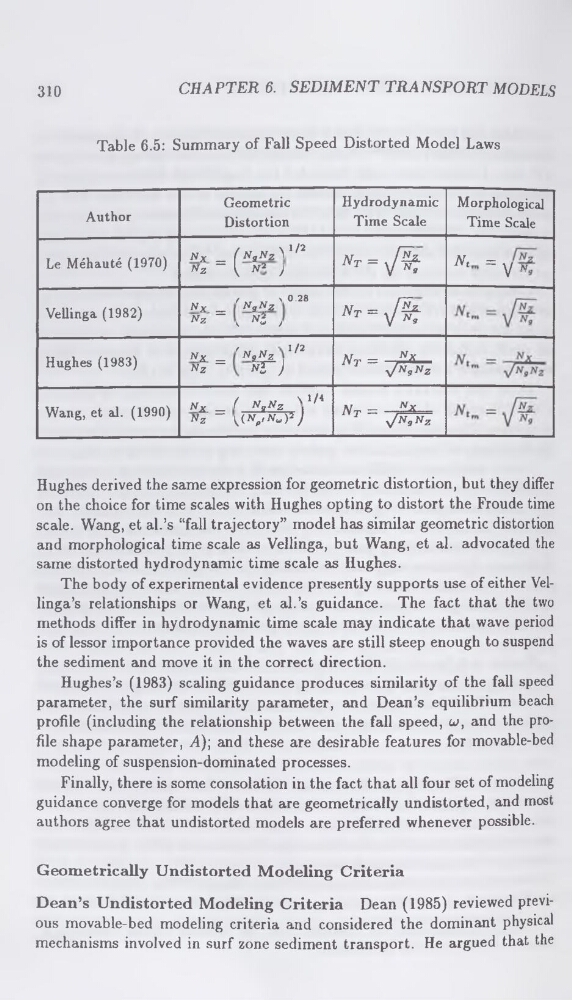
Table 6.5: Summary of Fall Speed Distorted Model Laws
Author
Geometric
Distortion
Hydrodynamic
Time Scale
Morphological
Time Scale
Le Méhauté (1970)
Nx _
NZ -
( NgNz >
< N *
)
1/2
to=fit Nt = \l NJ
V
Vellinga (1982)
Nx _
NZ ~
'NgNz '
k n£ ,
0.28
to-fit
Hughes (1983)
Nx _
NZ “
' NgNZ
nF~ J
1/2
Nt = /A
\/NgNZ
Wang, et al. (1990)
Nx _
Nz ~
< NgNZ
\^(.NpiNu
\ 1/4
)4J
Nt = ,N*
y/NgNz
Hughes derived the same expression for geometric distortion, but they differ
on the choice for time scales with Hughes opting to distort the Froude time
scale. Wang, et al.’s “fall trajectory” model has similar geometric distortion
and morphological time scale as Vellinga, but Wang, et al. advocated the
same distorted hydrodynamic time scale as Hughes.
The body of experimental evidence presently supports use of either Vellinga’s relationships or Wang, et al.’s guidance. The fact that the two
methods differ in hydrodynamic time scale may indicate that wave period
is of lessor importance provided the waves are still steep enough to suspend
the sediment and move it in the correct direction.
Hughes’s (1983) scaling guidance produces similarity of the fall speed
parameter, the surf similarity parameter, and Dean’s equilibrium beach
profile (including the relationship between the fall speed, w, and the profile shape parameter, A); and these are desirable features for movable-bed
modeling of suspension-dominated processes.
Finally, there is some consolation in the fact that all four set of modeling
guidance converge for models that are geometrically undistorted, and most
authors agree that undistorted models are preferred whenever possible.
GeometricaHy Undistorted Modeling Criteria
Dean’s Undistorted Modeling Criteria Dean (1985) reviewed previous movable-bed modeling criteria and considered the dominant physical
mechanisms involved in surf zone sediment transport. He argued that the
CHAPTER 6. SEDIMENT TRANSPORT MODELS
Table 6.5: Summary of Fall Speed Distorted Model Laws
Author
Geometric
Distortion
Hydrodynamic
Time Scale
Morphological
Time Scale
Le Méhauté (1970)
Nx _
NZ -
( NgNz >
< N *
)
1/2
to=fit Nt = \l NJ
V
Vellinga (1982)
Nx _
NZ ~
'NgNz '
k n£ ,
0.28
to-fit
Hughes (1983)
Nx _
NZ “
' NgNZ
nF~ J
1/2
Nt = /A
\/NgNZ
Wang, et al. (1990)
Nx _
Nz ~
< NgNZ
\^(.NpiNu
\ 1/4
)4J
Nt = ,N*
y/NgNz
Hughes derived the same expression for geometric distortion, but they differ
on the choice for time scales with Hughes opting to distort the Froude time
scale. Wang, et al.’s “fall trajectory” model has similar geometric distortion
and morphological time scale as Vellinga, but Wang, et al. advocated the
same distorted hydrodynamic time scale as Hughes.
The body of experimental evidence presently supports use of either Vellinga’s relationships or Wang, et al.’s guidance. The fact that the two
methods differ in hydrodynamic time scale may indicate that wave period
is of lessor importance provided the waves are still steep enough to suspend
the sediment and move it in the correct direction.
Hughes’s (1983) scaling guidance produces similarity of the fall speed
parameter, the surf similarity parameter, and Dean’s equilibrium beach
profile (including the relationship between the fall speed, w, and the profile shape parameter, A); and these are desirable features for movable-bed
modeling of suspension-dominated processes.
Finally, there is some consolation in the fact that all four set of modeling
guidance converge for models that are geometrically undistorted, and most
authors agree that undistorted models are preferred whenever possible.
GeometricaHy Undistorted Modeling Criteria
Dean’s Undistorted Modeling Criteria Dean (1985) reviewed previous movable-bed modeling criteria and considered the dominant physical
mechanisms involved in surf zone sediment transport. He argued that the