

6.4. SUSPENSION-DOMINATED MODELS
307
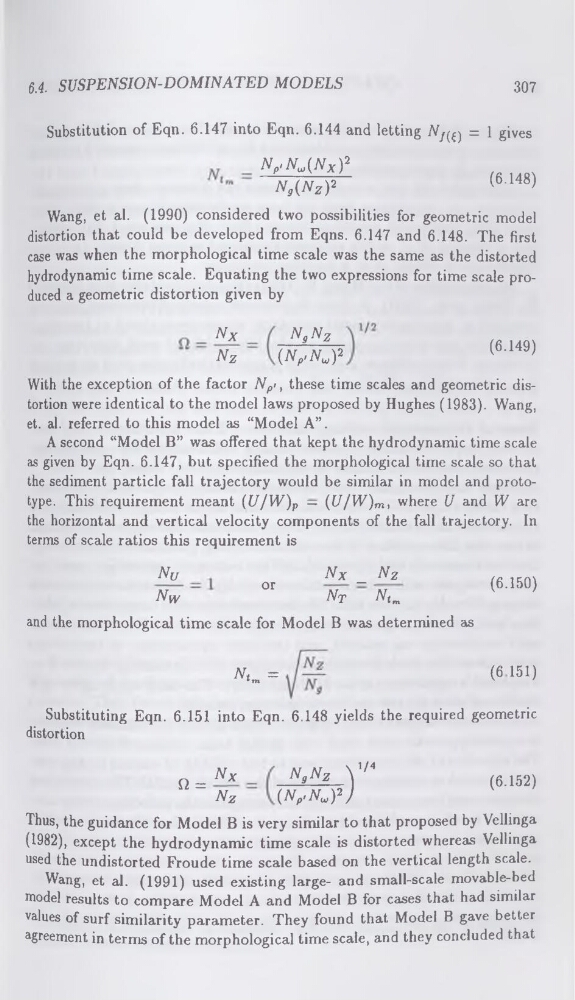
Substitution of Eqn. 6.147 into Eqn. 6.144 and letting Nf^ = 1 gives
NP'N^Nxy
Ng(Nzy
(6.148)
Wang, et al. (1990) considered two possibilities for geometric model
distortion that could be developed from Eqns. 6.147 and 6.148. The first
case was when the morphological time scale was the same as the distorted
hydrodynamic time scale. Equating the two expressions for time scale produced a geometric distortion given by
Nx
Nz
NgNz
(Np.Nuy
(6.149)
With the exception of the factor Np<, these time scales and geometric distortion were identical to the model laws proposed by Hughes (1983). Wang,
et. al. referred to this model as “Model A”.
A second “Model B” was offered that kept the hydrodynamic time scale
as given by Eqn. 6.147, but specified the morphological time scale so that
the sediment particle fall trajectory would be similar in model and prototype. This requirement meant (U/W}p — (U/W)m, where U and W are
the horizontal and vertical velocity components of the fall trajectory. In
terms of scale ratios this requirement is
Nu
Nw
or
Nx _ Nz
Nt
Ntm
(6.150)
and the morphological time scale for Model B was determined as
N‘-=(6151)
Substituting Eqn. 6.151 into Eqn. 6.148 yields the required geometric
distortion
Q =
Nx
Nz
NgNz y/4
(Np.N„y)
(6.152)
Thus, the guidance for Model B is very similar to that proposed by Vellinga
(1982), except the hydrodynamic time scale is distorted whereas Vellinga
used the undistorted Froude time scale based on the vertical length scale.
Wang, et al. (1991) used existing large- and small-scale movable-bed
model results to compare Model A and Model B for cases that had similar
values of surf similarity parameter. They found that Model B gave better
agreement in terms of the morphological time scale, and they concluded that
307
Substitution of Eqn. 6.147 into Eqn. 6.144 and letting Nf^ = 1 gives
NP'N^Nxy
Ng(Nzy
(6.148)
Wang, et al. (1990) considered two possibilities for geometric model
distortion that could be developed from Eqns. 6.147 and 6.148. The first
case was when the morphological time scale was the same as the distorted
hydrodynamic time scale. Equating the two expressions for time scale produced a geometric distortion given by
Nx
Nz
NgNz
(Np.Nuy
(6.149)
With the exception of the factor Np<, these time scales and geometric distortion were identical to the model laws proposed by Hughes (1983). Wang,
et. al. referred to this model as “Model A”.
A second “Model B” was offered that kept the hydrodynamic time scale
as given by Eqn. 6.147, but specified the morphological time scale so that
the sediment particle fall trajectory would be similar in model and prototype. This requirement meant (U/W}p — (U/W)m, where U and W are
the horizontal and vertical velocity components of the fall trajectory. In
terms of scale ratios this requirement is
Nu
Nw
or
Nx _ Nz
Nt
Ntm
(6.150)
and the morphological time scale for Model B was determined as
N‘-=(6151)
Substituting Eqn. 6.151 into Eqn. 6.148 yields the required geometric
distortion
Q =
Nx
Nz
NgNz y/4
(Np.N„y)
(6.152)
Thus, the guidance for Model B is very similar to that proposed by Vellinga
(1982), except the hydrodynamic time scale is distorted whereas Vellinga
used the undistorted Froude time scale based on the vertical length scale.
Wang, et al. (1991) used existing large- and small-scale movable-bed
model results to compare Model A and Model B for cases that had similar
values of surf similarity parameter. They found that Model B gave better
agreement in terms of the morphological time scale, and they concluded that