

292
CHAPTER 6. SEDIMENT TRANSPORT M0DE1
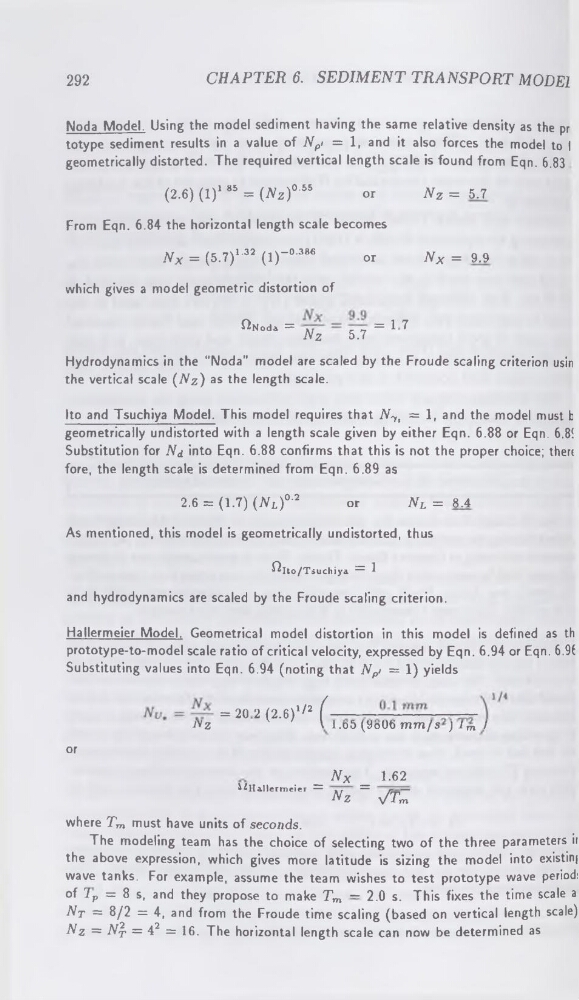
Noda Model. Using the model sediment having the same relative density as the pr
totype sediment results in a value of Np> = 1, and it also forces the model to I
geometrically distorted. The required vertical length scale is found from Eqn. 6.83
(2.6) (I)1 85 = (Az)0'55
or
AZ=5T
From Eqn. 6.84 the horizontal length scale becomes
Nx = (5.7)1’32 (I)"0-386
or
Nx = 9.9
which gives a model geometric distortion of
ÜNod. =
= 17
Nz
5.7
Hydrodynamics in the "Noda" model are scaled by the Froude scaling criterion usin
the vertical scale (Az) as the length scale.
Ito and Tsuchiya Model. This model requires that A7, = 1, and the model must b
geometrically undistorted with a length scale given by either Eqn. 6.88 or Eqn. 6.8!
Substitution for Nd into Eqn. 6.88 confirms that this is not the proper choice; then
fore, the length scale is determined from Eqn. 6.89 as
2.6 = (1.7) (Al)0'2
or
NL = 8.4
As mentioned, this model is geometrically undistorted, thus
^Ito/Tsuchiya = 1
and hydrodynamics are scaled by the Froude scaling criterion.
Hallermeier Model. Geometrical model distortion in this model is defined as th
prototype-to-model scale ratio of critical velocity, expressed by Eqn. 6.94 or Eqn. 6.96
Substituting values into Eqn. 6.94 (noting that Np> = 1) yields
= 20 2 (2.6)’' * (
JV z
\1.d5(9o(J6 mm/ s) 1 ™ /
or
_NX _ 1.62
^Hallermeier —
—
/- —
Nz
Vt;
where Tm must have units of seconds.
The modeling team has the choice of selecting two of the three parameters ii
the above expression, which gives more latitude is sizing the model into existing
wave tanks. For example, assume the team wishes to test prototype wave period;
of 7p = 8 s, and they propose to make Tm — 2.0 s. This fixes the time scale a
Ar = 8/2 = 4, and from the Froude time scaling (based on vertical length scale)
Az = A£ = 42 = 16. The horizontal length scale can now be determined as
CHAPTER 6. SEDIMENT TRANSPORT M0DE1
Noda Model. Using the model sediment having the same relative density as the pr
totype sediment results in a value of Np> = 1, and it also forces the model to I
geometrically distorted. The required vertical length scale is found from Eqn. 6.83
(2.6) (I)1 85 = (Az)0'55
or
AZ=5T
From Eqn. 6.84 the horizontal length scale becomes
Nx = (5.7)1’32 (I)"0-386
or
Nx = 9.9
which gives a model geometric distortion of
ÜNod. =
= 17
Nz
5.7
Hydrodynamics in the "Noda" model are scaled by the Froude scaling criterion usin
the vertical scale (Az) as the length scale.
Ito and Tsuchiya Model. This model requires that A7, = 1, and the model must b
geometrically undistorted with a length scale given by either Eqn. 6.88 or Eqn. 6.8!
Substitution for Nd into Eqn. 6.88 confirms that this is not the proper choice; then
fore, the length scale is determined from Eqn. 6.89 as
2.6 = (1.7) (Al)0'2
or
NL = 8.4
As mentioned, this model is geometrically undistorted, thus
^Ito/Tsuchiya = 1
and hydrodynamics are scaled by the Froude scaling criterion.
Hallermeier Model. Geometrical model distortion in this model is defined as th
prototype-to-model scale ratio of critical velocity, expressed by Eqn. 6.94 or Eqn. 6.96
Substituting values into Eqn. 6.94 (noting that Np> = 1) yields
= 20 2 (2.6)’' * (
JV z
\1.d5(9o(J6 mm/ s) 1 ™ /
or
_NX _ 1.62
^Hallermeier —
—
/- —
Nz
Vt;
where Tm must have units of seconds.
The modeling team has the choice of selecting two of the three parameters ii
the above expression, which gives more latitude is sizing the model into existing
wave tanks. For example, assume the team wishes to test prototype wave period;
of 7p = 8 s, and they propose to make Tm — 2.0 s. This fixes the time scale a
Ar = 8/2 = 4, and from the Froude time scaling (based on vertical length scale)
Az = A£ = 42 = 16. The horizontal length scale can now be determined as