

6.3. BEDLOAD-DOMINATED TRANSPORT MODELS
269
this new prototype condition, George still assumes channel shoaling is predominantly
a bedload transport phenomenon occurring under the action of short waves and currents, and he still neglects any differences between fresh and salt water.
Recalling that the model length scale is NL = 20, and the model movable-bed
material is made of quartz sand with a mean diameter of dm = 0.15 mm, determine
the prototype-to-model scale ratio for the tidal currents and estimate the maximum
prototype current that can be represented in the model by the maximum generated
current of about 60 cm/s (2 ft/sec).
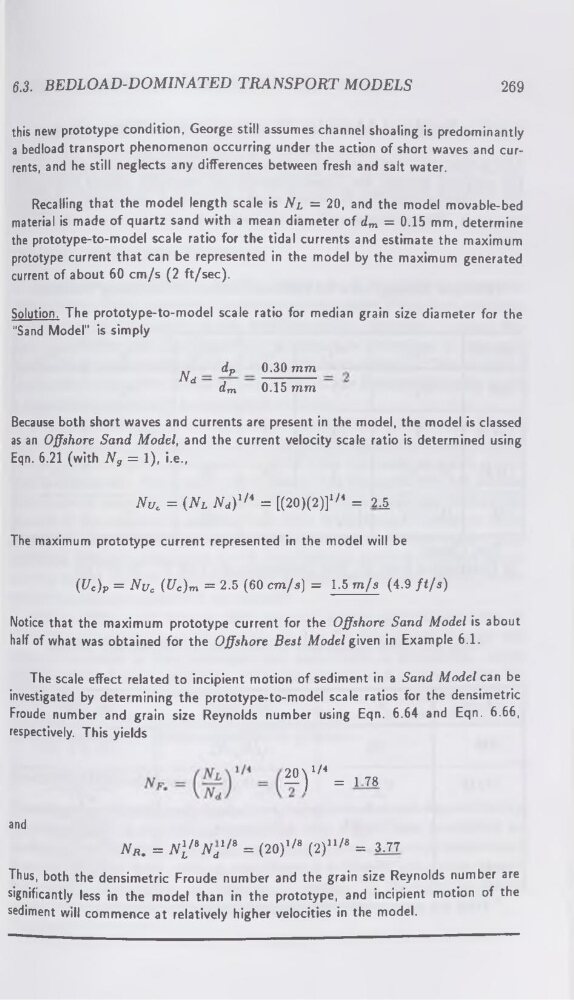
Solution. The prototype-to-model scale ratio for median grain size diameter for the
"Sand Model" is simply
N
dp
0.30 mm
d
dm
0.15 mm
Because both short waves and currents are present in the model, the model is classed
as an Offshore Sand Model, and the current velocity scale ratio is determined using
Eqn. 6.21 (with Ng = 1), i.e.,
NUc = (NL Nd)1/4 = [(20)(2)]1/4 = 2^
The maximum prototype current represented in the model will be
(Uc)p = Nuc (Uc)m = 2.5 (60 cm/s) = 1.5 m/s (4.9 ft/s)
Notice that the maximum prototype current for the Offshore Sand Model is about
half of what was obtained for the Offshore Best Model given in Example 6.1.
The scale effect related to incipient motion of sediment in a Sand Model can be
investigated by determining the prototype-to-model scale ratios for the densimetric
Froude number and grain size Reynolds number using Eqn. 6.64 and Eqn. 6.66,
respectively. This yields
20X 1/4
— )
= 178
and
Nr, = Nl,6Nj1/8 = (20)1/8 (2)11/8 = 3.77
Thus, both the densimetric Froude number and the grain size Reynolds number are
significantly less in the model than in the prototype, and incipient motion of the
sediment will commence at relatively higher velocities in the model.
269
this new prototype condition, George still assumes channel shoaling is predominantly
a bedload transport phenomenon occurring under the action of short waves and currents, and he still neglects any differences between fresh and salt water.
Recalling that the model length scale is NL = 20, and the model movable-bed
material is made of quartz sand with a mean diameter of dm = 0.15 mm, determine
the prototype-to-model scale ratio for the tidal currents and estimate the maximum
prototype current that can be represented in the model by the maximum generated
current of about 60 cm/s (2 ft/sec).
Solution. The prototype-to-model scale ratio for median grain size diameter for the
"Sand Model" is simply
N
dp
0.30 mm
d
dm
0.15 mm
Because both short waves and currents are present in the model, the model is classed
as an Offshore Sand Model, and the current velocity scale ratio is determined using
Eqn. 6.21 (with Ng = 1), i.e.,
NUc = (NL Nd)1/4 = [(20)(2)]1/4 = 2^
The maximum prototype current represented in the model will be
(Uc)p = Nuc (Uc)m = 2.5 (60 cm/s) = 1.5 m/s (4.9 ft/s)
Notice that the maximum prototype current for the Offshore Sand Model is about
half of what was obtained for the Offshore Best Model given in Example 6.1.
The scale effect related to incipient motion of sediment in a Sand Model can be
investigated by determining the prototype-to-model scale ratios for the densimetric
Froude number and grain size Reynolds number using Eqn. 6.64 and Eqn. 6.66,
respectively. This yields
20X 1/4
— )
= 178
and
Nr, = Nl,6Nj1/8 = (20)1/8 (2)11/8 = 3.77
Thus, both the densimetric Froude number and the grain size Reynolds number are
significantly less in the model than in the prototype, and incipient motion of the
sediment will commence at relatively higher velocities in the model.