

6.3. BEDLOAD-DOMINATED TRANSPORT MODELS
265
Example 6.2. Bedload Lightweight Tracer Model
Sediment movement around a coastal structure (groin) due to wave action is to be
studied qualitatively using sediment tracer in a geometrically undistorted l:40-scale
fixed-bed model. The model engineer proposes to use lightweight tracer material,
and she believes that bedload transport is the dominant sediment transport mode.
The prototype sediment is quartz sand with a median grain size diameter of dp =
0.25 mm and a specific gravity of (ps/p)p = 2.65.
Determine median grain size diameter, dm, and specific gravity, (ps/p)m, of a
model sediment tracer material that would satisfy the requirements of the Lightweight
Model. Neglect the difference between fresh and salt water.
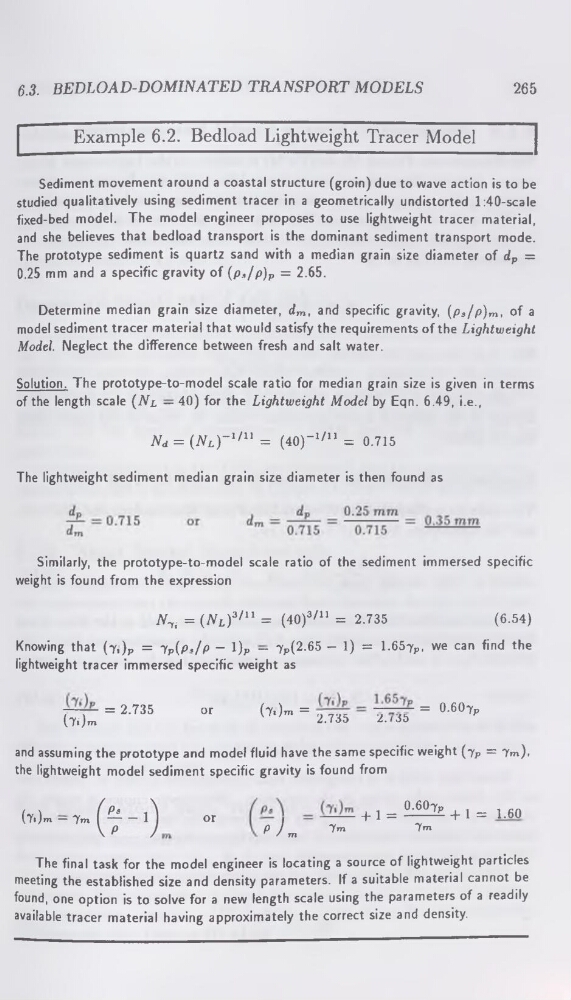
Solution. The prototype-to-model scale ratio for median grain size is given in terms
of the length scale (Nl — 40) for the Lightweight Model by Eqn. 6.49, i.e.,
Nd = (JVL)-1/11 = (40)-1/n = 0.715
The lightweight sediment median grain size diameter is then found as
Similarly, the prototype-to-model scale ratio of the sediment immersed specific
weight is found from the expression
Nyi = (AT)3/11 = (40)3/n = 2.735
(6.54)
Knowing that (7,)p = -ip(p
= 2.735
or
(T.)„ =
= 0-607p
(7i)m
2.735
2.(35
and assuming the prototype and model fluid have the same specific weight (7P = 7m).
the lightweight model sediment specific gravity is found from
(Ti)m — 7m
or
+ i = °'6°7-P- + i = 1.60
p )
y-m
y™
' m
The final task for the model engineer is locating a source of lightweight particles
meeting the established size and density parameters. If a suitable material cannot be
found, one option is to solve for a new length scale using the parameters of a readily
available tracer material having approximately the correct size and density.
265
Example 6.2. Bedload Lightweight Tracer Model
Sediment movement around a coastal structure (groin) due to wave action is to be
studied qualitatively using sediment tracer in a geometrically undistorted l:40-scale
fixed-bed model. The model engineer proposes to use lightweight tracer material,
and she believes that bedload transport is the dominant sediment transport mode.
The prototype sediment is quartz sand with a median grain size diameter of dp =
0.25 mm and a specific gravity of (ps/p)p = 2.65.
Determine median grain size diameter, dm, and specific gravity, (ps/p)m, of a
model sediment tracer material that would satisfy the requirements of the Lightweight
Model. Neglect the difference between fresh and salt water.
Solution. The prototype-to-model scale ratio for median grain size is given in terms
of the length scale (Nl — 40) for the Lightweight Model by Eqn. 6.49, i.e.,
Nd = (JVL)-1/11 = (40)-1/n = 0.715
The lightweight sediment median grain size diameter is then found as
Similarly, the prototype-to-model scale ratio of the sediment immersed specific
weight is found from the expression
Nyi = (AT)3/11 = (40)3/n = 2.735
(6.54)
Knowing that (7,)p = -ip(p
= 2.735
or
(T.)„ =
= 0-607p
(7i)m
2.735
2.(35
and assuming the prototype and model fluid have the same specific weight (7P = 7m).
the lightweight model sediment specific gravity is found from
(Ti)m — 7m
or
+ i = °'6°7-P- + i = 1.60
p )
y-m
y™
' m
The final task for the model engineer is locating a source of lightweight particles
meeting the established size and density parameters. If a suitable material cannot be
found, one option is to solve for a new length scale using the parameters of a readily
available tracer material having approximately the correct size and density.