

262
CHAPTER 6. SEDIMENT TRANSPORT MODELS
The long-wave bottom shear stresses will not be scaled the same as the
sediment and short-wave shear stresses if current velocities are scaled by the
Froude criterion. It is therefore necessary to distort the model horizontal
currents (unidirectional currents) in the Offshore LWM so that the current
bottom shear stresses have the correct scale. This is done using Eqn. 6.21
and substituting the requirement given by Eqn. 6.49 to yield
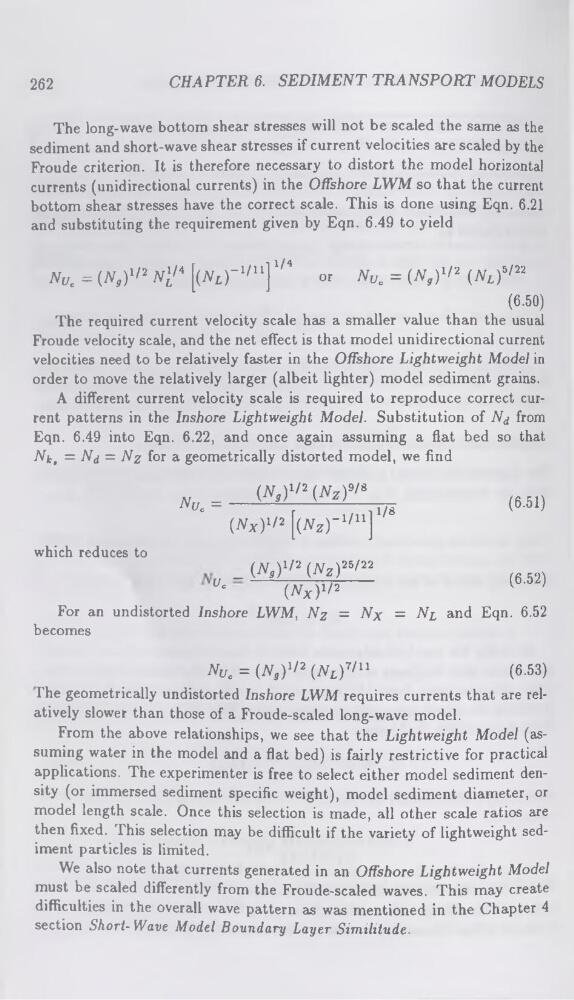
Nu, = (AT,)1'2 N'J4 [(Wl)-171']1'4
or
NUc = (JV,)1/2 (JV£)5/22
(6.50)
The required current velocity scale has a smaller value than the usual
Froude velocity scale, and the net effect is that model unidirectional current
velocities need to be relatively faster in the Offshore Lightweight Model in
order to move the relatively larger (albeit lighter) model sediment grains.
A different current velocity scale is required to reproduce correct current patterns in the Inshore Lightweight Model. Substitution of Nj from
Eqn. 6.49 into Eqn. 6.22, and once again assuming a flat bed so that
Nt, = Nd = Nz for a geometrically distorted model, we find
Nu. =
(Ngy'2 (nz)9/8
(Nxy/> [(ATz)-1/n]1/8
which reduces to
_ (7Vff)1/2 (TVz)25/22
Ue
(Nxy/>
(6.51)
(6.52)
For an undistorted Inshore LWM, Nz = Nx = Nl and Eqn. 6.52
becomes
Nuc = (Ngy/2(NLy/^
(6.53)
The geometrically undistorted Inshore LWM requires currents that are relatively slower than those of a Froude-scaled long-wave model.
From the above relationships, we see that the Lightweight Model (assuming water in the model and a flat bed) is fairly restrictive for practical
applications. The experimenter is free to select either model sediment density (or immersed sediment specific weight), model sediment diameter, or
model length scale. Once this selection is made, all other scale ratios are
then fixed. This selection may be difficult if the variety of lightweight sediment particles is limited.
We also note that currents generated in an Offshore Lightweight Model
must be scaled differently from the Froude-scaled waves. This may create
difficulties in the overall wave pattern as was mentioned in the Chapter 4
section Short-Wave Model Boundary Layer Similitude.
CHAPTER 6. SEDIMENT TRANSPORT MODELS
The long-wave bottom shear stresses will not be scaled the same as the
sediment and short-wave shear stresses if current velocities are scaled by the
Froude criterion. It is therefore necessary to distort the model horizontal
currents (unidirectional currents) in the Offshore LWM so that the current
bottom shear stresses have the correct scale. This is done using Eqn. 6.21
and substituting the requirement given by Eqn. 6.49 to yield
Nu, = (AT,)1'2 N'J4 [(Wl)-171']1'4
or
NUc = (JV,)1/2 (JV£)5/22
(6.50)
The required current velocity scale has a smaller value than the usual
Froude velocity scale, and the net effect is that model unidirectional current
velocities need to be relatively faster in the Offshore Lightweight Model in
order to move the relatively larger (albeit lighter) model sediment grains.
A different current velocity scale is required to reproduce correct current patterns in the Inshore Lightweight Model. Substitution of Nj from
Eqn. 6.49 into Eqn. 6.22, and once again assuming a flat bed so that
Nt, = Nd = Nz for a geometrically distorted model, we find
Nu. =
(Ngy'2 (nz)9/8
(Nxy/> [(ATz)-1/n]1/8
which reduces to
_ (7Vff)1/2 (TVz)25/22
Ue
(Nxy/>
(6.51)
(6.52)
For an undistorted Inshore LWM, Nz = Nx = Nl and Eqn. 6.52
becomes
Nuc = (Ngy/2(NLy/^
(6.53)
The geometrically undistorted Inshore LWM requires currents that are relatively slower than those of a Froude-scaled long-wave model.
From the above relationships, we see that the Lightweight Model (assuming water in the model and a flat bed) is fairly restrictive for practical
applications. The experimenter is free to select either model sediment density (or immersed sediment specific weight), model sediment diameter, or
model length scale. Once this selection is made, all other scale ratios are
then fixed. This selection may be difficult if the variety of lightweight sediment particles is limited.
We also note that currents generated in an Offshore Lightweight Model
must be scaled differently from the Froude-scaled waves. This may create
difficulties in the overall wave pattern as was mentioned in the Chapter 4
section Short-Wave Model Boundary Layer Similitude.