

260
CHAPTER 6. SEDIMENT TRANSPORT MODELS
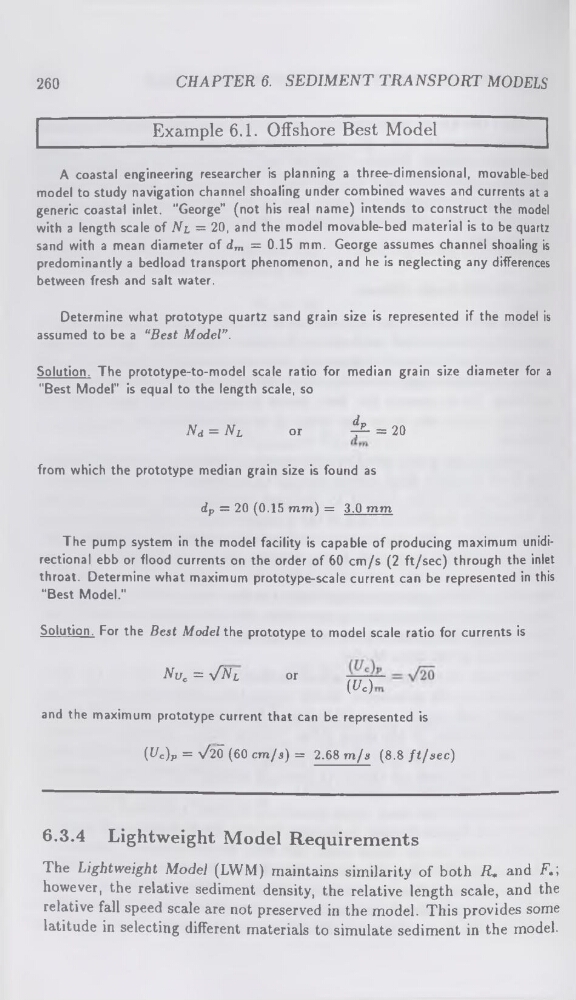
Example 6.1. Offshore Best Model
A coastal engineering researcher is planning a three-dimensional, movable-bed
model to study navigation channel shoaling under combined waves and currents at a
generic coastal inlet. "George" (not his real name) intends to construct the model
with a length scale of Nl = 20, and the model movable-bed material is to be quartz
sand with a mean diameter of dm = 0.15 mm. George assumes channel shoaling is
predominantly a bedload transport phenomenon, and he is neglecting any differences
between fresh and salt water.
Determine what prototype quartz sand grain size is represented if the model is
assumed to be a “Best Model”.
Solution. The prototype-to-model scale ratio for median grain size diameter for a
“Best Model" is equal to the length scale, so
Nd. = Nl
or
-^- = 20
from which the prototype median grain size is found as
dp = 20 (0.15 mm) = 3.0 mm
The pump system in the model facility is capable of producing maximum unidirectional ebb or flood currents on the order of 60 cm/s (2 ft/sec) through the inlet
throat. Determine what maximum prototype-scale current can be represented in this
“Best Model."
Solution. For the Best Model the prototype to model scale ratio for currents is
NUc = y/NL
or
(Dc)
and the maximum prototype current that can be represented is
(Uc)p = V2Ô (60 cm/s) = 2.68 m/s (8.8 ft/sec)
6.3.4 Lightweight Model Requirements
The Lightweight Model (LWM) maintains similarity of both R * and F«;
however, the relative sediment density, the relative length scale, and the
relative fall speed scale are not preserved in the model. This provides some
latitude in selecting different materials to simulate sediment in the model.
CHAPTER 6. SEDIMENT TRANSPORT MODELS
Example 6.1. Offshore Best Model
A coastal engineering researcher is planning a three-dimensional, movable-bed
model to study navigation channel shoaling under combined waves and currents at a
generic coastal inlet. "George" (not his real name) intends to construct the model
with a length scale of Nl = 20, and the model movable-bed material is to be quartz
sand with a mean diameter of dm = 0.15 mm. George assumes channel shoaling is
predominantly a bedload transport phenomenon, and he is neglecting any differences
between fresh and salt water.
Determine what prototype quartz sand grain size is represented if the model is
assumed to be a “Best Model”.
Solution. The prototype-to-model scale ratio for median grain size diameter for a
“Best Model" is equal to the length scale, so
Nd. = Nl
or
-^- = 20
from which the prototype median grain size is found as
dp = 20 (0.15 mm) = 3.0 mm
The pump system in the model facility is capable of producing maximum unidirectional ebb or flood currents on the order of 60 cm/s (2 ft/sec) through the inlet
throat. Determine what maximum prototype-scale current can be represented in this
“Best Model."
Solution. For the Best Model the prototype to model scale ratio for currents is
NUc = y/NL
or
(Dc)
and the maximum prototype current that can be represented is
(Uc)p = V2Ô (60 cm/s) = 2.68 m/s (8.8 ft/sec)
6.3.4 Lightweight Model Requirements
The Lightweight Model (LWM) maintains similarity of both R * and F«;
however, the relative sediment density, the relative length scale, and the
relative fall speed scale are not preserved in the model. This provides some
latitude in selecting different materials to simulate sediment in the model.