

258
CHAPTER 6. SEDIMENT TRANSPORT MODELS
Best Model Shear Stress and Current Scales
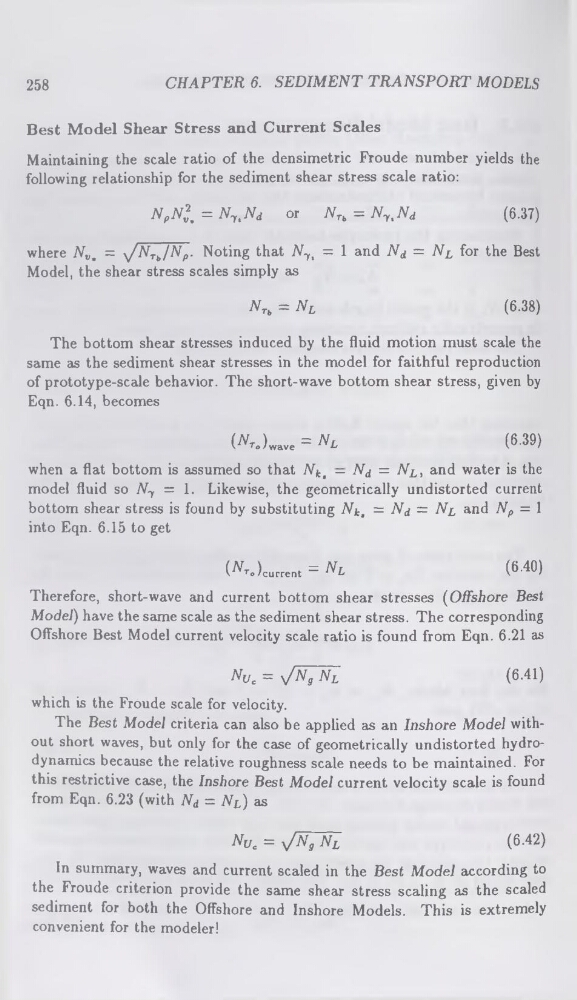
Maintaining the scale ratio of the densimetric Froude number yields the
following relationship for the sediment shear stress scale ratio:
NPN^ = Ny,Nd or
NTb = Ny,Nd
(6.37)
where Nv. = y/NTb/Np. Noting that Nyt = 1 and Nd = Nl for the Best
Model, the shear stress scales simply as
NTb = Nl
(6.38)
The bottom shear stresses induced by the fluid motion must scale the
same as the sediment shear stresses in the model for faithful reproduction
of prototype-scale behavior. The short-wave bottom shear stress, given by
Eqn. 6.14, becomes
(^)wave = Nl
(6.39)
when a flat bottom is assumed so that Nkt — Nd = Nl, and water is the
model fluid so Ny = 1. Likewise, the geometrically undistorted current
bottom shear stress is found by substituting Nkt = Nd = Nl and Np = 1
into Eqn. 6.15 to get
(Wr.)cur„„t = NL
(6.40)
Therefore, short-wave and current bottom shear stresses [Offshore Best
Mode]) have the same scale as the sediment shear stress. The corresponding
Offshore Best Model current velocity scale ratio is found from Eqn. 6.21 as
NUc = y/N^Nl
(6.41)
which is the Froude scale for velocity.
The Best Model criteria can also be applied as an Inshore Model without short waves, but only for the case of geometrically undistorted hydrodynamics because the relative roughness scale needs to be maintained. For
this restrictive case, the Inshore Best Model current velocity scale is found
from Eqn. 6.23 (with Nd = NL) as
NUe = y/ÏÇNl
(6-42)
In summary, waves and current scaled in the Best Model according to
the Froude criterion provide the same shear stress scaling as the scaled
sediment for both the Offshore and Inshore Models. This is extremely
convenient for the modeler!
CHAPTER 6. SEDIMENT TRANSPORT MODELS
Best Model Shear Stress and Current Scales
Maintaining the scale ratio of the densimetric Froude number yields the
following relationship for the sediment shear stress scale ratio:
NPN^ = Ny,Nd or
NTb = Ny,Nd
(6.37)
where Nv. = y/NTb/Np. Noting that Nyt = 1 and Nd = Nl for the Best
Model, the shear stress scales simply as
NTb = Nl
(6.38)
The bottom shear stresses induced by the fluid motion must scale the
same as the sediment shear stresses in the model for faithful reproduction
of prototype-scale behavior. The short-wave bottom shear stress, given by
Eqn. 6.14, becomes
(^)wave = Nl
(6.39)
when a flat bottom is assumed so that Nkt — Nd = Nl, and water is the
model fluid so Ny = 1. Likewise, the geometrically undistorted current
bottom shear stress is found by substituting Nkt = Nd = Nl and Np = 1
into Eqn. 6.15 to get
(Wr.)cur„„t = NL
(6.40)
Therefore, short-wave and current bottom shear stresses [Offshore Best
Mode]) have the same scale as the sediment shear stress. The corresponding
Offshore Best Model current velocity scale ratio is found from Eqn. 6.21 as
NUc = y/N^Nl
(6.41)
which is the Froude scale for velocity.
The Best Model criteria can also be applied as an Inshore Model without short waves, but only for the case of geometrically undistorted hydrodynamics because the relative roughness scale needs to be maintained. For
this restrictive case, the Inshore Best Model current velocity scale is found
from Eqn. 6.23 (with Nd = NL) as
NUe = y/ÏÇNl
(6-42)
In summary, waves and current scaled in the Best Model according to
the Froude criterion provide the same shear stress scaling as the scaled
sediment for both the Offshore and Inshore Models. This is extremely
convenient for the modeler!