

6.2. MOVABLE-BED SCALING REQUIREMENTS
251
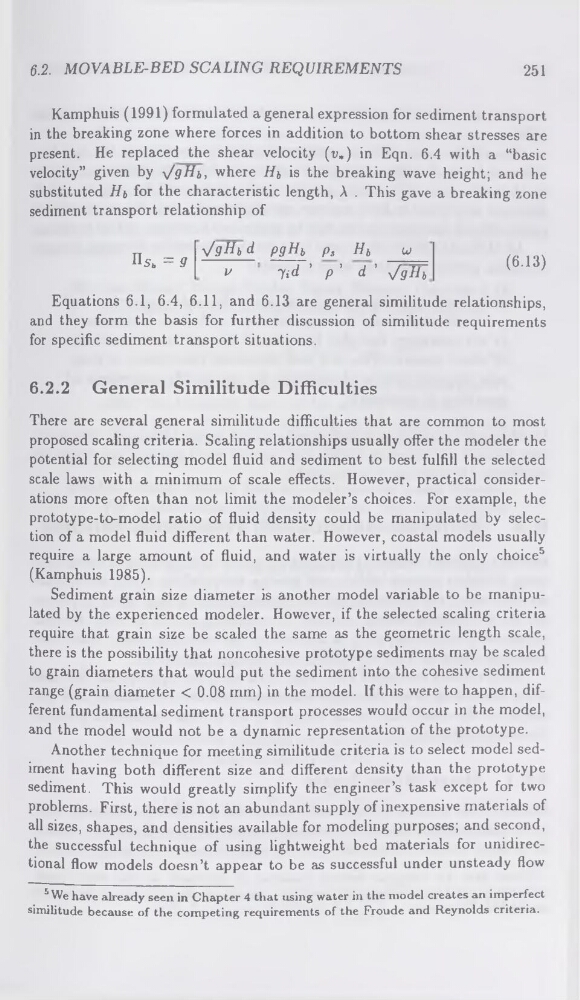
Kamphuis (1991) formulated a general expression for sediment transport
in the breaking zone where forces in addition to bottom shear stresses are
present. He replaced the shear velocity (v * )
in Eqn. 6.4 with a “basic
velocity” given by y/gHb, where Hb is the breaking wave height; and he
substituted Hb for the characteristic length, A . This gave a breaking zone
sediment transport relationship of
5 We have already seen in Chapter 4 that using water in the model creates an imperfect
similitude because of the competing requirements of the Froude and Reynolds criteria.
n5b = g
VgHb d pgHb ps Hb
w
v
yid ’ p' d ' y/gTFb
(6.13)
Equations 6.1, 6.4, 6.11, and 6.13 are general similitude relationships,
and they form the basis for further discussion of similitude requirements
for specific sediment transport situations.
6.2.2 General Similitude Difficulties
There are several general similitude difficulties that are common to most
proposed scaling criteria. Scaling relationships usually offer the modeler the
potential for selecting model fluid and sediment to best fulfill the selected
scale laws with a minimum of scale effects. However, practical considerations more often than not limit the modeler’s choices. For example, the
prototype-to-model ratio of fluid density could be manipulated by selection of a model fluid different than water. However, coastal models usually
require a large amount of fluid, and water is virtually the only choice5
(Kamphuis 1985).
Sediment grain size diameter is another model variable to be manipulated by the experienced modeler. However, if the selected scaling criteria
require that grain size be scaled the same as the geometric length scale,
there is the possibility that noncohesive prototype sediments may be scaled
to grain diameters that would put the sediment into the cohesive sediment
range (grain diameter < 0.08 mm) in the model. If this were to happen, different fundamental sediment transport processes would occur in the model,
and the model would not be a dynamic representation of the prototype.
Another technique for meeting similitude criteria is to select model sediment having both different size and different density than the prototype
sediment. This would greatly simplify the engineer’s task except for two
problems. First, there is not an abundant supply of inexpensive materials of
all sizes, shapes, and densities available for modeling purposes; and second,
the successful technique of using lightweight bed materials for unidirectional flow models doesn’t appear to be as successful under unsteady flow
251
Kamphuis (1991) formulated a general expression for sediment transport
in the breaking zone where forces in addition to bottom shear stresses are
present. He replaced the shear velocity (v * )
in Eqn. 6.4 with a “basic
velocity” given by y/gHb, where Hb is the breaking wave height; and he
substituted Hb for the characteristic length, A . This gave a breaking zone
sediment transport relationship of
5 We have already seen in Chapter 4 that using water in the model creates an imperfect
similitude because of the competing requirements of the Froude and Reynolds criteria.
n5b = g
VgHb d pgHb ps Hb
w
v
yid ’ p' d ' y/gTFb
(6.13)
Equations 6.1, 6.4, 6.11, and 6.13 are general similitude relationships,
and they form the basis for further discussion of similitude requirements
for specific sediment transport situations.
6.2.2 General Similitude Difficulties
There are several general similitude difficulties that are common to most
proposed scaling criteria. Scaling relationships usually offer the modeler the
potential for selecting model fluid and sediment to best fulfill the selected
scale laws with a minimum of scale effects. However, practical considerations more often than not limit the modeler’s choices. For example, the
prototype-to-model ratio of fluid density could be manipulated by selection of a model fluid different than water. However, coastal models usually
require a large amount of fluid, and water is virtually the only choice5
(Kamphuis 1985).
Sediment grain size diameter is another model variable to be manipulated by the experienced modeler. However, if the selected scaling criteria
require that grain size be scaled the same as the geometric length scale,
there is the possibility that noncohesive prototype sediments may be scaled
to grain diameters that would put the sediment into the cohesive sediment
range (grain diameter < 0.08 mm) in the model. If this were to happen, different fundamental sediment transport processes would occur in the model,
and the model would not be a dynamic representation of the prototype.
Another technique for meeting similitude criteria is to select model sediment having both different size and different density than the prototype
sediment. This would greatly simplify the engineer’s task except for two
problems. First, there is not an abundant supply of inexpensive materials of
all sizes, shapes, and densities available for modeling purposes; and second,
the successful technique of using lightweight bed materials for unidirectional flow models doesn’t appear to be as successful under unsteady flow