

248
CHAPTER 6. SEDIMENT TRANSPORT MODELS
Sediment Transport Similitude Requirements
Physical parameters of the sediment can be combined with some physical
properties of the fluid to form a set of dimensionless numbers commonly
used for unidirectional flow. Kamphuis (1985) used the sediment parameters, d, ps, and n combined with fluid parameters, p, p, and A to represent
the sediment phase in terms of the function
f(p, y,X,rb,d,p,) = 0
(6.2)
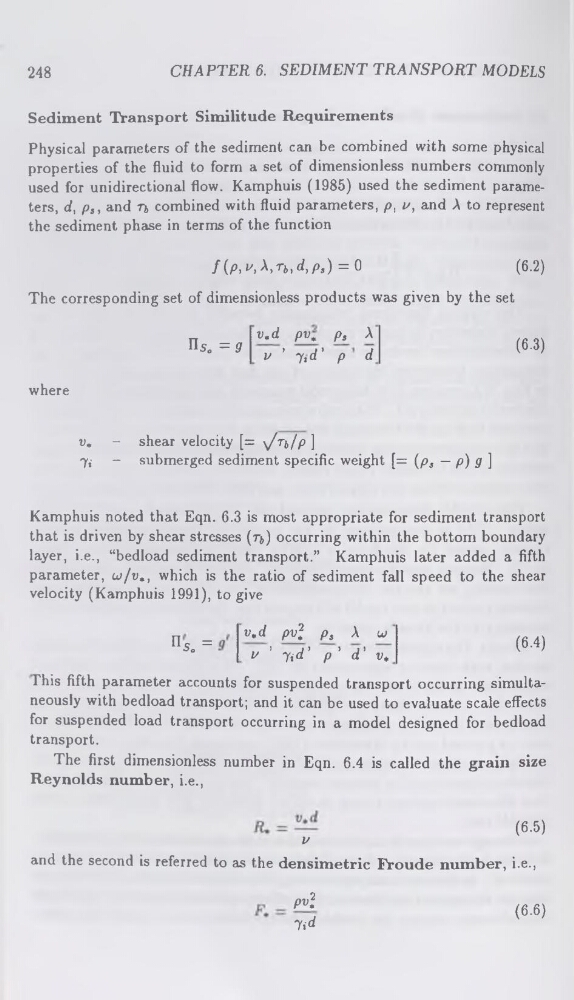
The corresponding set of dimensionless products was given by the set
n$o = g
v * d
pv *
ps A
y ’ 7, d ’ p d
(6-3)
where
v» - shear velocity [= x/rj/p ]
7i - submerged sediment specific weight [= (p, — p) g ]
Kamphuis noted that Eqn. 6.3 is most appropriate for sediment transport
that is driven by shear stresses (r^) occurring within the bottom boundary
layer, i.e., “bedload sediment transport.” Kamphuis later added a fifth
parameter, w/i»., which is the ratio of sediment fall speed to the shear
velocity (Kamphuis 1991), to give
nso =
v * d
pv? ps A
v ’ yid ’ p ’ d’
(6-4)
w
v*
This fifth parameter accounts for suspended transport occurring simultaneously with bedload transport; and it can be used to evaluate scale effects
for suspended load transport occurring in a model designed for bedload
transport.
The first dimensionless number in Eqn. 6.4 is called the grain size
Reynolds number, i.e.,
y
(6.5)
and the second is referred to as the densimetric Froude number, i.e.,
9
pvt
7 id
(6-6)
CHAPTER 6. SEDIMENT TRANSPORT MODELS
Sediment Transport Similitude Requirements
Physical parameters of the sediment can be combined with some physical
properties of the fluid to form a set of dimensionless numbers commonly
used for unidirectional flow. Kamphuis (1985) used the sediment parameters, d, ps, and n combined with fluid parameters, p, p, and A to represent
the sediment phase in terms of the function
f(p, y,X,rb,d,p,) = 0
(6.2)
The corresponding set of dimensionless products was given by the set
n$o = g
v * d
pv *
ps A
y ’ 7, d ’ p d
(6-3)
where
v» - shear velocity [= x/rj/p ]
7i - submerged sediment specific weight [= (p, — p) g ]
Kamphuis noted that Eqn. 6.3 is most appropriate for sediment transport
that is driven by shear stresses (r^) occurring within the bottom boundary
layer, i.e., “bedload sediment transport.” Kamphuis later added a fifth
parameter, w/i»., which is the ratio of sediment fall speed to the shear
velocity (Kamphuis 1991), to give
nso =
v * d
pv? ps A
v ’ yid ’ p ’ d’
(6-4)
w
v*
This fifth parameter accounts for suspended transport occurring simultaneously with bedload transport; and it can be used to evaluate scale effects
for suspended load transport occurring in a model designed for bedload
transport.
The first dimensionless number in Eqn. 6.4 is called the grain size
Reynolds number, i.e.,
y
(6.5)
and the second is referred to as the densimetric Froude number, i.e.,
9
pvt
7 id
(6-6)