

5.6. FLOATING STRUCTURES
223
with rubble-mound structures, and details are given in the section entitled
Short-Wave Model Laboratory and Scale Effects in Chapter 4. Shock forces
on the vertical-wall portion of the structure should be treated in the same
manner as described in the above section on vertical-wall structures.
Composite structures are tested at much the same scales as are typically
used for rubble-mound and vertical-wall structures. Jensen (1989) gave an
example of a typical model study of a composite breakwater structure.
5.6 Floating Structures
5.6.1 Scaling Requirements for Floating Structures
Floating coastal structures are subject to gravitational, inertial, elastic,
surface tension, and viscous shear forces; and no scale model will be able to
attain dynamic similarity of all these forces. Fortunately, complete similitude is not necessary because only a few of the forces are dominant in the
dynamic response of the floating structure.
The hydrodynamics (waves and currents) and the floating structure are
scaled according to the Froude criterion. It is important that the structure
be geometrically-scaled as an undistorted model with the correct weight and
mass distribution so the model has correct buoyancy and mass moments
of inertia (Hudson, et al. 1979). The model tests should be conducted
at a large enough scale to assure that scale effects arising from incorrect
similitude of surface tension and viscosity can be assumed negligible.
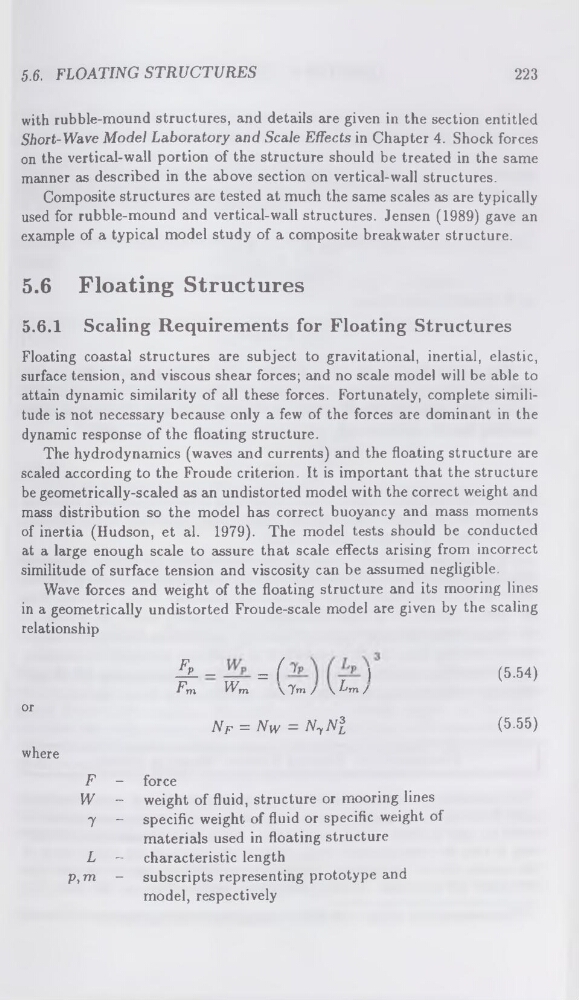
Wave forces and weight of the floating structure and its mooring lines
in a geometrically undistorted Froude-scale model are given by the scaling
relationship
Æ -
= ()
(5.54)
Fm
Wm
\7m / \Lm/
or
NF = Nw = Ny Nl
(5.55)
where
F - force
W - weight of fluid, structure or mooring lines
7 - specific weight of fluid or specific weight of
materials used in floating structure
L - characteristic length
p,m — subscripts representing prototype and
model, respectively
223
with rubble-mound structures, and details are given in the section entitled
Short-Wave Model Laboratory and Scale Effects in Chapter 4. Shock forces
on the vertical-wall portion of the structure should be treated in the same
manner as described in the above section on vertical-wall structures.
Composite structures are tested at much the same scales as are typically
used for rubble-mound and vertical-wall structures. Jensen (1989) gave an
example of a typical model study of a composite breakwater structure.
5.6 Floating Structures
5.6.1 Scaling Requirements for Floating Structures
Floating coastal structures are subject to gravitational, inertial, elastic,
surface tension, and viscous shear forces; and no scale model will be able to
attain dynamic similarity of all these forces. Fortunately, complete similitude is not necessary because only a few of the forces are dominant in the
dynamic response of the floating structure.
The hydrodynamics (waves and currents) and the floating structure are
scaled according to the Froude criterion. It is important that the structure
be geometrically-scaled as an undistorted model with the correct weight and
mass distribution so the model has correct buoyancy and mass moments
of inertia (Hudson, et al. 1979). The model tests should be conducted
at a large enough scale to assure that scale effects arising from incorrect
similitude of surface tension and viscosity can be assumed negligible.
Wave forces and weight of the floating structure and its mooring lines
in a geometrically undistorted Froude-scale model are given by the scaling
relationship
Æ -
= ()
(5.54)
Fm
Wm
\7m / \Lm/
or
NF = Nw = Ny Nl
(5.55)
where
F - force
W - weight of fluid, structure or mooring lines
7 - specific weight of fluid or specific weight of
materials used in floating structure
L - characteristic length
p,m — subscripts representing prototype and
model, respectively