

5.2. RUBBLE-MOUND STRUCTURES
211
Laboratory in 1980 was the first to use “load cells” placed in armor units
(Tetrapods) to measure bending moments (Burcharth, et al. 1991).
Scott, et al. (1986) described a study in which load cells were installed
at the mid-shank cross-section of 428-g model doles units. Strain gauges on
the load cell were arranged in such a way to measure the bending moment
and torsional moment at the mid-shank. These moments are considered to
be much more important than axial and shear forces in the slender members
of the dolos unit. Later, the load cell was moved to the cross-section at the
fluke-shank interface to coincide with the location where dolosse generally
fail, and 2000 parametric tests were conducted (Anglin, et al. 1990). Scott,
et al. (1990) presented results of a model breakwater study in which the
instrumented dolos units were used to measure model stresses due to static
and wave (pulsating) loads.
In 1988 engineers at the Coastal Engineering Research Center (CERC)
developed a load cell that was placed at the fluke-shank interface of 200-g
model dolosse (Markle 1990). Seven of the instrumented model units were
used in a 1:57.5 scale model of the Crescent City breakwater. The purpose
of the model was to compare pulsating stresses measured in the model
to prototype measurements that CERC had collected from instrumented
38,000-kg (42-short-ton) dolosse on the Crescent City breakwater. The
model unit load cell was designed to replicate the same measurement scheme
developed for the prototype instrumentation. The model unit and load cell
are shown in Figure 5.6.
Markle confirmed the validity of the load cell technique for measuring
static and pulsating stresses exerted by waves on individual model dolos
armor units. His simulations of storms recorded at Crescent City produced
results that matched prototype stress data9 collected on the Crescent City
breakwater.
9Surprisingly, no impacts were recorded in the many gigabytes of data collected at
Crescent City.
Further details of the Crescent City model study are given in Markle
(1990). The small-scale load cell technology is thoroughly discussed in
Markle and Greer (1992).
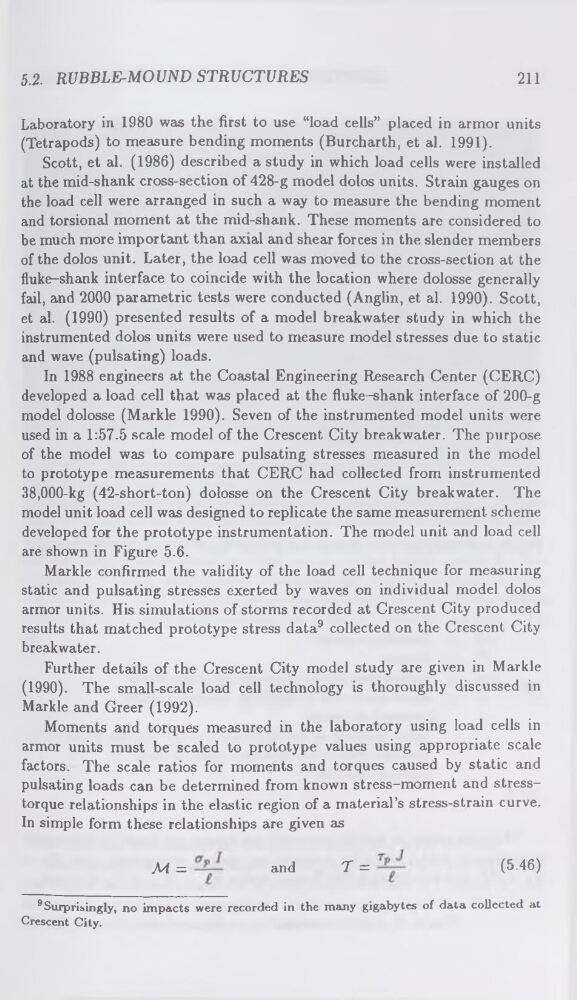
Moments and torques measured in the laboratory using load cells in
armor units must be scaled to prototype values using appropriate scale
factors. The scale ratios for moments and torques caused by static and
pulsating loads can be determined from known stress-moment and stresstorque relationships in the elastic region of a material’s stress-strain curve.
In simple form these relationships are given as
A4 =
and
T =
(5.46)
211
Laboratory in 1980 was the first to use “load cells” placed in armor units
(Tetrapods) to measure bending moments (Burcharth, et al. 1991).
Scott, et al. (1986) described a study in which load cells were installed
at the mid-shank cross-section of 428-g model doles units. Strain gauges on
the load cell were arranged in such a way to measure the bending moment
and torsional moment at the mid-shank. These moments are considered to
be much more important than axial and shear forces in the slender members
of the dolos unit. Later, the load cell was moved to the cross-section at the
fluke-shank interface to coincide with the location where dolosse generally
fail, and 2000 parametric tests were conducted (Anglin, et al. 1990). Scott,
et al. (1990) presented results of a model breakwater study in which the
instrumented dolos units were used to measure model stresses due to static
and wave (pulsating) loads.
In 1988 engineers at the Coastal Engineering Research Center (CERC)
developed a load cell that was placed at the fluke-shank interface of 200-g
model dolosse (Markle 1990). Seven of the instrumented model units were
used in a 1:57.5 scale model of the Crescent City breakwater. The purpose
of the model was to compare pulsating stresses measured in the model
to prototype measurements that CERC had collected from instrumented
38,000-kg (42-short-ton) dolosse on the Crescent City breakwater. The
model unit load cell was designed to replicate the same measurement scheme
developed for the prototype instrumentation. The model unit and load cell
are shown in Figure 5.6.
Markle confirmed the validity of the load cell technique for measuring
static and pulsating stresses exerted by waves on individual model dolos
armor units. His simulations of storms recorded at Crescent City produced
results that matched prototype stress data9 collected on the Crescent City
breakwater.
9Surprisingly, no impacts were recorded in the many gigabytes of data collected at
Crescent City.
Further details of the Crescent City model study are given in Markle
(1990). The small-scale load cell technology is thoroughly discussed in
Markle and Greer (1992).
Moments and torques measured in the laboratory using load cells in
armor units must be scaled to prototype values using appropriate scale
factors. The scale ratios for moments and torques caused by static and
pulsating loads can be determined from known stress-moment and stresstorque relationships in the elastic region of a material’s stress-strain curve.
In simple form these relationships are given as
A4 =
and
T =
(5.46)