

186
CHAPTER 5. COASTAL STRUCTURE MODELS
These results support earlier work by Hudson and Jackson (1953) in
which it was demonstrated that prototype damage of San Pedro breakwater could be reasonably reproduced at scales of 1:30, 1:45, and 1:60.
Oumeraci (1984) cited a study by Delft Hydraulics Laboratory were a 1:61
scale physical model of the final repair to the Arzew breakwater produced
the same result as a 1:11 large-scale model. Mol, et al. (1983) discussed
testing of the Sines breakwater in which models at scales of 1:85, 1:78, and
1:12 produced the same stability result. In these two cases, results were obtained when the flow Reynolds number was greater than 3 x 10⁴ (Oumeraci
1984).
In the underlayers and core of model breakwaters, geometric scaling of
the material sizes may lead to viscous scale effects because these layers can
become less permeable and lead to relatively higher downrush pressures
from inside the structure (Oumeraci 1984) or different values of transmission and reflection than what occurs at prototype scale. In this situation,
it is necessary to increase the size of the core and underlayer materials using the wave transmission methods discussed in Chapter 4 in the section
entitled Short-Wave Model Laboratory and Scale Effects.
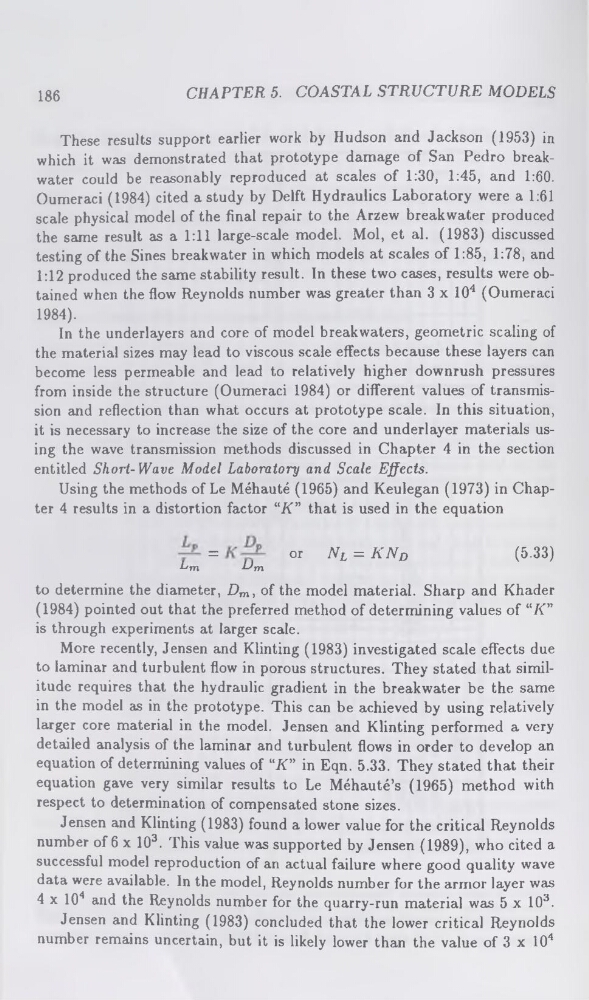
Using the methods of Le Méhauté (1965) and Keulegan (1973) in Chapter 4 results in a distortion factor “7<” that is used in the equation
=
or
Nl = KNd
(5.33)
^m
Um
to determine the diameter, Dm, of the model material. Sharp and Khader
(1984) pointed out that the preferred method of determining values of “/<”
is through experiments at larger scale.
More recently, Jensen and Klinting (1983) investigated scale effects due
to laminar and turbulent flow in porous structures. They stated that similitude requires that the hydraulic gradient in the breakwater be the same
in the model as in the prototype. This can be achieved by using relatively
larger core material in the model. Jensen and Klinting performed a very
detailed analysis of the laminar and turbulent flows in order to develop an
equation of determining values of “/<” in Eqn. 5.33. They stated that their
equation gave very similar results to Le Méhauté’s (1965) method with
respect to determination of compensated stone sizes.
Jensen and Klinting (1983) found a lower value for the critical Reynolds
number of 6 x 10³. This value was supported by Jensen (1989), who cited a
successful model reproduction of an actual failure where good quality wave
data were available. In the model, Reynolds number for the armor layer was
4 x 10⁴ and the Reynolds number for the quarry-run material was 5 x 10³.
Jensen and Klinting (1983) concluded that the lower critical Reynolds
number remains uncertain, but it is likely lower than the value of 3 x 10⁴
CHAPTER 5. COASTAL STRUCTURE MODELS
These results support earlier work by Hudson and Jackson (1953) in
which it was demonstrated that prototype damage of San Pedro breakwater could be reasonably reproduced at scales of 1:30, 1:45, and 1:60.
Oumeraci (1984) cited a study by Delft Hydraulics Laboratory were a 1:61
scale physical model of the final repair to the Arzew breakwater produced
the same result as a 1:11 large-scale model. Mol, et al. (1983) discussed
testing of the Sines breakwater in which models at scales of 1:85, 1:78, and
1:12 produced the same stability result. In these two cases, results were obtained when the flow Reynolds number was greater than 3 x 10⁴ (Oumeraci
1984).
In the underlayers and core of model breakwaters, geometric scaling of
the material sizes may lead to viscous scale effects because these layers can
become less permeable and lead to relatively higher downrush pressures
from inside the structure (Oumeraci 1984) or different values of transmission and reflection than what occurs at prototype scale. In this situation,
it is necessary to increase the size of the core and underlayer materials using the wave transmission methods discussed in Chapter 4 in the section
entitled Short-Wave Model Laboratory and Scale Effects.
Using the methods of Le Méhauté (1965) and Keulegan (1973) in Chapter 4 results in a distortion factor “7<” that is used in the equation
=
or
Nl = KNd
(5.33)
^m
Um
to determine the diameter, Dm, of the model material. Sharp and Khader
(1984) pointed out that the preferred method of determining values of “/<”
is through experiments at larger scale.
More recently, Jensen and Klinting (1983) investigated scale effects due
to laminar and turbulent flow in porous structures. They stated that similitude requires that the hydraulic gradient in the breakwater be the same
in the model as in the prototype. This can be achieved by using relatively
larger core material in the model. Jensen and Klinting performed a very
detailed analysis of the laminar and turbulent flows in order to develop an
equation of determining values of “/<” in Eqn. 5.33. They stated that their
equation gave very similar results to Le Méhauté’s (1965) method with
respect to determination of compensated stone sizes.
Jensen and Klinting (1983) found a lower value for the critical Reynolds
number of 6 x 10³. This value was supported by Jensen (1989), who cited a
successful model reproduction of an actual failure where good quality wave
data were available. In the model, Reynolds number for the armor layer was
4 x 10⁴ and the Reynolds number for the quarry-run material was 5 x 10³.
Jensen and Klinting (1983) concluded that the lower critical Reynolds
number remains uncertain, but it is likely lower than the value of 3 x 10⁴