

5.2. RUBBLE-MOUND STRUCTURES
175
5.2 Rubble-Mound Structures
5.2.1 Rubble-Mound Structure Scaling Requirements
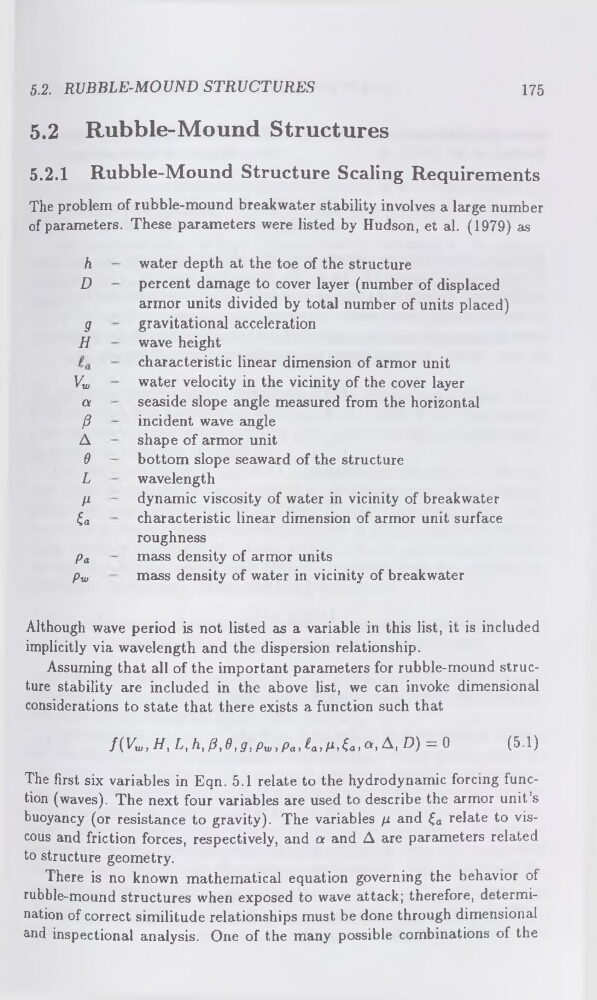
The problem of rubble-mound breakwater stability involves a large number
of parameters. These parameters were listed by Hudson, et al. (1979) as
h
D
9
H
Vw
a
/?
A
e
L
p
6
Pa
Pw
water depth at the toe of the structure
percent damage to cover layer (number of displaced
armor units divided by total number of units placed)
gravitational acceleration
wave height
characteristic linear dimension of armor unit
water velocity in the vicinity of the cover layer
seaside slope angle measured from the horizontal
incident wave angle
shape of armor unit
bottom slope seaward of the structure
wavelength
dynamic viscosity of water in vicinity of breakwater
characteristic linear dimension of armor unit surface
roughness
mass density of armor units
mass density of water in vicinity of breakwater
Although wave period is not listed as a variable in this list, it is included
implicitly via wavelength and the dispersion relationship.
Assuming that all of the important parameters for rubble-mound structure stability are included in the above list, we can invoke dimensional
considerations to state that there exists a function such that
f(Vw,H, L,h,(3,0,g,pw,pa,£a,n^a,oi, A, D) = 0
(5.1)
The first six variables in Eqn. 5.1 relate to the hydrodynamic forcing function (waves). The next four variables are used to describe the armor unit’s
buoyancy (or resistance to gravity). The variables p and £a relate to viscous and friction forces, respectively, and a and A are parameters related
to structure geometry.
There is no known mathematical equation governing the behavior of
rubble-mound structures when exposed to wave attack; therefore, determination of correct similitude relationships must be done through dimensional
and inspectional analysis. One of the many possible combinations of the
175
5.2 Rubble-Mound Structures
5.2.1 Rubble-Mound Structure Scaling Requirements
The problem of rubble-mound breakwater stability involves a large number
of parameters. These parameters were listed by Hudson, et al. (1979) as
h
D
9
H
Vw
a
/?
A
e
L
p
6
Pa
Pw
water depth at the toe of the structure
percent damage to cover layer (number of displaced
armor units divided by total number of units placed)
gravitational acceleration
wave height
characteristic linear dimension of armor unit
water velocity in the vicinity of the cover layer
seaside slope angle measured from the horizontal
incident wave angle
shape of armor unit
bottom slope seaward of the structure
wavelength
dynamic viscosity of water in vicinity of breakwater
characteristic linear dimension of armor unit surface
roughness
mass density of armor units
mass density of water in vicinity of breakwater
Although wave period is not listed as a variable in this list, it is included
implicitly via wavelength and the dispersion relationship.
Assuming that all of the important parameters for rubble-mound structure stability are included in the above list, we can invoke dimensional
considerations to state that there exists a function such that
f(Vw,H, L,h,(3,0,g,pw,pa,£a,n^a,oi, A, D) = 0
(5.1)
The first six variables in Eqn. 5.1 relate to the hydrodynamic forcing function (waves). The next four variables are used to describe the armor unit’s
buoyancy (or resistance to gravity). The variables p and £a relate to viscous and friction forces, respectively, and a and A are parameters related
to structure geometry.
There is no known mathematical equation governing the behavior of
rubble-mound structures when exposed to wave attack; therefore, determination of correct similitude relationships must be done through dimensional
and inspectional analysis. One of the many possible combinations of the