

4.3. LONG-WAVE HYDRODYNAMIC MODELS
143
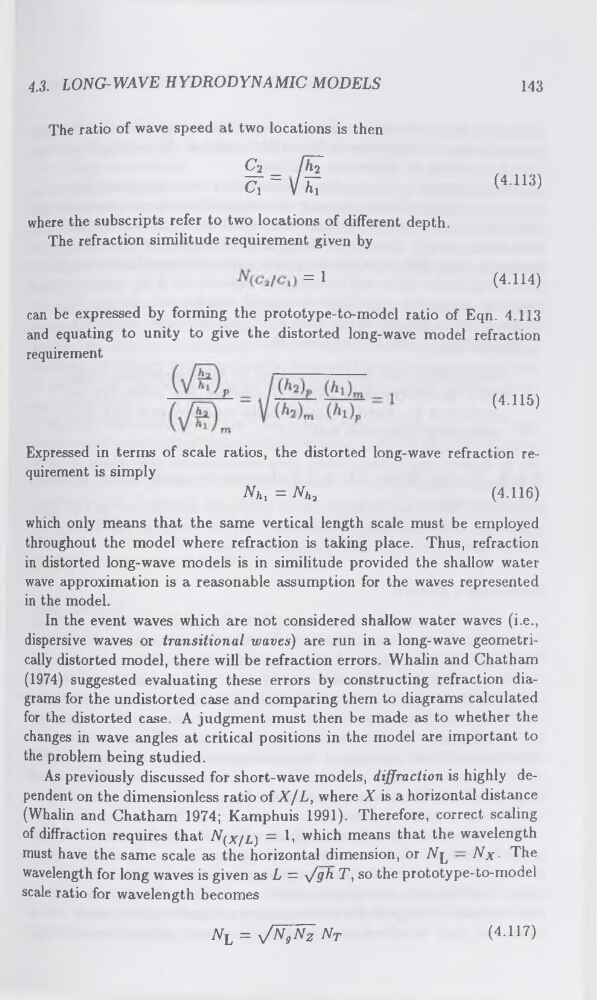
The ratio of wave speed at two locations is then
Ql= /K
Ci
V h.
(4.113)
where the subscripts refer to two locations of different depth.
The refraction similitude requirement given by
= 1
(4.114)
can be expressed by forming the prototype-to-model ratio of Eqn. 4.113
and equating to unity to give the distorted long-wave model refraction
requirement
(4.115)
Expressed in terms of scale ratios, the distorted long-wave refraction requirement is simply
Nhl=Nh2
(4.116)
which only means that the same vertical length scale must be employed
throughout the model where refraction is taking place. Thus, refraction
in distorted long-wave models is in similitude provided the shallow water
wave approximation is a reasonable assumption for the waves represented
in the model.
In the event waves which are not considered shallow water waves (i.e.,
dispersive waves or transitional waves) are run in a long-wave geometrically distorted model, there will be refraction errors. Whalin and Chatham
(1974) suggested evaluating these errors by constructing refraction diagrams for the undistorted case and comparing them to diagrams calculated
for the distorted case. A judgment must then be made as to whether the
changes in wave angles at critical positions in the model are important to
the problem being studied.
As previously discussed for short-wave models, diffraction is highly dependent on the dimensionless ratio of X/L, where X is a horizontal distance
(Whalin and Chatham 1974; Kamphuis 1991). Therefore, correct scaling
of diffraction requires that N^x/L) — T which means that the wavelength
must have the same scale as the horizontal dimension, or N^ — Nx- The
wavelength for long waves is given as L = y/g~h T, so the prototype-to-model
scale ratio for wavelength becomes
Wl = \JNgNz Nt
(4-117)
143
The ratio of wave speed at two locations is then
Ql= /K
Ci
V h.
(4.113)
where the subscripts refer to two locations of different depth.
The refraction similitude requirement given by
= 1
(4.114)
can be expressed by forming the prototype-to-model ratio of Eqn. 4.113
and equating to unity to give the distorted long-wave model refraction
requirement
(4.115)
Expressed in terms of scale ratios, the distorted long-wave refraction requirement is simply
Nhl=Nh2
(4.116)
which only means that the same vertical length scale must be employed
throughout the model where refraction is taking place. Thus, refraction
in distorted long-wave models is in similitude provided the shallow water
wave approximation is a reasonable assumption for the waves represented
in the model.
In the event waves which are not considered shallow water waves (i.e.,
dispersive waves or transitional waves) are run in a long-wave geometrically distorted model, there will be refraction errors. Whalin and Chatham
(1974) suggested evaluating these errors by constructing refraction diagrams for the undistorted case and comparing them to diagrams calculated
for the distorted case. A judgment must then be made as to whether the
changes in wave angles at critical positions in the model are important to
the problem being studied.
As previously discussed for short-wave models, diffraction is highly dependent on the dimensionless ratio of X/L, where X is a horizontal distance
(Whalin and Chatham 1974; Kamphuis 1991). Therefore, correct scaling
of diffraction requires that N^x/L) — T which means that the wavelength
must have the same scale as the horizontal dimension, or N^ — Nx- The
wavelength for long waves is given as L = y/g~h T, so the prototype-to-model
scale ratio for wavelength becomes
Wl = \JNgNz Nt
(4-117)