

4.3. LONG-WAVE HYDRODYNAMIC MODELS
139
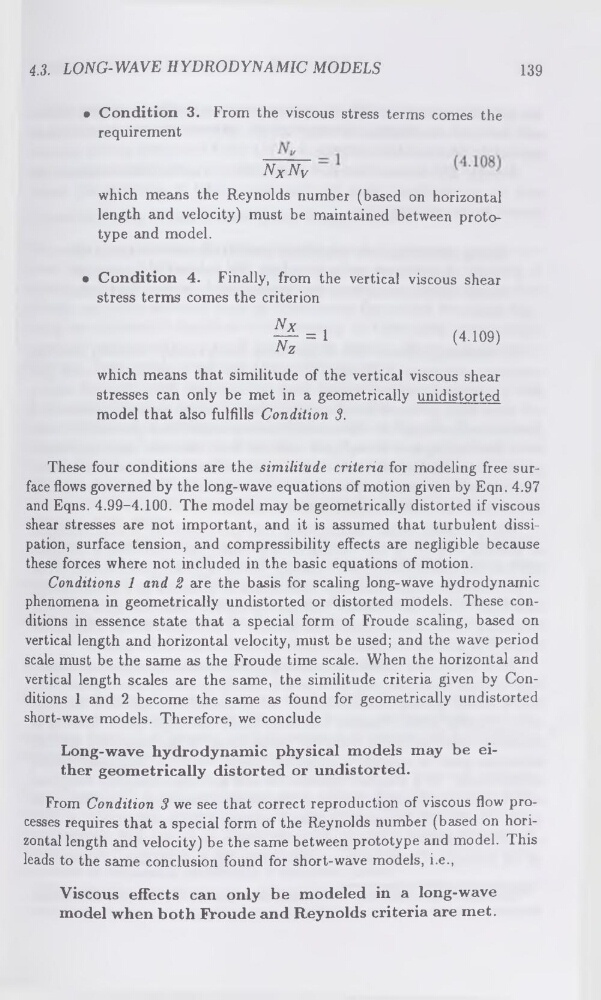
• Condition 3. From the viscous stress terms comes the
requirement
NXNV
which means the Reynolds number (based on horizontal
length and velocity) must be maintained between prototype and model.
• Condition 4. Finally, from the vertical viscous shear
stress terms comes the criterion
Nx
yr = 1
(4.109)
ng
which means that similitude of the vertical viscous shear
stresses can only be met in a geometrically unidistorted
model that also fulfills Condition 3.
These four conditions are the similitude criteria for modeling free surface flows governed by the long-wave equations of motion given by Eqn. 4.97
and Eqns. 4.99-4.100. The model may be geometrically distorted if viscous
shear stresses are not important, and it is assumed that turbulent dissipation, surface tension, and compressibility effects are negligible because
these forces where not included in the basic equations of motion.
Conditions 1 and 2 are the basis for scaling long-wave hydrodynamic
phenomena in geometrically undistorted or distorted models. These conditions in essence state that a special form of Froude scaling, based on
vertical length and horizontal velocity, must be used; and the wave period
scale must be the same as the Froude time scale. When the horizontal and
vertical length scales are the same, the similitude criteria given by Conditions 1 and 2 become the same as found for geometrically undistorted
short-wave models. Therefore, we conclude
Long-wave hydrodynamic physical models may be either geometrically distorted or undistorted.
From Condition 3 we see that correct reproduction of viscous flow processes requires that a special form of the Reynolds number (based on horizontal length and velocity) be the same between prototype and model. This
leads to the same conclusion found for short-wave models, i.e.,
Viscous effects can only be modeled in a long-wave
model when both Froude and Reynolds criteria are met.
139
• Condition 3. From the viscous stress terms comes the
requirement
NXNV
which means the Reynolds number (based on horizontal
length and velocity) must be maintained between prototype and model.
• Condition 4. Finally, from the vertical viscous shear
stress terms comes the criterion
Nx
yr = 1
(4.109)
ng
which means that similitude of the vertical viscous shear
stresses can only be met in a geometrically unidistorted
model that also fulfills Condition 3.
These four conditions are the similitude criteria for modeling free surface flows governed by the long-wave equations of motion given by Eqn. 4.97
and Eqns. 4.99-4.100. The model may be geometrically distorted if viscous
shear stresses are not important, and it is assumed that turbulent dissipation, surface tension, and compressibility effects are negligible because
these forces where not included in the basic equations of motion.
Conditions 1 and 2 are the basis for scaling long-wave hydrodynamic
phenomena in geometrically undistorted or distorted models. These conditions in essence state that a special form of Froude scaling, based on
vertical length and horizontal velocity, must be used; and the wave period
scale must be the same as the Froude time scale. When the horizontal and
vertical length scales are the same, the similitude criteria given by Conditions 1 and 2 become the same as found for geometrically undistorted
short-wave models. Therefore, we conclude
Long-wave hydrodynamic physical models may be either geometrically distorted or undistorted.
From Condition 3 we see that correct reproduction of viscous flow processes requires that a special form of the Reynolds number (based on horizontal length and velocity) be the same between prototype and model. This
leads to the same conclusion found for short-wave models, i.e.,
Viscous effects can only be modeled in a long-wave
model when both Froude and Reynolds criteria are met.