

4.2. SHORT-WAVE HYDRODYNAMIC MODELS
123
Kamphuis (1974, 1975) proposed a method for distorting model currents
to provide the same bottom shear stress scale as produced by the short
waves when the roughness scale is less than the geometric length scale in a
hydrodynamic model. This way, the contributions of waves and currents to
bottom shear stresses in the model would be in the same proportion as in
the prototype. Typical cases of laboratory studies when this is important
include the study of scour around drilling platforms in a wave/current environment and the movement of dredged disposal mounds outside the surf
zone. Kamphuis (1974, 1975) referred to this kind of model as an Offshore
Model because it is more typical of the flow regime found in deeper water.
Kamphuis felt that the offshore model should be a waves model where
the currents are distorted to achieve similar bottom shear stress scales. The
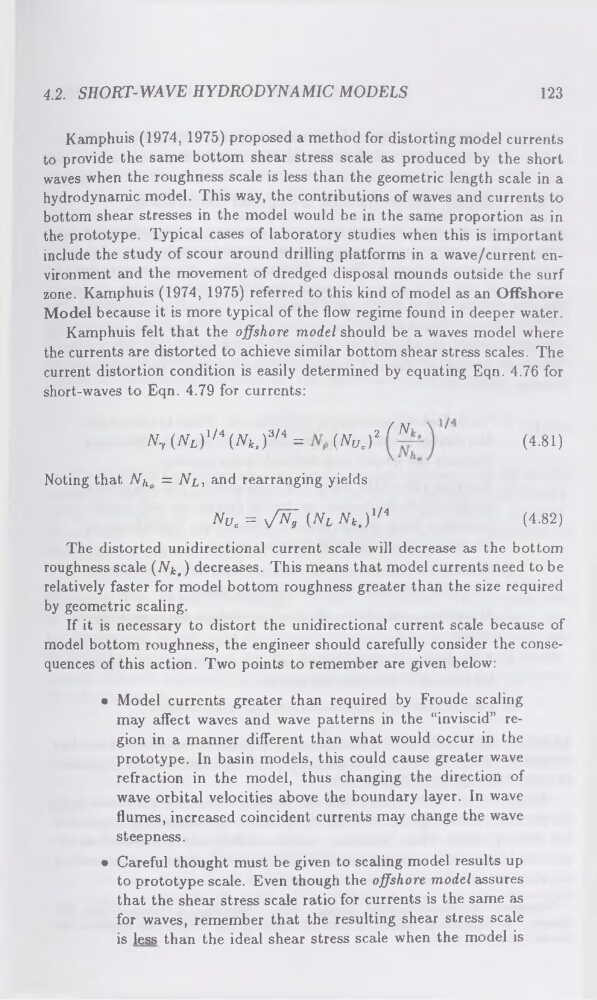
current distortion condition is easily determined by equating Eqn. 4.76 for
short-waves to Eqn. 4.79 for currents:
f N
Ny ( A^)1/4 (7M3/4 =
(NUc)2
(4.81)
Noting that Nho = Nl, and rearranging yields
Nuc= y/N', (NLNti)t/4
(4.82)
The distorted unidirectional current scale will decrease as the bottom
roughness scale (N^^ decreases. This means that model currents need to be
relatively faster for model bottom roughness greater than the size required
by geometric scaling.
If it is necessary to distort the unidirectional current scale because of
model bottom roughness, the engineer should carefully consider the consequences of this action. Two points to remember are given below:
• Model currents greater than required by Froude scaling
may affect waves and wave patterns in the “inviscid” region in a manner different than what would occur in the
prototype. In basin models, this could cause greater wave
refraction in the model, thus changing the direction of
wave orbital velocities above the boundary layer. In wave
flumes, increased coincident currents may change the wave
steepness.
• Careful thought must be given to scaling model results up
to prototype scale. Even though the offshore model assures
that the shear stress scale ratio for currents is the same as
for waves, remember that the resulting shear stress scale
is less than the ideal shear stress scale when the model is
123
Kamphuis (1974, 1975) proposed a method for distorting model currents
to provide the same bottom shear stress scale as produced by the short
waves when the roughness scale is less than the geometric length scale in a
hydrodynamic model. This way, the contributions of waves and currents to
bottom shear stresses in the model would be in the same proportion as in
the prototype. Typical cases of laboratory studies when this is important
include the study of scour around drilling platforms in a wave/current environment and the movement of dredged disposal mounds outside the surf
zone. Kamphuis (1974, 1975) referred to this kind of model as an Offshore
Model because it is more typical of the flow regime found in deeper water.
Kamphuis felt that the offshore model should be a waves model where
the currents are distorted to achieve similar bottom shear stress scales. The
current distortion condition is easily determined by equating Eqn. 4.76 for
short-waves to Eqn. 4.79 for currents:
f N
Ny ( A^)1/4 (7M3/4 =
(NUc)2
(4.81)
Noting that Nho = Nl, and rearranging yields
Nuc= y/N', (NLNti)t/4
(4.82)
The distorted unidirectional current scale will decrease as the bottom
roughness scale (N^^ decreases. This means that model currents need to be
relatively faster for model bottom roughness greater than the size required
by geometric scaling.
If it is necessary to distort the unidirectional current scale because of
model bottom roughness, the engineer should carefully consider the consequences of this action. Two points to remember are given below:
• Model currents greater than required by Froude scaling
may affect waves and wave patterns in the “inviscid” region in a manner different than what would occur in the
prototype. In basin models, this could cause greater wave
refraction in the model, thus changing the direction of
wave orbital velocities above the boundary layer. In wave
flumes, increased coincident currents may change the wave
steepness.
• Careful thought must be given to scaling model results up
to prototype scale. Even though the offshore model assures
that the shear stress scale ratio for currents is the same as
for waves, remember that the resulting shear stress scale
is less than the ideal shear stress scale when the model is