

120
CHAPTER 4. HYDRODYNAMIC MODELS
and
Z^\3/4
fw = 0.47 -
\a6/
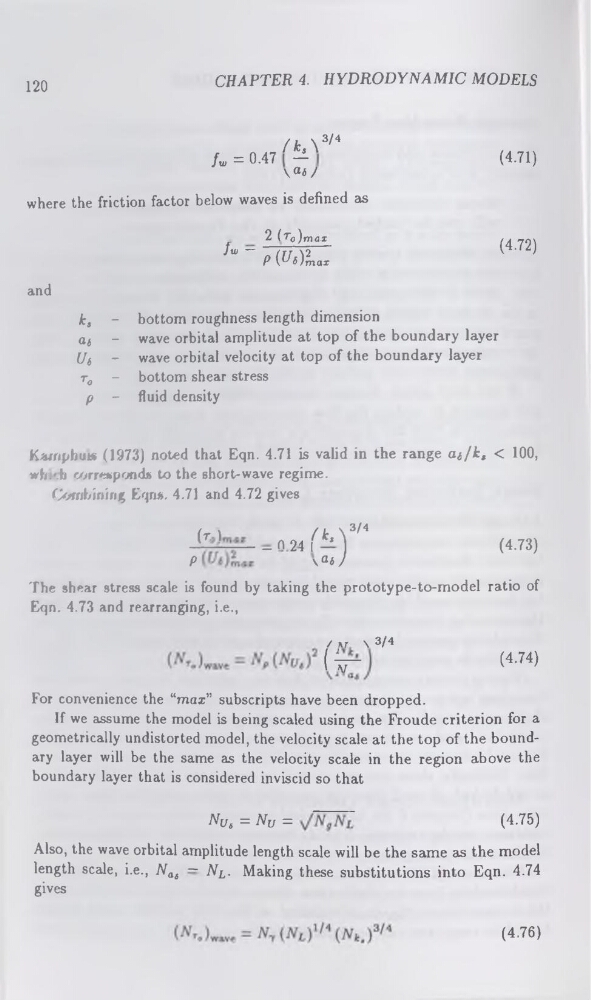
where the friction factor below waves is defined as
(4.71)
2 (To')rnai
fw~ p(usymax
(4-72)
ks - bottom roughness length dimension
at - wave orbital amplitude at top of the boundary layer
U6 ~ wave orbital velocity at top of the boundary layer
rc - bottom shear stress
p - fluid density
Kamphuw (1973) noted that Eqn. 4.71 is valid in the range at/kt < 100,
wt.'.h corresponds to the short-wave regime.
Combining Eqns. 4.71 and 4.72 gives
(r 1
Zl \3/4
\
_ 0 21 1 ' 1
P
\a6 J
(4.73)
The shear stress scale is found by taking the prototype-to-model ratio of
Eqn. 4.73 and rearranging, i.e.,
/ AT \ 3/4
hr
(4.74)
For convenience the “mar” subscripts have been dropped.
If we assume the model is being scaled using the Froude criterion for a
geometrically undistorted model, the velocity scale at the top of the boundary layer will be the same as the velocity scale in the region above the
boundary layer that is considered inviscid so that
NUf =Nu =
(4.75)
Also, the wave orbital amplitude length scale will be the same as the model
length scale, i.e., Na( — N^. Making these substitutions into Eqn. 4.74
gives
(4.76)
CHAPTER 4. HYDRODYNAMIC MODELS
and
Z^\3/4
fw = 0.47 -
\a6/
where the friction factor below waves is defined as
(4.71)
2 (To')rnai
fw~ p(usymax
(4-72)
ks - bottom roughness length dimension
at - wave orbital amplitude at top of the boundary layer
U6 ~ wave orbital velocity at top of the boundary layer
rc - bottom shear stress
p - fluid density
Kamphuw (1973) noted that Eqn. 4.71 is valid in the range at/kt < 100,
wt.'.h corresponds to the short-wave regime.
Combining Eqns. 4.71 and 4.72 gives
(r 1
Zl \3/4
\
_ 0 21 1 ' 1
P
\a6 J
(4.73)
The shear stress scale is found by taking the prototype-to-model ratio of
Eqn. 4.73 and rearranging, i.e.,
/ AT \ 3/4
hr
(4.74)
For convenience the “mar” subscripts have been dropped.
If we assume the model is being scaled using the Froude criterion for a
geometrically undistorted model, the velocity scale at the top of the boundary layer will be the same as the velocity scale in the region above the
boundary layer that is considered inviscid so that
NUf =Nu =
(4.75)
Also, the wave orbital amplitude length scale will be the same as the model
length scale, i.e., Na( — N^. Making these substitutions into Eqn. 4.74
gives
(4.76)