

4.2. SHORT-WAVE HYDRODYNAMIC MODELS
89
z-Direction
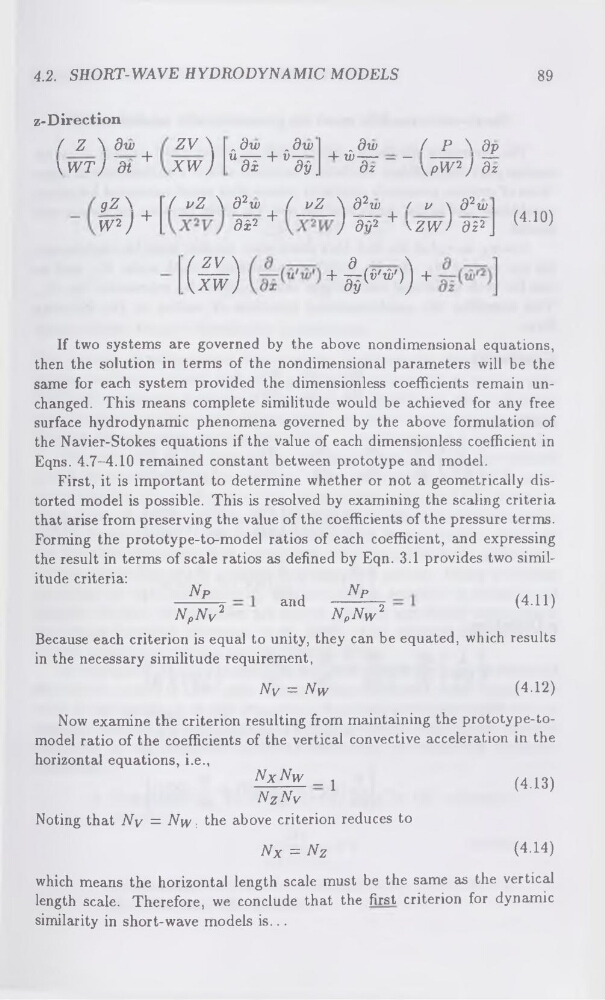
/ Z \ dw
\WTj ~dt +
zv \
xw)
~dw
~dw
“âï + vâÿ.
„ dw
/ P \ dp
4- w---- — — ------ --dz
\pW2 J dz
gZ \
/ vZ \ d2w
f vZ \ d^w
/ y \ d^w
W^) +
ôï2 +
J ~di? + \Zw) dï\ (4.10)
(S
+ ^(W)) +
If two systems are governed by the above nondimensional equations,
then the solution in terms of the nondimensional parameters will be the
same for each system provided the dimensionless coefficients remain unchanged. This means complete similitude would be achieved for any free
surface hydrodynamic phenomena governed by the above formulation of
the Navier-Stokes equations if the value of each dimensionless coefficient in
Eqns. 4.7-4.10 remained constant between prototype and model.
First, it is important to determine whether or not a geometrically distorted model is possible. This is resolved by examining the scaling criteria
that arise from preserving the value of the coefficients of the pressure terms.
Forming the prototype-to-model ratios of each coefficient, and expressing
the result in terms of scale ratios as defined by Eqn. 3.1 provides two similitude criteria:
NP
NpNv2
and
NP
NPNW2
(4.H)
Because each criterion is equal to unity, they can be equated, which results
in the necessary similitude requirement,
Ny = Nw
(4-12)
Now examine the criterion resulting from maintaining the prototype-tomodel ratio of the coefficients of the vertical convective acceleration in the
horizontal equations, i.e.,
NxNw _ j
NZNV
Noting that Ny = Nw, the above criterion reduces to
Nx = Nz
(4-13)
(4-14)
which means the horizontal length scale must be the same as the vertical
length scale. Therefore, we conclude that the first criterion for dynamic
similarity in short-wave models is...
89
z-Direction
/ Z \ dw
\WTj ~dt +
zv \
xw)
~dw
~dw
“âï + vâÿ.
„ dw
/ P \ dp
4- w---- — — ------ --dz
\pW2 J dz
gZ \
/ vZ \ d2w
f vZ \ d^w
/ y \ d^w
W^) +
ôï2 +
J ~di? + \Zw) dï\ (4.10)
(S
+ ^(W)) +
If two systems are governed by the above nondimensional equations,
then the solution in terms of the nondimensional parameters will be the
same for each system provided the dimensionless coefficients remain unchanged. This means complete similitude would be achieved for any free
surface hydrodynamic phenomena governed by the above formulation of
the Navier-Stokes equations if the value of each dimensionless coefficient in
Eqns. 4.7-4.10 remained constant between prototype and model.
First, it is important to determine whether or not a geometrically distorted model is possible. This is resolved by examining the scaling criteria
that arise from preserving the value of the coefficients of the pressure terms.
Forming the prototype-to-model ratios of each coefficient, and expressing
the result in terms of scale ratios as defined by Eqn. 3.1 provides two similitude criteria:
NP
NpNv2
and
NP
NPNW2
(4.H)
Because each criterion is equal to unity, they can be equated, which results
in the necessary similitude requirement,
Ny = Nw
(4-12)
Now examine the criterion resulting from maintaining the prototype-tomodel ratio of the coefficients of the vertical convective acceleration in the
horizontal equations, i.e.,
NxNw _ j
NZNV
Noting that Ny = Nw, the above criterion reduces to
Nx = Nz
(4-13)
(4-14)
which means the horizontal length scale must be the same as the vertical
length scale. Therefore, we conclude that the first criterion for dynamic
similarity in short-wave models is...