

66
Coastal Engineering: Theory and Practice
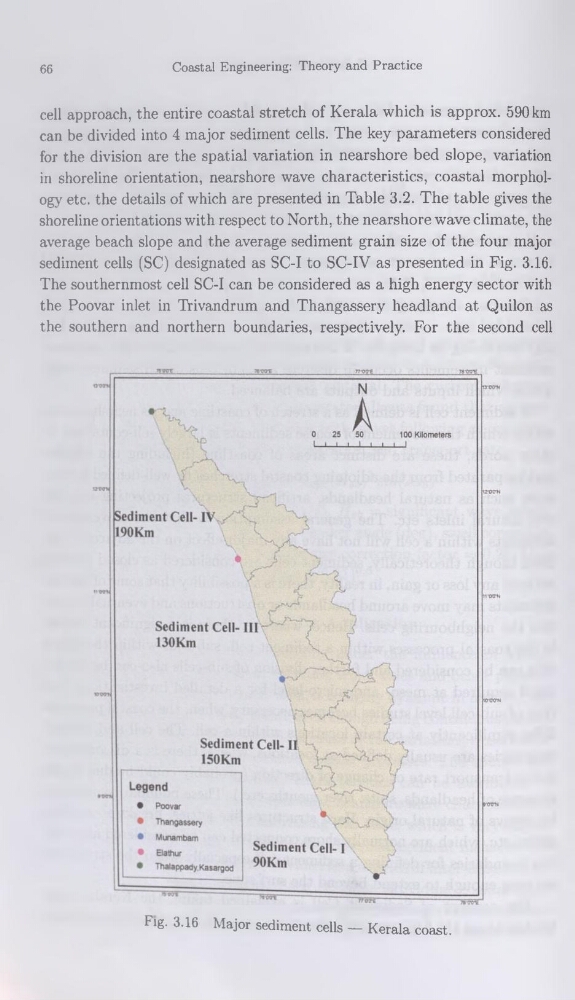
cell approach, the entire Coastal stretch of Kérala which is approx. 590 km
can be divided into 4 major sédiment cells. The key parameters considered
for the division are the spatial variation in nearshore bed slope, variation
in shoreline orientation, nearshore wave characteristics, Coastal morphology etc. the details of which are presented in Table 3.2. The table gives the
shoreline orientations with respect to North, the nearshore wave climate, the
average beach slope and the average sédiment grain size of the four major
sédiment cells (SC) designated as SC-I to SC-IV as presented in Fig. 3.16.
The southernmost cell SC-I can be considered as a high energy sector with
the Poovar inlet in Trivandrum and Thangassery headland at Quilon as
the Southern and northern boundaries, respectively. For the second cell
Fig- 3.16 Major sédiment cells — Kérala coast.
Coastal Engineering: Theory and Practice
cell approach, the entire Coastal stretch of Kérala which is approx. 590 km
can be divided into 4 major sédiment cells. The key parameters considered
for the division are the spatial variation in nearshore bed slope, variation
in shoreline orientation, nearshore wave characteristics, Coastal morphology etc. the details of which are presented in Table 3.2. The table gives the
shoreline orientations with respect to North, the nearshore wave climate, the
average beach slope and the average sédiment grain size of the four major
sédiment cells (SC) designated as SC-I to SC-IV as presented in Fig. 3.16.
The southernmost cell SC-I can be considered as a high energy sector with
the Poovar inlet in Trivandrum and Thangassery headland at Quilon as
the Southern and northern boundaries, respectively. For the second cell
Fig- 3.16 Major sédiment cells — Kérala coast.