

58
Coastal Engineering: Theory and Practice
are available as significant heights, and therefore significant wave height is
substituted in the équation by certain approximation.
Based on the assumption, longshore energy flux in the surf zone is
approximated by conservation of energy and evaluating the energy flux
relation at the breaker line. Further, by assuming that the waves follow
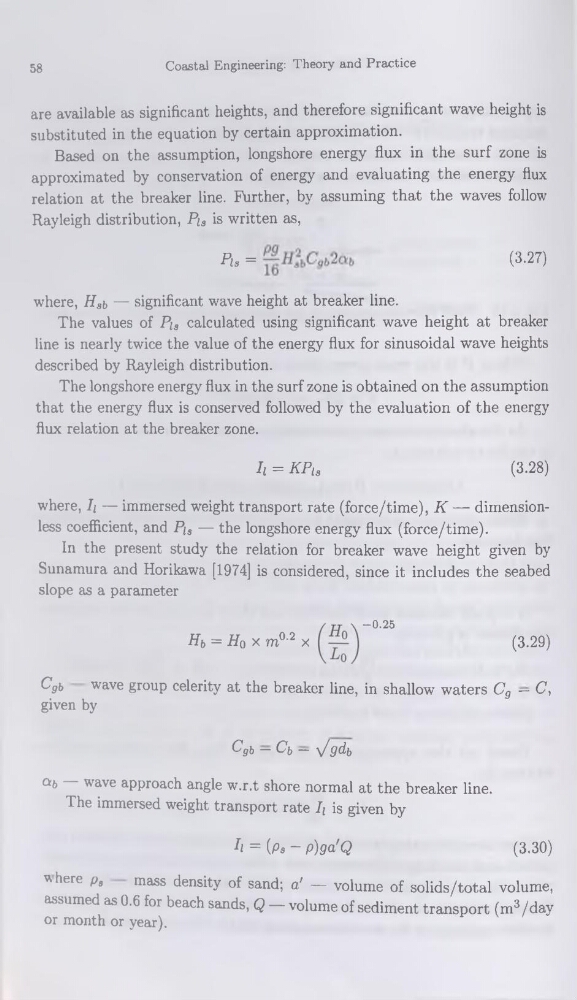
Rayleigh distribution, Pis is written as,
Pt, =
(3.27)
where, Hsb — significant wave height at breaker line.
The values of Pis calculated using significant wave height at breaker
line is nearly twice the value of the energy flux for sinusoïdal wave heights
described by Rayleigh distribution.
The longshore energy flux in the surf zone is obtained on the assumption
that the energy flux is conserved followed by the évaluation of the energy
flux relation at the breaker zone.
h = KPls
(3.28)
where, Ii — immersed weight transport rate (force/time), K — dimensionless coefficient, and P/s — the longshore energy flux (force/time).
In the présent study the relation for breaker wave height given by
Sunamura and Horikawa [1974] is considered, since it includes the seabed
slope as a parameter
Hb = Hq x m0-2 x
-0.25
(3.29)
Cgb
wave group celerity at the breaker line, in shallow waters Cg — C,
given by
Cgb — Cb — \/ gdb
ab — wave approach angle w.r.t shore normal at the breaker line.
The immersed weight transport rate IL is given by
h = (ps ~ pjga'Q
(3.30)
where ps
mass density of sand; a' — volume of solids/total volume,
assumed as 0.6 for beach sands, Q — volume of sédiment transport (m3/day
or month or year).
Coastal Engineering: Theory and Practice
are available as significant heights, and therefore significant wave height is
substituted in the équation by certain approximation.
Based on the assumption, longshore energy flux in the surf zone is
approximated by conservation of energy and evaluating the energy flux
relation at the breaker line. Further, by assuming that the waves follow
Rayleigh distribution, Pis is written as,
Pt, =
(3.27)
where, Hsb — significant wave height at breaker line.
The values of Pis calculated using significant wave height at breaker
line is nearly twice the value of the energy flux for sinusoïdal wave heights
described by Rayleigh distribution.
The longshore energy flux in the surf zone is obtained on the assumption
that the energy flux is conserved followed by the évaluation of the energy
flux relation at the breaker zone.
h = KPls
(3.28)
where, Ii — immersed weight transport rate (force/time), K — dimensionless coefficient, and P/s — the longshore energy flux (force/time).
In the présent study the relation for breaker wave height given by
Sunamura and Horikawa [1974] is considered, since it includes the seabed
slope as a parameter
Hb = Hq x m0-2 x
-0.25
(3.29)
Cgb
wave group celerity at the breaker line, in shallow waters Cg — C,
given by
Cgb — Cb — \/ gdb
ab — wave approach angle w.r.t shore normal at the breaker line.
The immersed weight transport rate IL is given by
h = (ps ~ pjga'Q
(3.30)
where ps
mass density of sand; a' — volume of solids/total volume,
assumed as 0.6 for beach sands, Q — volume of sédiment transport (m3/day
or month or year).