

56
Coastal Engineering: Theory and Practice
CREST OF BERM
/ \pATH OF SAND GRAINS
/
SURF ZONE
Llne of Breakers
PATH OF SAND GRAINS OUTSIDE
SURF ZONE
LONGSHORE
CURRENTS
OBLIQUE
WAVE ATTACK
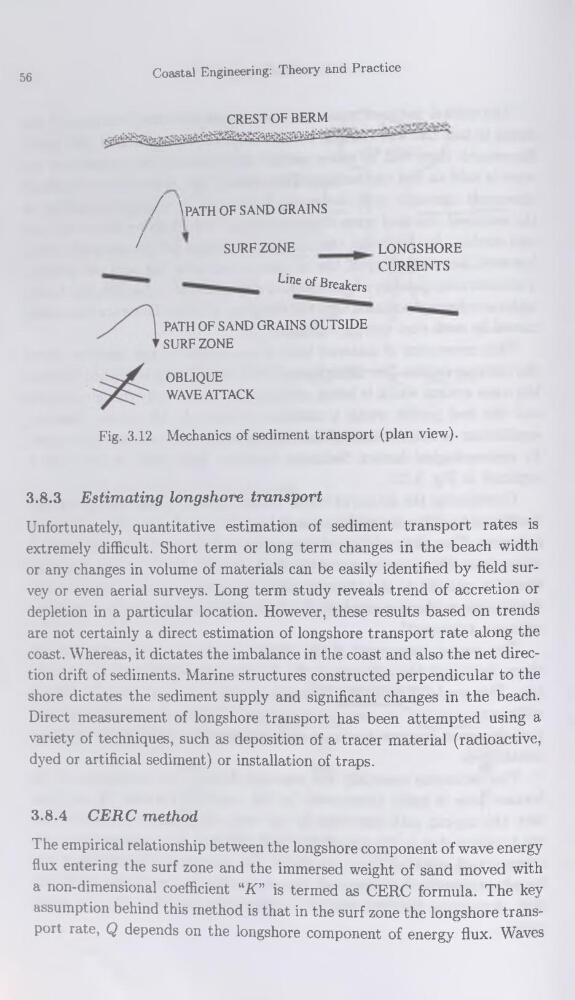
Fig. 3.12 Mechanics of sédiment transport (plan view).
3.8.3 Estimating longshore transport
Unfortunately, quantitative estimation of sédiment transport rates is
extremely difficult. Short term or long term changes in the beach width
or any changes in volume of materials can be easily identified by field survey or even aerial surveys. Long term study reveals trend of accretion or
déplétion in a particular location. However, these results based on trends
are not certainly a direct estimation of longshore transport rate along the
coast. Whereas, it dictâtes the imbalance in the coast and also the net direction drift of sédiments. Marine structures constructed perpendicular to the
shore dictâtes the sédiment supply and significant changes in the beach.
Direct measurement of longshore transport has been attempted using a
variety of techniques, such as déposition of a tracer material (radioactive,
dyed or artificial sédiment) or installation of traps.
3.8.4 CE RC method
The empirical relationship between the longshore component of wave energy
flux entering the surf zone and the immersed weight of sand moved with
a non-dimensional coefficient “X” is termed as CERC formula. The key
assumption behind this method is that in the surf zone the longshore transport rate, Q dépends on the longshore component of energy flux. Waves
Coastal Engineering: Theory and Practice
CREST OF BERM
/ \pATH OF SAND GRAINS
/
SURF ZONE
Llne of Breakers
PATH OF SAND GRAINS OUTSIDE
SURF ZONE
LONGSHORE
CURRENTS
OBLIQUE
WAVE ATTACK
Fig. 3.12 Mechanics of sédiment transport (plan view).
3.8.3 Estimating longshore transport
Unfortunately, quantitative estimation of sédiment transport rates is
extremely difficult. Short term or long term changes in the beach width
or any changes in volume of materials can be easily identified by field survey or even aerial surveys. Long term study reveals trend of accretion or
déplétion in a particular location. However, these results based on trends
are not certainly a direct estimation of longshore transport rate along the
coast. Whereas, it dictâtes the imbalance in the coast and also the net direction drift of sédiments. Marine structures constructed perpendicular to the
shore dictâtes the sédiment supply and significant changes in the beach.
Direct measurement of longshore transport has been attempted using a
variety of techniques, such as déposition of a tracer material (radioactive,
dyed or artificial sédiment) or installation of traps.
3.8.4 CE RC method
The empirical relationship between the longshore component of wave energy
flux entering the surf zone and the immersed weight of sand moved with
a non-dimensional coefficient “X” is termed as CERC formula. The key
assumption behind this method is that in the surf zone the longshore transport rate, Q dépends on the longshore component of energy flux. Waves