

3. Sédiment Transport
53
an empirical relation derived from Large Wave Tank (LWT) experiments
[Kraus and Larson, 1988] given by,
Zr/HQ = 1.47 Ç0-79
(3.22)
' where £ is the surf similarity parameter = tan /?/(Hq/Lq)1/2.
The slope to be adopted in this formula is the average beach slope.
The corresponding Æ-coordinate “ær” of the run-up limit in Eq. (3.21) is
interpolated from the profile depths defined at grid points.
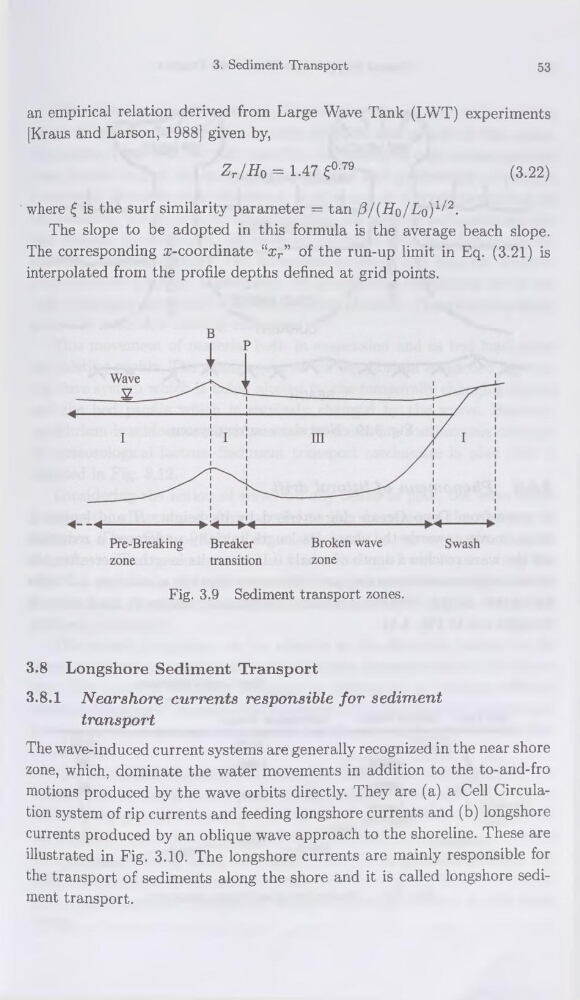
Fig. 3.9 Sédiment transport zones.
3.8 Longshore Sédiment Transport
3.8.1 Nearshore currents responsible for sédiment
transport
The wave-induced current Systems are generally recognized in the near shore
zone, which, dominate the water movements in addition to the to-and-fro
motions produced by the wave orbits directly. They are (a) a Cell Circulation System of rip currents and feeding longshore currents and (b) longshore
currents produced by an oblique wave approach to the shoreline. These are
illustrated in Fig. 3.10. The longshore currents are mainly responsible for
the transport of sédiments along the shore and it is called longshore sédiment transport.
53
an empirical relation derived from Large Wave Tank (LWT) experiments
[Kraus and Larson, 1988] given by,
Zr/HQ = 1.47 Ç0-79
(3.22)
' where £ is the surf similarity parameter = tan /?/(Hq/Lq)1/2.
The slope to be adopted in this formula is the average beach slope.
The corresponding Æ-coordinate “ær” of the run-up limit in Eq. (3.21) is
interpolated from the profile depths defined at grid points.
Fig. 3.9 Sédiment transport zones.
3.8 Longshore Sédiment Transport
3.8.1 Nearshore currents responsible for sédiment
transport
The wave-induced current Systems are generally recognized in the near shore
zone, which, dominate the water movements in addition to the to-and-fro
motions produced by the wave orbits directly. They are (a) a Cell Circulation System of rip currents and feeding longshore currents and (b) longshore
currents produced by an oblique wave approach to the shoreline. These are
illustrated in Fig. 3.10. The longshore currents are mainly responsible for
the transport of sédiments along the shore and it is called longshore sédiment transport.